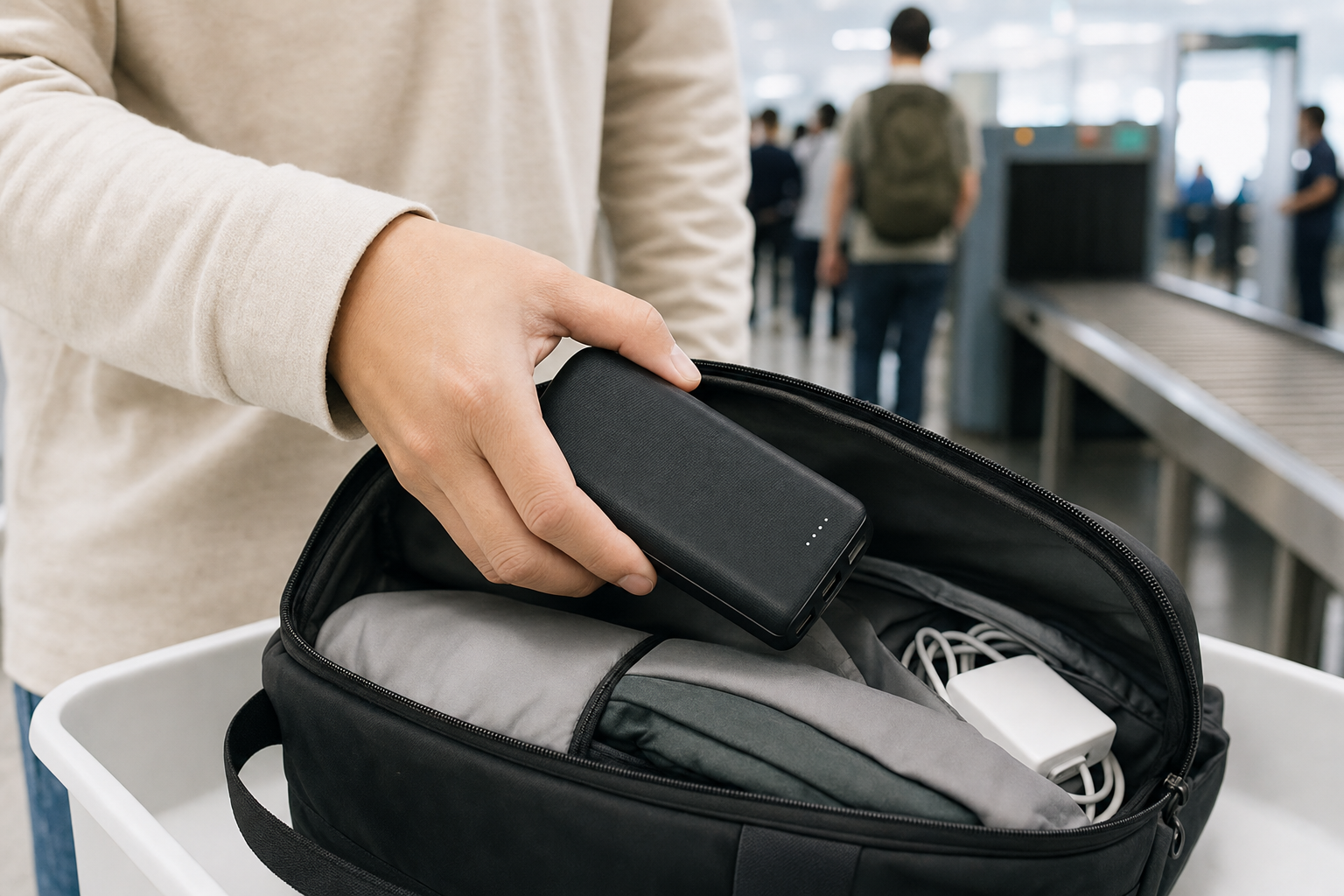
For flights departing from or within the United States, power-bank limits are measured in watt-hours (Wh), not milliamp-hours (mAh). A lithium-ion power bank of 100Wh or less is generally permitted in carry-on baggage. A power bank rated 101Wh to 160Wh needs the airline’s approval, and passengers may carry no more than two spare batteries in that range. Power banks above 160Wh are not permitted on passenger aircraft. Because mAh alone does not show stored energy, the answer depends on the battery voltage and the Wh rating printed on the unit.
| Advertised capacity | Example at 3.7V | Typical U.S. category |
|---|---|---|
| 10,000mAh | 37Wh | Allowed in carry-on baggage |
| 20,000mAh | 74Wh | Allowed in carry-on baggage |
| 26,800mAh | 99.16Wh | Usually allowed, but check the printed rating |
| 30,000mAh | 111Wh | Airline approval required |
These examples use a nominal battery voltage of 3.7 volts. A particular product may have a different nominal voltage or a different manufacturer-rated Wh figure, so inspect the label before travelling rather than relying only on the table.
How to check your power bank’s watt-hour rating
Airline battery rules use watt-hours because milliamp-hours are not a complete measurement of energy without voltage. Two power banks with the same mAh figure can have different Wh ratings.
Check the back, bottom or side of the power bank for small printed specifications. Look for “Wh,” “watt-hours,” “battery capacity,” “nominal voltage” or “rated capacity.” The product manual or the manufacturer’s official product page may also provide the rating.
If the casing shows a Wh rating, use that figure when deciding whether the power bank is suitable for a flight. This is particularly important close to the 100Wh and 160Wh thresholds. If Wh is not shown but both mAh and voltage are available, the Federal Aviation Administration formula is:
Wh = (mAh ÷ 1,000) × volts
To calculate the rating:
- Find the battery capacity in milliamp-hours.
- Divide it by 1,000 to convert it to amp-hours.
- Multiply the result by the battery’s nominal voltage.
For example, a 20,000mAh power bank with a 3.7V battery is calculated as follows:
(20,000 ÷ 1,000) × 3.7 = 74Wh
Do not automatically use the five-volt Universal Serial Bus output printed next to a charging port. That is commonly the output supplied to a phone or other device, rather than the nominal voltage of the power bank’s internal cells. Use the voltage associated with the battery capacity, or the manufacturer’s stated Wh rating.
Common power bank sizes and flight limits
A 10,000mAh power bank rated at 3.7V equals 37Wh. It is below 100Wh and is generally allowed in carry-on baggage without airline approval.
A 20,000mAh model at 3.7V equals 74Wh. It is also below 100Wh. Under the Federal Aviation Administration baseline, there is no set numerical limit for rechargeable batteries of 100Wh or less carried for personal use, but an airline may set a lower quantity limit.
A 26,800mAh power bank at 3.7V equals 99.16Wh. This capacity is often marketed as suitable for air travel because it can sit just below 100Wh. However, there is little margin: another nominal voltage, or a different Wh figure printed by the manufacturer, could change the result. Check the actual unit you are taking.
A 30,000mAh power bank at 3.7V equals 111Wh. It falls within the 101Wh to 160Wh category, so airline approval is required. Contact the operating airline before travel and keep its approval available. Do not assume that an airline will accept a power bank above 100Wh simply because the federal rules allow approval in that range.
The limits apply to each battery, not to the combined mAh capacity of several smaller power banks. Batteries over 160Wh are forbidden on passenger aircraft, except for limited rules that apply to certain mobility aids and are not relevant to ordinary power banks.
Where to pack a power bank
Power banks are treated as spare lithium-ion batteries. They must be in carry-on baggage and cannot be packed in checked luggage. Switching one off or placing it inside a suitcase does not make it acceptable in the cargo hold.
If an airline asks you to gate-check a carry-on bag, remove the power bank before handing over the bag. Keep it with you in the cabin, ideally in a personal item. The same applies if your bag is collected at the aircraft door for planeside checking.
Protect the power bank from damage and short circuits during travel. Useful precautions include:
- Keep it in retail packaging, a protective pouch or a separate plastic bag.
- Keep it away from loose keys, coins and other metal objects.
- Cover exposed terminals with non-metallic tape when appropriate.
- Pack it so its power button cannot be pressed accidentally.
- Do not carry a swollen, leaking, punctured, recalled or otherwise damaged power bank.
- Do not place it where heavy items could crush or bend it.
If a power bank becomes hot, expands, smokes, burns or produces an unusual smell during a flight, stop using it and tell a flight attendant immediately. Cabin crews are trained to respond to battery incidents.
Why you must also check the airline’s rules
Federal limits are the U.S. baseline, not a guarantee that every airline will accept or permit use of a particular power bank. Airlines and international authorities may impose stricter capacity, quantity, storage and in-flight-use rules. Check the operating carrier for every flight, including connecting and codeshare flights.
For example, Delta Air Lines permits no more than two power banks per passenger, limits each one to 100Wh and does not allow them in overhead bins. Delta says they should be kept in an accessible location, such as under the seat or in a seatback pocket. It also prohibits charging a power bank in flight and prohibits using one to charge another device during taxi, take-off and landing.
Emirates has different restrictions. Since October 1, 2025, it has allowed passengers to carry one power bank under 100Wh, but it does not permit power banks to be used to charge devices or recharged on board. The power bank must be stored in a seat pocket or a bag under the seat, not in an overhead locker, and its capacity rating must be visible.
Before leaving for the airport, confirm the Wh rating on the casing and read the operating airline’s current battery or dangerous-goods policy. For a power bank above 100Wh, obtain the airline’s approval before travelling. If the specifications are missing, unreadable or contradictory, the safer option is to travel with a clearly labelled power bank below 100Wh.