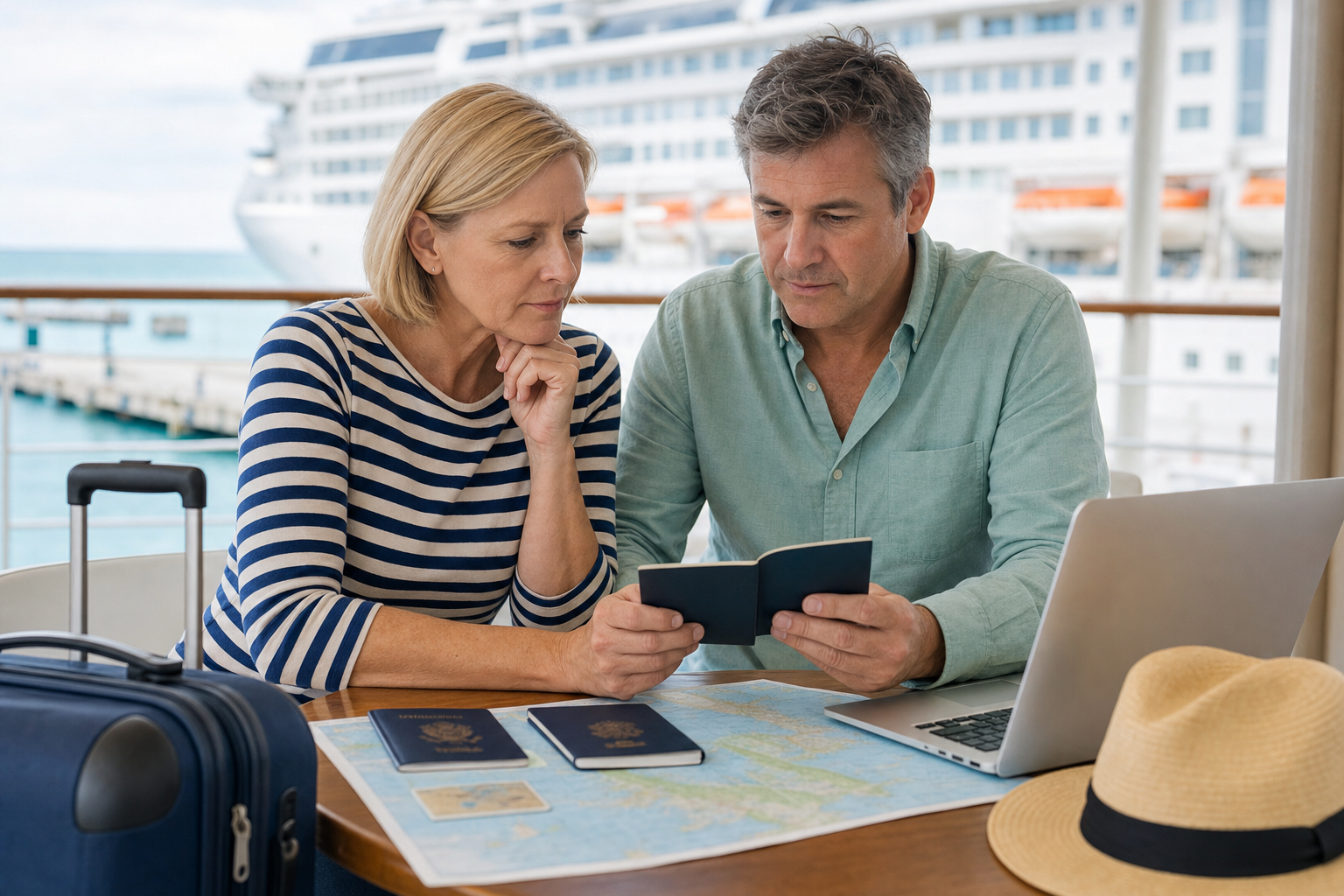
For most U.S. citizens, a valid passport book is the best document to bring on an international cruise. It works for travel by air, land and sea, while a passport card cannot be used for international flights. A passport card or a birth certificate plus photo identification may be accepted for some closed-loop cruises, but those options can create serious problems if you need to fly home unexpectedly. Choose based on your exact itinerary and cruise line’s rules, not on a general assumption that a passport is optional.
Choose your cruise document by itinerary
Use this process when comparing a passport card vs passport book for a cruise:
- Does the cruise begin and end at the same U.S. port? If so, it may be a closed-loop cruise. If it starts and ends at different ports, bring a passport book.
- Is the voyage within the Western Hemisphere? U.S. Customs and Border Protection describes closed-loop cruises as voyages that begin and end at the same U.S. port and travel within the Western Hemisphere.
- Will the cruise line accept your document? A cruise line can require a passport book even when U.S. re-entry rules allow another document. Read the requirements for the specific sailing before booking travel around a passport card or birth certificate.
- Could you need an international flight? This includes flying to an overseas embarkation port, catching up after missing the ship, receiving medical treatment ashore or flying home from a foreign port. If the answer is yes, take a passport book.
- Do destination countries have additional requirements? Check each port’s entry, visa, electronic travel authorization, passport-validity and blank-page rules. A document that is enough for U.S. re-entry may not meet another country’s requirements.
| Document | When it may work | Main limitation | Practical choice |
|---|---|---|---|
| Passport book | International travel by air, land and sea | Must meet the destination’s validity, visa and condition requirements | Best option for nearly every international cruise |
| Passport card | U.S. land and sea re-entry from Canada, Mexico, Bermuda and some Caribbean destinations | Not valid for international air travel and has no visa pages | Use only after confirming the cruise line and itinerary accept it |
| Birth certificate plus photo ID | Some closed-loop cruises for U.S. citizens | Cannot be used for international flights and may not be accepted by the cruise line | Lowest-document option and the highest disruption risk |
When a passport card or birth certificate may be enough
For U.S. border purposes, a closed-loop cruise generally begins and ends at the same U.S. port and travels within the Western Hemisphere. For example, a round trip from Fort Lauderdale that calls in Mexico and returns to Fort Lauderdale can qualify. A cruise that departs San Diego, travels through the Panama Canal and ends in Miami is not closed-loop because it ends at a different U.S. port.
U.S. citizens on qualifying closed-loop cruises may be able to re-enter the United States using proof of citizenship, such as a U.S. passport, passport card, Enhanced Driver’s License or government-issued birth certificate. Travelers age 16 and older who use a birth certificate also need government-issued photo identification showing their photo, name and date of birth. Children under 16 may use an original, notarized or certified copy of a birth certificate, a Consular Report of Birth Abroad or a Certificate of Naturalization.
If you plan to rely on a birth certificate, use the document format your cruise line specifically requires. Customs and Border Protection refers to a government-issued birth certificate from the vital-records authority, while cruise lines can set their own boarding rules. Do not assume a phone image, ordinary photocopy, baptismal record or commemorative hospital certificate will be accepted. Make sure the name on the document matches the reservation and photo identification. Bring legal name-change documents when needed.
A passport card is a wallet-sized document that proves both U.S. citizenship and identity. It allows U.S. citizens to enter the United States by land or sea from Canada, Mexico, Bermuda and some Caribbean destinations. It is not a general substitute for a passport book on worldwide cruises, does not contain visa pages and does not override a cruise line’s passport-book requirement.
Meeting the minimum U.S. re-entry rule does not guarantee boarding. The operator must consider its own policies, destination-country requirements and the possibility that passengers may need to leave the ship or travel independently after a disruption. Confirm acceptance in writing if you are considering anything other than a passport book.
When you should carry a passport book
Take a passport book for a one-way, open-jaw or repositioning cruise. The closed-loop exception does not apply when a voyage begins and ends at different U.S. ports. It also does not make a birth certificate or passport card suitable for international flights associated with the trip.
Bring a passport book when embarking outside the United States. You will normally need it for the international flight to the departure country. You may also need a visa or electronic travel authorization, depending on your nationality, route and destination. Being able to cross into Canada or Mexico by land with a passport card does not establish that the card is adequate for the cruise itinerary or return travel.
Use a passport book whenever an unplanned international flight is possible. Passport cards are not valid for international air travel. A birth certificate and driver’s license are not substitutes for a passport book when flying internationally.
This matters if you become ill or injured, miss the ship in port, face a family emergency, or the ship changes its itinerary. The U.S. Department of State strongly recommends that all cruise passengers carry a passport book for this reason. Without one, you may need to contact a U.S. embassy or consulate for help obtaining an emergency passport before you can fly home, which can add delay and expense at a difficult time.
The same issue can arise when you miss embarkation and want to fly to a later port to rejoin the ship. A passport card may be sufficient for a planned sea return in limited circumstances, but it cannot be used for the international flight needed to catch up.
Check children’s documents and passport validity
Children need passport books whenever the itinerary or an international flight requires them. A passport issued to a child under age 16 is generally valid for five years. A passport issued at age 16 or older is generally valid for 10 years. Children under 16 cannot renew a passport; they must apply in person for a new one.
If a child travels without one or both parents or legal guardians, review the rules for every destination. The United States does not generally require proof of both parents’ permission for a child to leave the country, but some countries require a notarized consent letter, proof of sole custody or other documents. Bring evidence of your relationship to the child, such as a birth certificate, when appropriate.
An unexpired passport may still fail a destination’s entry rules. Some countries require a passport to remain valid for a specified period after arrival or departure, often up to six months. Countries may also require blank visa pages. Check the requirements for each destination and transit country, then inspect the passport for significant damage and confirm that its name and date of birth match the booking.
If renewal is already underway, do not assume the previous document remains usable. Review whether you can use your old passport while renewal is pending before finalizing travel plans.
Predeparture cruise document checklist
- Confirm whether the cruise begins and ends at the same U.S. port.
- Read the cruise line’s document requirements for the exact ship, sailing date and itinerary.
- Check entry, visa, electronic authorization and passport-validity rules for every country visited.
- Verify that every traveler’s document is unexpired, undamaged and accepted.
- Make sure names on travel documents, cruise reservations and airline tickets match.
- Bring the required original, notarized or certified birth certificate rather than relying on a phone image.
- Pack government-issued photo identification for each traveler who must carry it.
- Carry consent or custody documents when a child is not traveling with both parents or guardians.
- Keep copies separately from the originals and leave another set with a trusted contact.
- Recheck requirements shortly before departure because cruise-line and destination rules can change.
If you have a valid passport book, take it even when a passport card or birth certificate appears to meet the minimum rule. Use the less comprehensive option only when the cruise line confirms it accepts that document for your exact itinerary and you understand it will not solve an unexpected need to fly internationally.