Yes, you may bring an internationally purchased duty-free liquid over 3.4 ounces or 100 millilitres through a Transportation Security Administration checkpoint during a U.S. connection, but only if it meets a narrow exception. The liquid must be in a transparent, secure tamper-evident bag prepared by the retailer, show no evidence of tampering, have its original receipt, and have been bought within the previous 48 hours. It must also be screened successfully. If you collect a checked suitcase at your first U.S. airport, the most reliable option is usually to put the purchase in that suitcase before rechecking it.
Customs admission, airport-security screening and airline hazardous-material rules are separate requirements. A bottle may be allowed into the United States by U.S. Customs and Border Protection but still be refused at a security checkpoint, or be unsuitable for carriage because of its alcohol content.
Choose the plan that fits your route
| Journey | What usually happens | Best plan for a liquid over 100 millilitres |
|---|---|---|
| Arrive from abroad and connect within the United States | You normally collect checked baggage, complete customs processing, recheck the bag and pass Transportation Security Administration screening before the domestic flight. | Place the sealed purchase in the checked bag before recheck. |
| Depart from a U.S. preclearance airport abroad | You complete U.S. entry processing before boarding and normally arrive in the United States as a domestic passenger. | Check the airport and airline process before buying. You normally will not face a U.S. arrival checkpoint, but an earlier security point may still matter. |
| Connect in another country before the United States | The transfer airport’s security authority controls the next checkpoint. | Check that airport’s official transfer-liquids rules before buying; do not assume the U.S. exception applies there. |
| Stop over and begin travel again later | You may be treated as a new departing passenger and face normal security rules. | Use checked baggage or keep each carry-on container at 100 millilitres or less. |
A through boarding pass or through-checked bag tag does not guarantee that you will avoid customs, baggage collection or another security checkpoint. Follow the instructions for the airport and flight involved.
Repack the bottle at your first U.S. airport
When travellers enter the United States from overseas, they generally complete Customs and Border Protection processing at their first U.S. port of entry. On a typical international-to-domestic connection, checked bags are collected, brought through customs and handed back to the airline for the onward flight. See when bags must be rechecked on a U.S. connection for the usual process and its exceptions.
This is the practical point at which to move an oversized duty-free bottle into checked baggage. Bring a bottle sleeve or sealable leak-resistant bag and some cushioning in an easily reached part of your suitcase. Wrap the bottle, place it in the centre of the case between soft items, close the suitcase and give it back at the recheck belt or desk as directed.
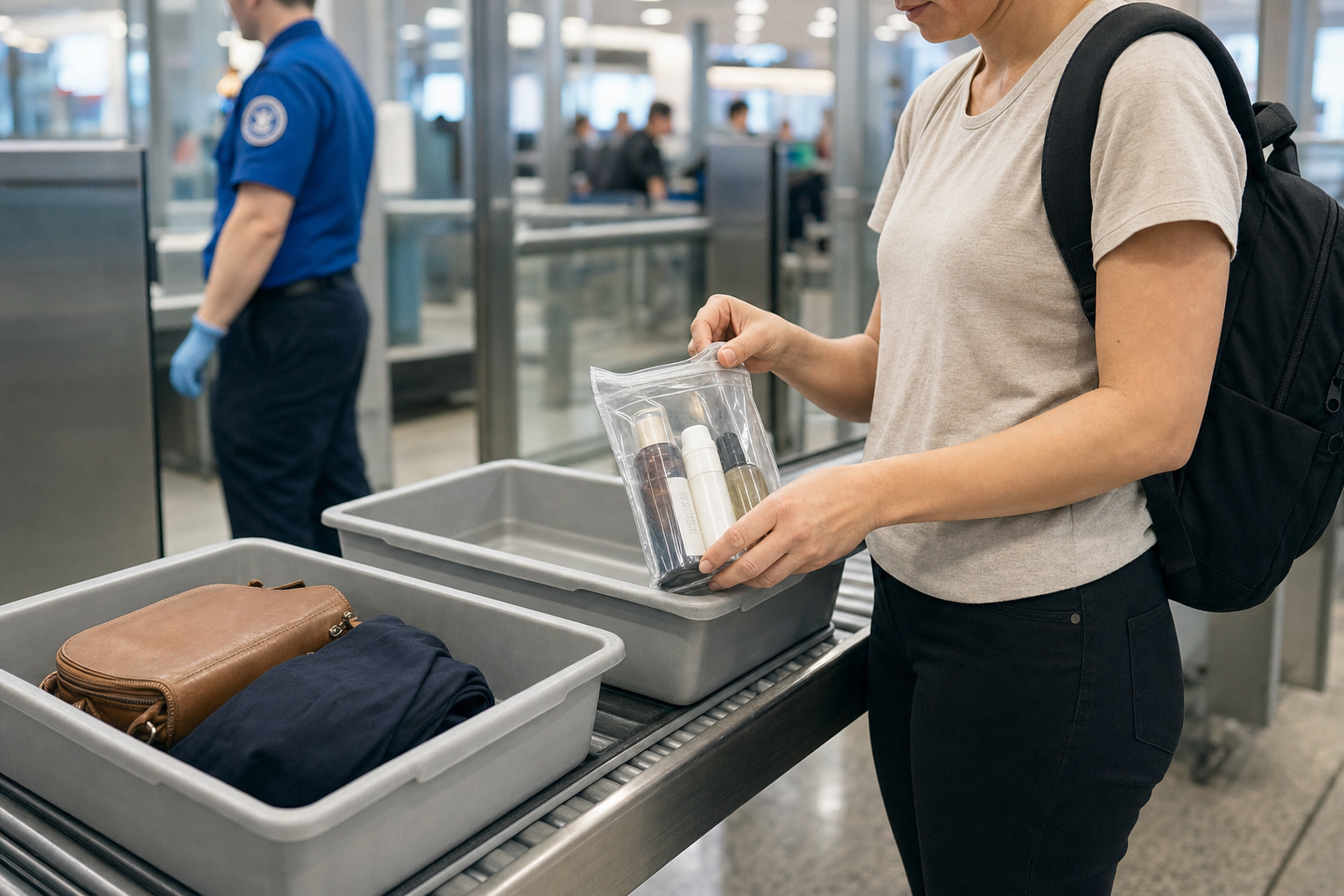
If you keep the purchase in your cabin bag, it must meet the Transportation Security Administration exception for duty-free liquids on inbound international journeys. The retailer must have packed it in a transparent, secure tamper-evident bag; the bag must remain intact; you must have the original receipt; and the purchase must be less than 48 hours old. The item inside must be screened and cleared. An item that alarms or cannot be screened cannot continue in carry-on baggage.
Hypothetical example one: A traveller flies from Paris to Chicago and then to Denver with a 750-millilitre bottle of wine. In Chicago, the traveller collects the checked suitcase, completes customs processing, puts the protected bottle in the suitcase and rechecks it. The wine then avoids the passenger security checkpoint for the Chicago-to-Denver flight.
Do not rely on finding packing supplies after customs. Space and time between customs processing and baggage recheck can be limited. If an airport or airline gives different instructions for a particular flight, follow those instructions.
Understand what U.S. preclearance changes
At a U.S. preclearance location, Customs and Border Protection processes passengers before they board the U.S.-bound flight. Current airport locations include sites in Canada, Ireland, Aruba, Bermuda, the Bahamas and Abu Dhabi. After preclearance, passengers normally arrive in the United States without another Customs and Border Protection inspection or Transportation Security Administration arrival checkpoint and may continue to a domestic connection or their final destination.
That changes the baggage decision. You may not collect your checked suitcase after landing in the United States, so you may not have an opportunity to transfer a bottle from cabin baggage to checked baggage there. The relevant question is whether you will encounter another security checkpoint before boarding the U.S.-bound flight, or elsewhere in an itinerary that includes separate tickets, an overnight stay or a landside terminal change.
Before purchasing a large liquid at a preclearance airport, ask the retailer or airline:
- Will the item be handed to you after the final applicable security checkpoint, or immediately at the shop?
- Will it be packed in an official transparent secure tamper-evident bag?
- Will the original itemised receipt be enclosed with the purchase?
- Does your itinerary require a terminal change, a separate check-in or another security screening point?
- If the item cannot remain in cabin baggage, can you still check a bag before the airline’s bag-acceptance deadline?
Preclearance does not itself make an oversized liquid acceptable at every earlier checkpoint. If you are uncertain where security occurs at that airport, choose a container of 100 millilitres or less, buy after the last relevant checkpoint where available, or place the item in checked baggage before check-in.
Transfers outside the United States follow local rules
If you fly through another country before reaching the United States, the security authority at the transfer airport decides whether the item can continue in cabin baggage. The U.S. 48-hour exception applies at Transportation Security Administration checkpoints; it does not compel a foreign airport to accept the purchase.
Many airports permit qualifying duty-free liquids in sealed security bags, but the rules can differ on accepted bag types, receipts, screening methods and whether the purchase came from the same airport or flight. Some airports may open a bag for inspection and reseal it; others may not be able to clear the item. Check the official website of every transfer airport or its national aviation-security authority for “transfer liquids,” “duty-free liquids” or “security tamper-evident bags.” Also check the operating airline if you are changing carriers or travelling on separate tickets.
Hypothetical example two: A traveller buys 200 millilitres of perfume in Bangkok, connects in London and then flies to New York. The perfume must first meet the transfer rules in London. If it is accepted there and New York is the final destination, it will not normally meet a further Transportation Security Administration checkpoint. If the traveller then connects from New York to Boston and must pass a Transportation Security Administration checkpoint, the purchase must also meet the U.S. secure-bag, receipt and 48-hour requirements.
An overnight stay, baggage collection or leaving the airport can turn a transfer into a new departure. In that situation, expect the ordinary carry-on liquid limit unless the relevant authority expressly allows the sealed purchase through its checkpoint.
Follow these steps from shop to gate
- Map every checkpoint. Identify your first U.S. airport, customs point, baggage collection point and all overseas transfer-security points.
- Check the container and contents. A container over 100 millilitres needs either checked baggage or a valid security-bag exception. For alcohol, also check the alcohol by volume.
- Get proper packaging. Ask the retailer to use a transparent secure tamper-evident bag. An ordinary shopping bag does not qualify.
- Keep the original receipt with the purchase. Do not assume a photograph, email receipt or card statement will replace the original receipt required for the U.S. exception.
- Do not open the bag. Leave it sealed until the final destination unless a security officer instructs otherwise. If it is opened during screening, ask whether the airport can reseal it for a later connection; do not assume this will be possible.
- Declare regulated goods. Declare alcohol beyond any allowance and declare all food, plant and agricultural items when entering the United States. Buying an item in a duty-free shop does not automatically exempt it from U.S. import requirements or charges.
- Use a checked bag when you can. At the first U.S. airport where you collect baggage, repack the item securely before baggage recheck.
- Allow extra time. A duty-free bag can require additional screening. Do not plan a short connection around immediate clearance.
- Check the outcome. After recheck, confirm that the suitcase has its destination tag. After a security inspection, make sure you take both the liquid and receipt.
What to do if the normal plan fails
The bag is opened, broken or not transparent: Ask the retailer to replace it before departure if possible. Do not try to repair it with tape or move it into a different plastic bag and expect it to qualify. At a later checkpoint, pack it in checked baggage if that remains possible or expect it to be refused.
The receipt is missing or the purchase is more than 48 hours old: The item does not meet the published U.S. exception for an oversized duty-free carry-on liquid. A digital record may help you explain what the item is, but it is not a substitute for the original qualifying receipt.
The item cannot be cleared at security: It cannot continue in carry-on baggage. If time and airport access allow, ask the airline whether you can check it. That could require returning landside, paying any checked-bag fee and passing security again. If those steps are not possible, surrendering the item may be the only immediate option.
You have a short connection or no checked bag: Avoid buying oversized liquids before the final checkpoint. Buy a container of 100 millilitres or less, buy after arrival, or arrange legitimate retailer shipping where permitted. Adding a checked bag during a connection may be impossible after the airline’s bag-acceptance deadline.
Alcohol has additional air-travel and import limits
Alcohol must meet security, customs and aviation-safety requirements. Under the Federal Aviation Administration rules for alcoholic beverages, drinks containing more than 24% and no more than 70% alcohol by volume must be in unopened retail packaging. They are limited to five litres per passenger in total, and no individual package may exceed five litres. Alcohol above 70% alcohol by volume, including many high-proof spirits, is prohibited in both carry-on and checked baggage. Drinks containing 24% alcohol by volume or less are not subject to that hazardous-material quantity limit, though security and customs rules still apply.
For a traveller aged 21 or older, one litre of alcohol may generally be included in a returning resident’s personal exemption when the legal conditions are met. Additional personal-use alcohol may be admitted after declaration, but it can be subject to duty and federal excise tax. State law can be more restrictive, and unusually large quantities may be treated as commercial rather than personal imports. Declare the alcohol rather than assuming that a duty-free-shop purchase is automatically free of U.S. duty or tax.
Perfume, cosmetics and food oils are not alcohol imports, but containers over 100 millilitres create the same cabin-baggage screening issue. Food oils and other food products should be declared. Aerosol toiletries and other potentially flammable products can also have separate air-carriage restrictions.
If keeping an oversized purchase matters more than carrying it in the cabin, travel with a checked suitcase, protective packaging and enough connection time to repack the item after customs. Carry-on-only travellers should buy a duty-free liquid over 100 millilitres only when every remaining security checkpoint has been confirmed and they can accept the risk that screening may still prevent it from continuing.