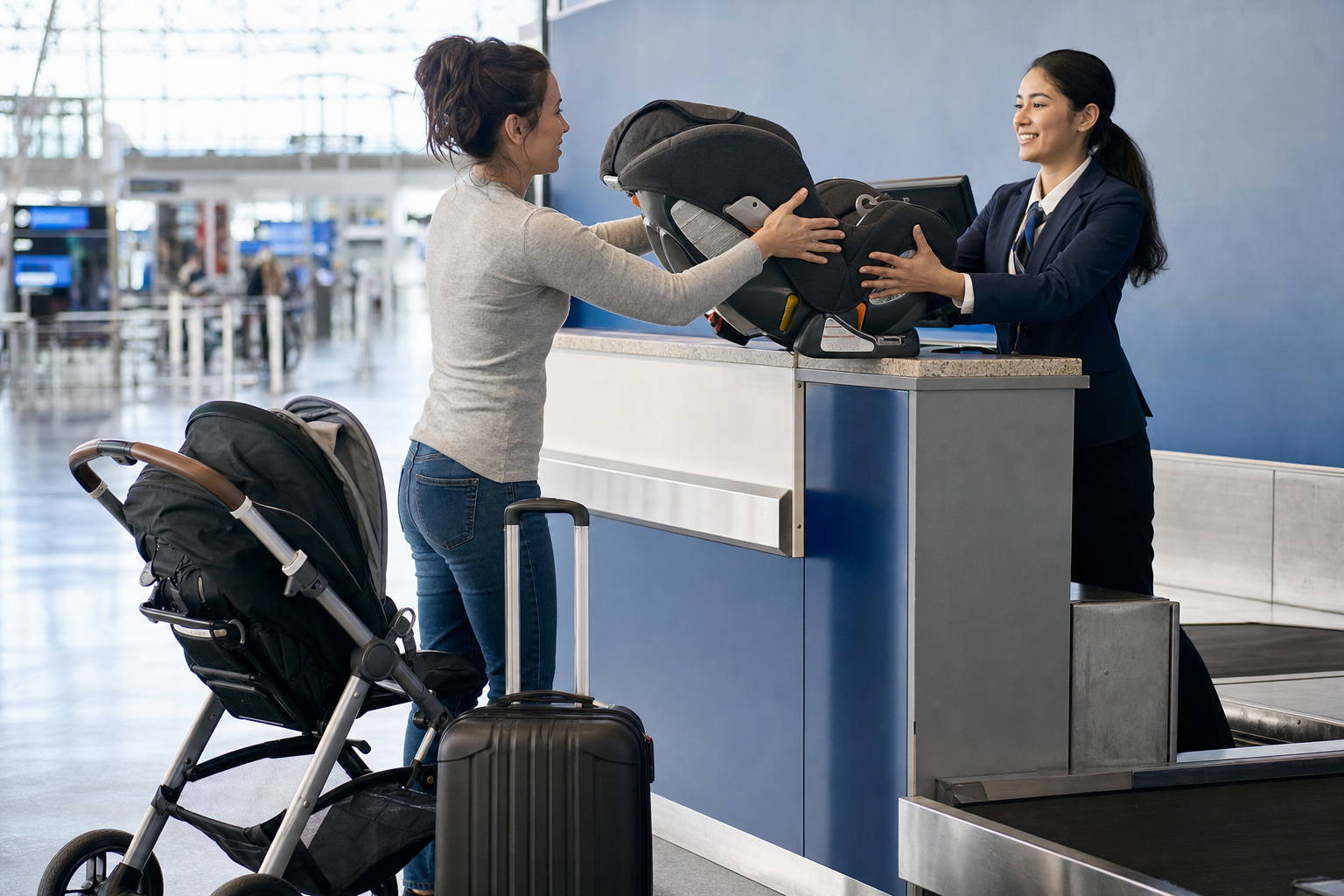
On the four major United States airlines checked here, a child’s car seat can be checked free without using the normal checked-baggage allowance. American Airlines, Delta Air Lines, Southwest Airlines and Alaska Airlines also provide a free stroller allowance, subject to their individual conditions. This is not a universal rule for every airline or itinerary, so check the baggage information shown with your booking before travel.
The policies below were verified on September 17, 2026. A complimentary car seat is generally separate from ordinary checked bags included with a fare, airline status or payment-card benefit. Portable cribs, playpens, pack-and-plays and some wagons are often treated as regular baggage instead.
Car seat policies at four major airlines
| Airline | Published allowance | Important conditions |
|---|---|---|
| American Airlines | One stroller and one car seat for each ticketed customer travelling with a child or to adopt | American says both can be checked at the ticket counter, or one can be checked at the gate and the other at the counter. Playpens, cribs, pack-and-plays and wagons without built-in safety straps count as regular bags. |
| Delta Air Lines | Strollers and child safety seats checked free | Delta says these items do not count as standard baggage and may be checked at the curb, ticket counter or gate. Its policy also covers child safety seats brought for a lap infant, although cabin use depends on seat availability or purchasing a seat. |
| Southwest Airlines | One stroller and one car seat or child restraint system for each ticketed customer travelling with a child | Southwest accepts the items at the curb where available, ticket counter or gate. Strollers and restraints are carried under a limited release of liability. Portable cribs and pack-and-plays follow the regular checked-bag policy. |
| Alaska Airlines | A child’s car seat and stroller checked free | Both may be checked with other baggage or at the gate. A child-carrying stroller wagon also qualifies if it collapses to under 90 linear inches and weighs no more than 35 pounds. |
The exact wording matters. American and Southwest connect their allowances to a ticketed customer travelling with a child. Delta describes strollers and child safety seats as complimentary items outside the standard baggage allowance. Alaska states that it transports a child’s car seat and stroller free as checked baggage.
A travel system may have several detachable pieces, such as a stroller frame, infant seat and base. Do not assume that every component receives its own free allowance. Ask whether the airline will tag the complete system as one stroller and one car seat, and pack small detachable parts so they cannot be lost during handling.
Which airline policy applies to a connecting itinerary
Do not automatically use the policy of the airline physically operating each flight. On codeshare and interline itineraries, the controlling baggage allowance can come from the marketing carrier shown on the ticket or from another carrier selected under the itinerary’s baggage-rule methodology.
For an itinerary whose ultimate ticketed origin or destination is in the United States, Department of Transportation rules generally require the baggage allowances and fees applied at the beginning of the itinerary to continue throughout that ticket. When a codeshare marketing carrier and operating carrier have different baggage allowances or fees, the marketing carrier’s rules generally take precedence for that itinerary.
International itineraries that do not fall under the United States rule may use a different method, such as rules associated with the journey’s most significant carrier. Separate tickets can also produce separate baggage determinations, even when the flights connect at the same airport.
The safest approach is to review the baggage allowance displayed on the e-ticket confirmation and ask the airline that issued or marketed the ticket which carrier’s child-equipment allowance applies. Then ask the operating airline about practical procedures such as where to obtain a tag, where to leave a gate-checked seat and where it will be returned. The airline controlling the allowance and the airline handling the equipment at the airport are not necessarily the same.
Counter checking gate checking and cabin use
Counter checking means handing the car seat over with ordinary checked baggage before security. This is usually the simplest choice if the child will travel as a lap infant or will not use the restraint on board. Ask whether the seat will arrive on the normal carousel or at an oversize-baggage area, and keep the baggage receipt until collection.
Gate checking lets you keep the seat or stroller in the terminal until boarding. An agent attaches a baggage tag, and you leave the item at the place identified near the aircraft door or jet bridge. A gate check does not guarantee delivery beside the aircraft after landing. For example, Southwest normally sends gate-checked child equipment to baggage claim at the final destination unless another arrangement is requested when the item is tagged.
Cabin use is different from checking a car seat. To guarantee that a child under two can use a restraint on board, purchase a separate passenger seat. An airline may allow a lap infant to use an unoccupied adjacent seat after boarding, but it does not have to keep that seat available.
The Federal Aviation Administration calls an aircraft-compatible car seat a child restraint system. A United States-approved restraint should have a label saying that it is certified for use in motor vehicles and aircraft. Certain restraints approved by a foreign government or manufactured under United Nations standards may also qualify. Install the restraint according to its label and instructions, including the correct forward-facing or rear-facing position for the child.
A restraint cannot block another passenger’s route to the aisle and cannot be placed in an exit row. Airlines may impose additional location restrictions for particular aircraft, cabins or seats with special seat belts. If a ticketed child has an approved restraint that does not fit in a particular seat, federal guidance says the airline must accommodate it in another suitable seat in the same class of service.
Lap infants boosters and travel preparation
A lap infant can generally still be accompanied by a free checked car seat under the four policies compared here. The infant should be added to the reservation, even when no separate passenger seat has been purchased. Carry acceptable proof of age if the airline may request it.
A belt-positioning booster is not the same as a harnessed car seat. Vehicle boosters rely on a lap-and-shoulder belt, while most aircraft passenger seats have only a lap belt. The Federal Aviation Administration prohibits ordinary booster seats and backless child restraints during ground movement, take-off and landing. Some combination seats marketed as boosters can be used if they have an internal harness, a solid back and the required aircraft-certification label.
Before leaving for the airport:
- Read the allowance on your booking. For a partner itinerary, confirm which carrier’s baggage rule applies instead of relying only on the operating airline’s website.
- Name every item. Ask separately about the car seat, base, stroller, wagon, booster and portable crib.
- Choose where to check it. Use the counter if you do not need the equipment in the terminal. If gate checking, confirm the collection point.
- Inspect the approval label. Do this before planning to install the restraint on board, and bring the manufacturer’s instructions.
- Protect loose components. Remove detachable cup holders, toys and accessories. Place contact details both inside and outside a protective bag.
- Document the condition. Photograph the restraint before checking it and retain the baggage tag.
- Inspect it promptly. Look for cracks, missing pieces or damaged harness parts before leaving the airport. Report a problem immediately to the airline’s baggage-service desk.
Battery-powered strollers, wagons or car seats may be subject to separate battery restrictions. Portable cribs, playpens, pack-and-plays, extra child-equipment items and wagons that fail an airline’s design or size requirements may incur normal baggage fees. Treat “baby equipment” as a general description, not as a single baggage category.
Sources
- United States Department of Transportation codeshare baggage guidance and Federal Aviation Administration child restraint guidance
- American Airlines travelling with children policy
- Delta Air Lines children and infant baggage policy
- Southwest Airlines stroller and child items policy
- Alaska Airlines infants and children policy