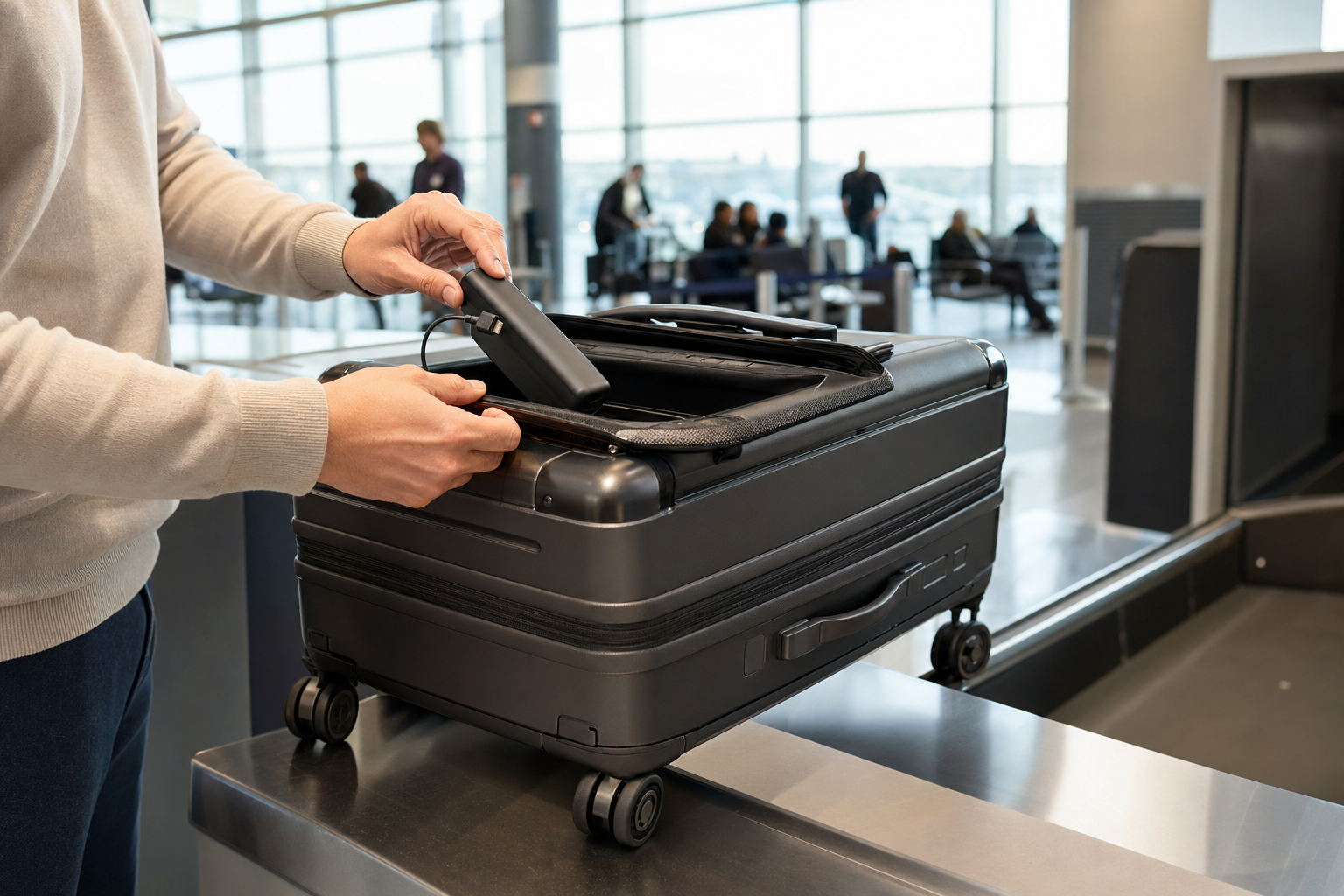
Yes, smart luggage is allowed on many U.S. flights when its lithium battery can be removed and carried in the cabin. The safest choice is a suitcase with a clearly labelled removable battery of 100 watt-hours or less. Remove the battery before checking or gate-checking the suitcase. Some airlines also require removal before a smart bag is boarded or placed in an overhead bin. A bag with a non-removable, damaged or unlabelled battery may be refused.
Use this preflight decision tree
Before packing, answer these questions in order:
- What does the battery power? Identify whether it powers a charging bank, tracking device, electronic lock, digital scale, motor or ride-on feature.
- Can you remove the battery yourself? You should be able to take it out promptly at the check-in counter or boarding gate without damaging the case.
- What is the battery capacity? Find its watt-hour rating on the battery label, manual or manufacturer’s technical specifications.
- How might the suitcase travel? Consider whether it will stay in the cabin, be checked at the counter or be taken for gate checking.
- Which airline operates each flight? Check the rules for the operating carrier, not just the airline that sold the ticket.
The Federal Aviation Administration rules for battery-equipped baggage provide the U.S. baseline: smart bags generally must travel in the cabin unless their batteries are removed. A smart bag may remain in checked baggage with its battery installed only when it contains a lithium-ion battery rated at no more than 2.7 watt-hours or a lithium-metal battery containing no more than 0.3 grams of lithium. That narrow exception can cover certain small trackers, locks and scales, but not an ordinary phone-charging power bank.
Identify the battery and remove it if necessary
“Smart luggage” describes products with very different features, so identify the battery rather than relying on the product description. A suitcase with a Universal Serial Bus charging port usually contains a lithium-ion power bank. Once removed, that power bank must travel in the cabin, protected from short circuits; it cannot stay in checked or gate-checked baggage.
A small tracker, electronic lock or digital scale may use a coin cell or a very small installed rechargeable battery. For a checked smart bag, the installed battery must remain within the 2.7 Wh lithium-ion or 0.3 g lithium-metal limit above. A Bluetooth luggage tracker may meet that limit, but the airline can apply a stricter policy. A tracker with mobile-network or wireless functions may also have airline operating requirements.
A motor does not automatically make a case forbidden, but it makes the airline’s individual policy especially important. Some self-propelling cases use removable batteries within ordinary passenger limits. A case intended to carry a standing or seated rider is not treated as a medical mobility aid, and an airline may impose separate restrictions on the exact model.
If you placed a separate tracker inside an otherwise ordinary suitcase, the suitcase is not necessarily smart luggage. See whether an AirTag can go in checked luggage for that narrower question.
Do not depend only on a product listing that says “removable.” Remove the battery at home and reinstall it before deciding that the bag is suitable for flying. A practical design lets you open the battery compartment, remove the complete battery and show its capacity label without cutting fabric, dismantling the shell or requiring manufacturer service. A tool-free design is preferable because a last-minute gate check leaves little time to deal with a complicated compartment.
Airline rules can be stricter than the federal baseline. American Airlines, for example, does not accept smart bags with non-removable lithium batteries on its flights. Even where an airline permits a smart bag in the cabin, it may require the battery to be removed before boarding or before overhead-bin storage.
Find and calculate the watt-hour rating
Look for “Wh” on the removable battery itself. Do not use the suitcase’s total weight, its charger wattage or the wattage of a charging port. If watt-hours are not printed, calculate them from the battery’s nominal voltage and capacity:
Watt-hours = volts × amp-hours
If the capacity is shown in milliamp-hours, divide by 1,000 first:
Watt-hours = volts × milliamp-hours ÷ 1,000
Hypothetical example: A battery labelled 10,000 mAh and 3.7 V is rated at 37 Wh. The calculation is 10,000 ÷ 1,000 × 3.7. Do not substitute a 5 V Universal Serial Bus output rating unless the manufacturer specifically identifies it as the battery’s nominal voltage.
| Battery rating | Practical U.S. travel position |
|---|---|
| Up to 2.7 Wh installed | May remain in checked smart luggage under the federal exception, subject to the airline’s rules |
| Up to 100 Wh | Usually permitted in the cabin; remove it before checking the suitcase |
| 101 to 160 Wh | May be permitted only in the cabin with airline approval; airlines may impose a lower limit for power banks or smart bags |
| Over 160 Wh | Not permitted in passenger baggage, except under separate rules for certain mobility aids |
When a smart-bag battery is removed, it is handled as a spare lithium battery or power bank. Federal rules allow lithium-ion spare batteries up to 100 Wh in carry-on baggage. Batteries from 101 to 160 Wh need airline approval and are limited to two spare batteries per person. A carrier may be more restrictive, including by limiting power banks to 100 Wh.
If the label is missing, find the manual, original packaging or the manufacturer’s official specifications before travelling. Save the relevant information on your phone. Staff may refuse a battery whose rating cannot be verified, and a handwritten calculation will not replace reliable battery specifications.
Pack differently for the cabin, gate and cargo hold
When the suitcase will remain in the cabin
Confirm that the case meets the airline’s carry-on size limit, but keep the battery compartment accessible in case removal is required. Do not bury it beneath tightly packed clothing. If you remove the battery, protect exposed terminals with terminal tape, original packaging or a protective pouch.
Some airlines let a removable battery stay installed in a cabin bag; others require removal before boarding or before the bag enters an overhead bin. Follow the more restrictive rule for your operating carrier.
When a carry-on is unexpectedly gate checked
Remove the smart-bag battery before handing over the suitcase. Put it in your personal item or other cabin baggage and tell the gate agent that the battery has been removed. Also take out other power banks, spare batteries, medication, keys, travel documents and valuables.
Gate checking can happen when overhead bins are full, the aircraft is small or your bag exceeds the cabin limit. Plan for it even when your fare includes a carry-on. The guide to what to do when you must gate check a carry-on explains how to prepare for that situation.
When the suitcase is intended for the cargo hold
Remove an integrated power bank before reaching the counter and carry it aboard. Do not place it in the checked bag after removal. A small installed battery that meets the federal 2.7 Wh or 0.3 g limit may be allowed to remain in the suitcase, but the airline can still require removal or refuse a non-removable design.
Check the operating airline’s current rule
The federal rules set a minimum safety standard, not a promise that every airline will accept every smart bag. The following requirements were checked on October 29, 2026. Check again shortly before departure, particularly on an international or codeshare itinerary.
| Airline | Examples of current requirements |
|---|---|
| American | The battery must be removable if the bag might need to be checked. It may remain installed in an accepted cabin bag, but the passenger must remove it if the bag is checked or valeted. Non-removable smart bags are not accepted. |
| Delta | Passengers carrying a smart bag with a removable lithium-ion battery must remove it from its designed enclosure before boarding. The removed battery must be kept within reach, such as under the seat or in a seatback pocket, rather than in an overhead bin. A portable-charger smart-bag battery is limited to 100 Wh. |
| Southwest | Each customer may carry one power bank of no more than 100 Wh. It must stay out of the overhead bin. If travelling with a smart bag, the passenger must remove its battery before placing the bag in an overhead bin under Southwest’s lithium-battery and power-bank requirements. |
| Frontier | The battery must be removed before boarding and carried in the cabin. Frontier does not allow smart bags with a non-removable, damaged or defective battery, or a battery over 100 Wh. It asks travellers to disclose the battery type and size at check-in. |
On a codeshare itinerary, check each operating carrier. A rule displayed by the airline that issued the ticket may not control a partner-operated flight. If an airline has a power-bank quantity limit, include the smart-bag battery when counting your portable chargers. Review the separate guide to bringing a power bank on a plane in 2026 before adding other chargers to your cabin bag.
Handle common failure cases before security
- The battery is inaccessible or non-removable: Do not assume the case will be accepted in the cabin. Ask the operating airline before travelling. If its policy does not allow the design, use a different suitcase.
- The capacity label is missing: Obtain official manufacturer documentation stating watt-hours or both voltage and capacity. Without verifiable information, use another battery or suitcase.
- The battery is swollen, cracked, leaking, unusually hot, damaged or recalled: Do not bring it in checked or carry-on baggage. Follow the manufacturer’s recall instructions or local battery-disposal rules.
- The battery exceeds 100 Wh: Contact the airline with the exact model and rating before travel. Do not assume a general 160 Wh allowance applies to a charging power bank or smart bag.
- Your airline limits power banks: Leave another charger at home or use a conventional suitcase. Never move a spare power bank into checked baggage to get around the limit.
- The suitcase is rideable: Ask the airline about the exact model before travelling. Removing its battery does not guarantee that a vehicle-like case will be accepted.
Apply the rules to two travel situations
Hypothetical airport scenario: A traveller has a cabin-size suitcase with a removable 37 Wh charging battery. The bag fits the airline’s carry-on limit, but the gate agent announces that all roller bags must be checked. The traveller removes the battery, protects its contacts, puts it in a personal item and hands over the now battery-free suitcase. On Delta or Frontier, the battery should already have been removed before boarding. On Southwest, it must be removed before the bag goes into an overhead bin.
Hypothetical buyer scenario: A shopper is comparing two large checked suitcases. One has a permanently sealed charging system. The other has a clearly labelled, hand-removable 37 Wh battery. The second is the practical choice because its battery can travel in the cabin while the suitcase goes in the hold. The sealed model risks rejection, especially on airlines that require a smart-bag battery to be removable.
If an airline refuses the bag at the airport, the realistic alternatives are to remove a compliant battery and check the unpowered case, transfer your belongings to a conventional suitcase or leave the bag with a non-travelling companion. Do not conceal the battery, put it into checked luggage or attempt to ship a damaged lithium battery through ordinary mail.
Make the bag airport ready
- Remove and reinstall the battery at home to make sure you can do it promptly.
- Photograph the capacity label and save the manufacturer’s specifications offline.
- Check the policy for every airline operating a flight in your itinerary.
- Count the smart-bag battery against any airline power-bank allowance.
- Keep terminal tape or a protective pouch in your personal item.
- Leave the battery compartment accessible until the suitcase has been accepted.
- Remove the battery before checking the bag at the counter or gate.
- Keep removed batteries in the cabin and out of overhead storage where the airline prohibits it.
- Leave damaged, recalled, unlabelled or oversized batteries at home.
For the least complicated trip, choose a clearly labelled battery under 100 Wh that slides out without tools, then follow the strictest operating airline’s rule from check-in through arrival.