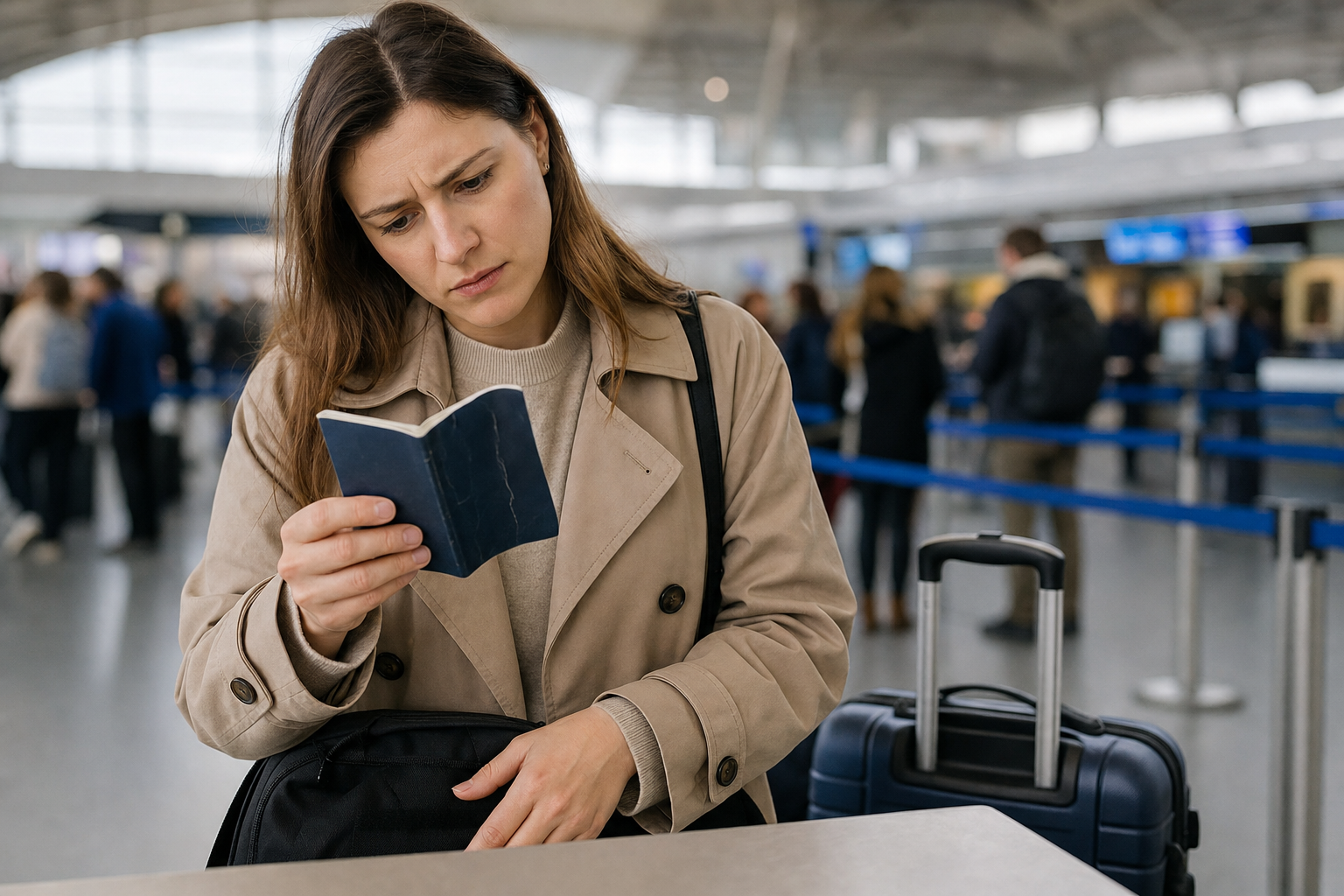
Can you travel with a damaged passport? No, if it has more than normal wear and tear. A small bend, fanned visa pages or slight fraying at the edges can still be used. Water damage, mold, stains, a significant tear, unofficial markings on the biographical page, missing or torn visa pages, or a hole punch mean the passport must be replaced before international travel. For a damaged U.S. passport, apply in person with Form DS-11 rather than risk being denied boarding or delayed at the border.
Decide whether the passport has normal wear or damage
Inspect the closed passport under good light on a clean, dry surface. Do not try to flatten it with heat, tape loose parts into place or remove damaged pages. The Department of State distinguishes ordinary wear from damage that makes a passport unusable for travel.
| Condition | Classification | What to do |
|---|---|---|
| A small bend from carrying the passport in a pocket | Normal wear | It can generally still be used. |
| Visa pages that fan after repeated opening and closing | Normal wear | Replacement is not normally needed. |
| Slight fraying around the cover or page edges | Normal wear | Protect it from further wear and inspect it before travel. |
| Water stains, rippling, mold or color bleeding | Damage | Replace the passport. |
| A significant tear in the cover or pages | Damage | Replace the passport. |
| Writing, labels, stickers or other unofficial marks on the biographical page | Damage | Replace the passport. |
| A missing or torn visa page | Damage | Replace the passport. |
| A hole punch or another major alteration | Damage | Replace the passport. |
A passport is not necessarily acceptable merely because its photograph, name and number are readable. Water exposure is especially easy to underestimate. If the booklet has stains, swollen or rippled pages, mold, or visible evidence that its construction has changed, treat it as damaged and replace it.
Hypothetical example: Maya’s passport has a curved cover and its pages spread slightly when she puts it on a table. The biographical page is intact, every page is present, and there are no stains or tears. Those signs fit normal wear and tear.
Hypothetical example: Daniel’s passport went through a wash cycle. It dried flat enough to read, but several pages have pale water lines and rippling. He should replace it before travelling, even if the identity details remain legible.
Inspect the identity page, binding and visa pages
Do more than glance at the cover. Check the entire passport before relying on it for a trip.
- Biographical page: Confirm that the photograph, printed details and machine-readable lines are clear and unobstructed. Look for stains, scratches, unofficial writing, labels or stickers.
- Binding: Check that the cover and pages are securely attached. Loose groups of pages, exposed stitching or pages separating from the spine are not ordinary fanning.
- Visa pages: Turn every page gently. Missing pages and significant tears are damage. A passport with no usable blank pages is a separate issue, but some destinations require blank pages for visas or entry stamps.
- Water exposure: Look for tide marks, wrinkling, color transfer, mold spots or a musty smell. Drying the passport does not restore it to an undamaged condition.
- Alterations: Check for children’s drawings, handwritten notes, souvenir stamps, labels and hole punches, especially on or near the biographical page.
When the condition is uncertain, do not depend on an informal opinion from an airline employee. A carrier may deny boarding, and border officials make their own decisions about travel documents. Replacing a questionable passport before departure is the safer course.
Replace a damaged passport in person with Form DS-11
A damaged passport cannot be renewed online or by mail. You must apply in person with Form DS-11 at a passport acceptance facility, passport agency or center, or U.S. embassy or consulate if you are abroad.
- Complete Form DS-11. Use the online form filler or complete the paper form, then print it single-sided. Do not sign it until an authorized acceptance agent or passport employee tells you to do so.
- Bring the damaged passport. Do not discard it or take it apart. Submit it with the application; the Department of State keeps damaged passports.
- Write a signed and dated damage statement. State briefly how and when the damage occurred and identify the affected areas. A short factual explanation is enough.
- Bring proof of U.S. citizenship and a photocopy. Because a damaged passport is not acceptable citizenship evidence, bring an original or certified U.S. birth certificate, Consular Report of Birth Abroad, Certificate of Naturalization or Certificate of Citizenship, plus a clear photocopy.
- Bring photo identification and a photocopy. A fully valid driver’s license is a common choice. Provide a photocopy of the front and back on separate sides of single-sided white 8.5-by-11-inch paper. If your identification was issued by a different state from the one where you apply, bring a second photo identification document.
- Bring one compliant passport photo. It must be a recent, unedited color photograph measuring 2 by 2 inches, with a plain white or off-white background. Do not attach it to the form yourself.
- Pay the required fees. Acceptance facilities and passport agencies use different payment arrangements, so check the location before your appointment.
The Department of State instructions for adult passport applicants set out the DS-11 document, photocopy, photograph and payment requirements. Bringing citizenship evidence and its photocopy at the first appointment helps avoid a request for additional documents.
Hypothetical statement: “My passport was damaged on October 20, 2026, when water leaked into my bag. The biographical page and several visa pages developed water stains and rippling.” Sign and date the statement. This wording is an example, not required language.
Know the current fees and processing times
As of October 30, 2026, an adult replacing a damaged passport book with Form DS-11 pays a $130 application fee. When applying at an acceptance facility, the applicant also pays a $35 acceptance fee, for a basic total of $165. A passport book and card together cost $160, plus the $35 acceptance fee when applying at an acceptance facility. A passport card is not valid for international air travel.
Expedited service costs an additional $60. Optional one-to-three-day return delivery for a passport book costs $26.87. If you apply at an acceptance facility, you can also pay that facility to send the application by Priority Mail Express; the cost varies by location.
Routine processing takes four to six weeks, while expedited processing takes two to three weeks. Neither estimate includes mailing time, which may add up to two weeks for delivery to the Department of State and up to two weeks for the completed passport to reach you. A request for more evidence, a replacement photo or clarification about the damage can add time.
Children under 16 also use Form DS-11, but the requirements differ. A child passport book has a $100 application fee, plus a $35 acceptance fee when applying at an acceptance facility. The child must attend in person, and both parents or guardians generally must appear or provide the required consent documentation.
Apply early when travel is several weeks away
Scenario one: A traveler finds a torn visa page six weeks before an international flight.
Make the earliest available appointment at a passport acceptance facility, such as a participating post office, library or clerk of court. Six weeks leaves little room for mailing delays or a request for more documents, so expedited service is the prudent option. Acceptance facilities may require appointments and may use different payment methods for the $35 acceptance fee.
Take Form DS-11, the damaged passport, the signed and dated damage statement, citizenship evidence and its photocopy, photo identification and its photocopy, one passport photo, and the required payments. After applying, use the Department of State’s passport-status service and respond promptly if more information is requested.
Do not treat the damaged passport as a backup travel document while the application is pending. For a related explanation, see whether you can use an old passport while renewal is pending.
Use a passport agency when travel is within 14 days
Scenario two: A traveler discovers water damage eight days before departure.
Use a Department of State passport agency or center rather than expecting same-day service from a local acceptance facility. If you have not yet applied, use the official online appointment system. If you have already applied and are travelling within 14 days, call the National Passport Information Center at 877-487-2778. Appointment availability is not guaranteed, and the nearest opening may be in another city.
Passport agencies and centers take urgent-travel appointments for international travel within 14 calendar days, or when a foreign visa is needed within 28 calendar days. The passport agency appointment guidance also confirms that appointments are free; do not pay a third party to book one.
Bring printed appointment confirmation and printed proof of international travel. For a flight, bring a flight receipt or itinerary. For qualifying travel by road or boat to Canada, Mexico, Bermuda or the Caribbean, acceptable evidence can include a hotel reservation, cruise or bus ticket, or international vehicle insurance. Also bring the complete DS-11 application package, including the damaged passport, supporting documents, photocopies, photo and applicable fees. An urgent appointment does not guarantee same-day issuance.
Get help if the damage is discovered abroad
If you are already outside the United States, contact the nearest U.S. embassy or consulate as soon as you identify the damage and explain your next confirmed journey. Do not wait until you arrive at the airport or assume that the passport remains usable because you entered the country before the damage occurred.
Follow the post’s instructions, which can vary by location. Expect to appear in person and bring the damaged passport, Form DS-11, a signed damage statement, one passport photo, identification, citizenship evidence if available, your itinerary and fees. If there is not enough time for a regular passport, a consular section may issue a limited-validity emergency passport, which may be valid for up to one year. Check whether the countries on your itinerary will accept an emergency passport before relying on it for onward travel.
If the passport is also lost or stolen, do not report it as merely damaged. Follow the separate steps in what to do if your passport is lost abroad.
Avoid repairs and prevent a second travel problem
- Do not use tape, glue or lamination. A repair can obscure security features and make the passport appear altered. Carry it loosely in a protective sleeve until you submit it.
- Do not use online or mail renewal. A damaged passport requires an in-person DS-11 application.
- Do not sign DS-11 in advance. The acceptance agent or passport employee must witness your signature.
- Do not arrive at an urgent appointment without printed travel evidence. Appointment confirmation alone does not establish eligibility for urgent service.
- Check destination entry rules after the replacement arrives. Confirm the new passport’s expiration date and required blank pages. Travelers visiting Europe can review the Schengen passport validity rules for United States travelers.
When the replacement arrives, check the spelling of your name, date and place of birth, sex marker and expiration date before travelling. Sign the passport as instructed. Update airline bookings and travel authorizations that use the old passport number. If a valid foreign visa remains in the damaged passport, ask the country that issued it whether the visa can be used with the replacement passport or must be transferred or replaced.