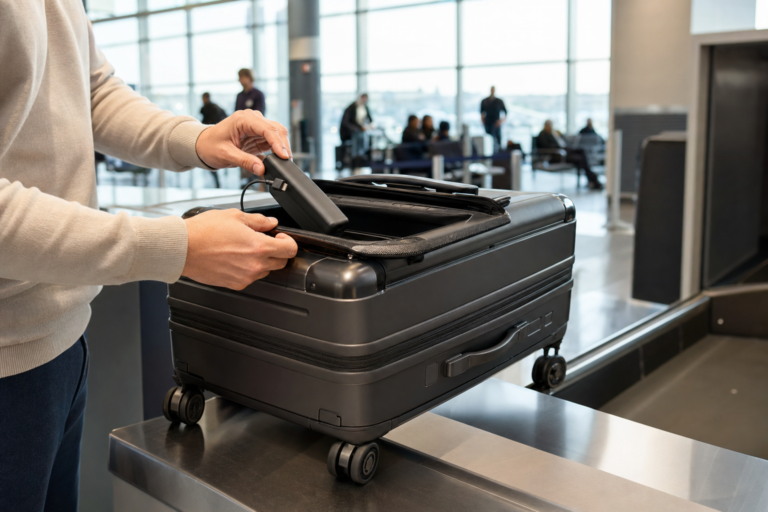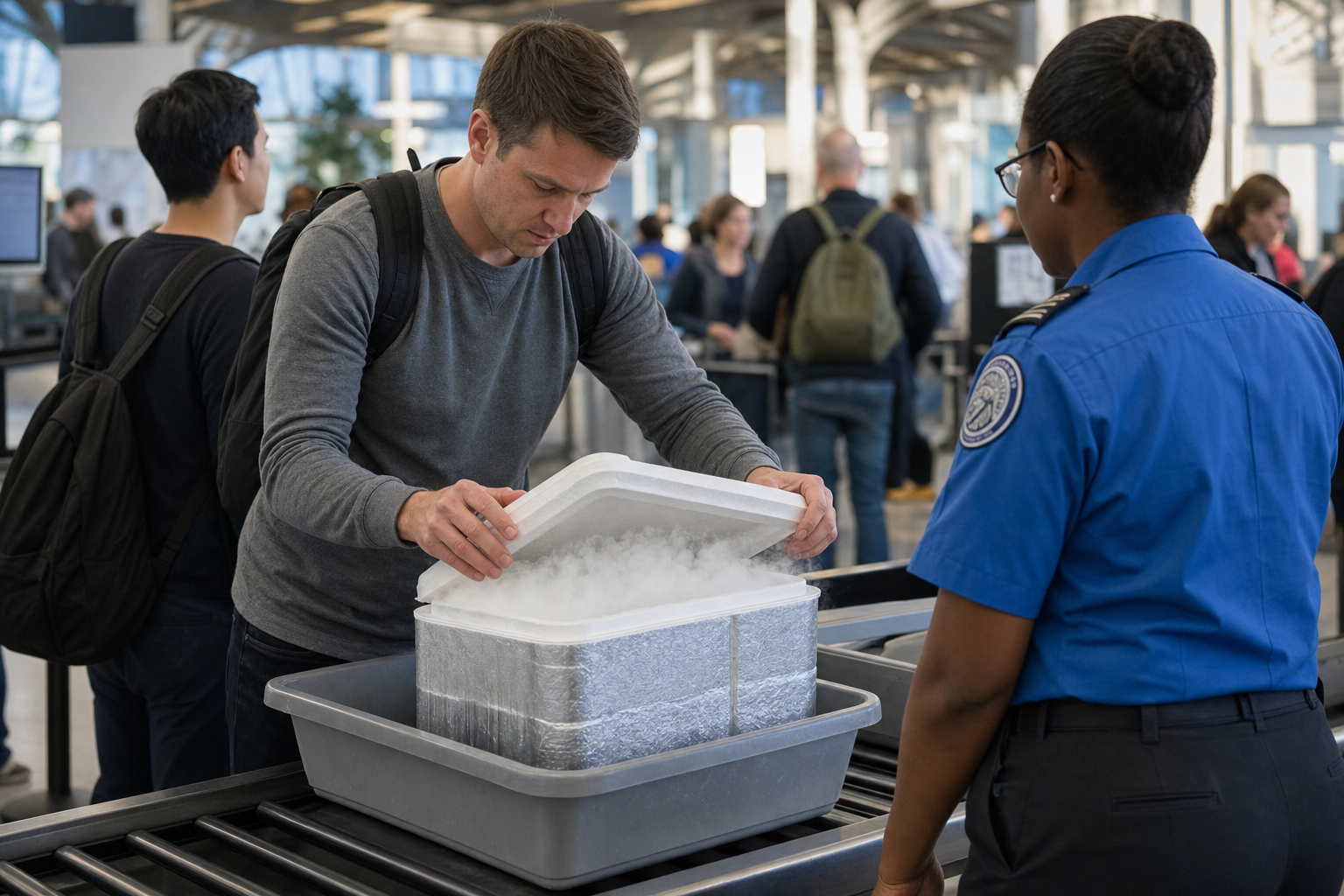
Yes. In the United States, a passenger may bring up to 2.5 kilograms or 5.5 pounds of dry ice to refrigerate nonhazardous perishables, but only with the operating airline’s approval. The limit applies per passenger and per package. The container must release carbon dioxide gas rather than seal airtight, and a package placed in checked baggage needs the required dry-ice marking. Security screening, airline acceptance and food-import rules are separate decisions, so meeting one requirement does not guarantee that the package will complete the journey.
Decide whether dry ice is necessary
Dry ice is useful when food must remain frozen for the entire door-to-door journey, not merely during the flight. Count the trip to the airport, check-in, screening, delays, connections, baggage claim and travel after landing. It can be practical for frozen seafood, meat or prepared food on a long itinerary, especially when reliable freezer space will not be available at the destination.
For a short domestic trip, frozen gel packs are often simpler. They do not require airline approval or dry-ice package markings. In carry-on baggage, however, a gel pack containing more than 100 millilitres or 3.4 ounces of liquid or gel must be completely frozen solid at the security checkpoint. A partly thawed or slushy pack may be treated as a liquid or gel and may not pass screening.
- Use frozen gel packs when a short trip and ordinary freezer temperatures will keep the food safe.
- Use dry ice when a hard freeze is essential and every operating airline accepts the package.
- Consider shipping or buying food after arrival when the journey includes multiple carriers, international entry rules or a package too large for cabin baggage.
See the separate guidance on whether ice packs have to stay frozen through TSA screening before deciding that dry ice is essential.
Know the federal limit and the separate decisions involved
The Federal Aviation Administration allows dry ice in carry-on or checked baggage when it is used to pack perishables that are not themselves regulated as hazardous materials. The allowance is no more than 2.5 kilograms or 5.5 pounds per passenger and per package. Airline approval is required, and the package must permit carbon dioxide gas to escape. The FAA’s passenger dry-ice guidance also confirms the marking required when the package travels in checked baggage.
Four separate parties can affect the outcome:
- The airline: The operating carrier must approve dry ice and may set stricter rules for routes, container construction, carry-on size, checked baggage or advance notice.
- The Transportation Security Administration: Transportation Security Administration officers decide whether an item may pass the security checkpoint. They can inspect the cooler, food and refrigerant.
- The baggage operation: A carry-on can be gate-checked if cabin space is limited. A package that moves to the hold must meet checked-baggage requirements.
- Customs and agricultural authorities: A destination country can restrict the food even when the airline accepts the dry ice and the package clears security.
Do not treat approval from the airline that sold the ticket as enough on a codeshare trip. Check the airline that actually operates each flight, including return segments. An airline may accept dry ice in one type of baggage, on one route or for one aircraft, but not another.
Choose carry-on or checked baggage before packing
Carry-on baggage gives you control of the package and avoids the risk that a checked bag is delayed or sent to the wrong airport. It is usually the better option for a small cooler, provided it meets the airline’s cabin size limits and can be opened for inspection if requested.
Its main drawback is gate-checking. If a gate agent needs to place your cooler in the hold, immediately say that it contains dry ice. Do not let an unmarked package be loaded as checked baggage. The airline must be able to approve the checked placement, and the package needs the checked-baggage marking before it leaves your possession.
Checked baggage can suit a larger, well-protected cooler. It will receive more handling, however, and you will have no access to it after check-in. Use an outer package strong enough for normal baggage handling, protect food from leakage and keep the required venting path clear. Airlines commonly limit or exclude compensation for spoiled perishables, so avoid checking food that would be expensive or irreplaceable.
| Consideration | Carry-on baggage | Checked baggage |
|---|---|---|
| Access during the trip | You keep the package with you until arrival. | No access after check-in. |
| Size | Must meet the airline’s cabin limits. | May allow a larger cooler, subject to baggage limits. |
| Federal dry-ice marking | Not required solely because it is carry-on baggage. | Required on each package containing dry ice. |
| Main risk | Unexpected gate-checking. | Delays, rough handling or misrouting. |
| Best fit | Small packages that need close monitoring. | Packages too large for the cabin but properly protected. |
If you are selecting a container, first check whether the cooler itself qualifies under the airline’s cabin rules. This guide explains how to tell whether a cooler qualifies as carry-on luggage.
Get airline approval and measure the dry ice
Contact every operating airline before you buy dry ice. Use the carrier’s restricted-items or dangerous-goods information and, if needed, call its reservations or airport team. Ask whether dry ice is accepted on your exact itinerary in carry-on baggage, checked baggage or both. Also ask whether the airline wants advance approval, a declaration at the counter, a particular container type or additional wording on the package.
Have these details ready when you ask:
- the flight numbers, dates and operating airlines;
- whether the package will be carry-on or checked;
- the type of food being cooled;
- the planned net weight of dry ice; and
- the cooler material and how it will vent gas.
Apply both parts of the allowance. One passenger may have no more than 5.5 pounds in total, and no single package may contain more than 5.5 pounds. Two travellers may each have a separately compliant package, but do not combine their allowances into one 11-pound package. If one traveller carries two packages, the total dry ice assigned to that traveller must stay at or below 5.5 pounds.
Ask the supplier to provide a measured amount and retain the receipt or other record of the dry-ice weight. The weight of the entire cooler is not enough because it includes food and packaging. If you cannot establish the dry-ice quantity, the airline can refuse the package rather than accept a guess.
Pack a container that vents safely
Dry ice is solid carbon dioxide. It changes directly into gas as it warms, so a sealed container can build pressure and rupture. The outer package must stay closed for handling while allowing gas to escape. Never tape every seam shut, block a designed vent or force an airtight lid closed.
- Freeze the food fully. Starting with solidly frozen food reduces the amount of refrigerant needed.
- Seal food containers against leaks. Food bags and individual containers may be sealed; the outer dry-ice package must not be airtight.
- Use an airline-accepted insulated container. Airline rules may be more specific than the federal minimum, so follow the operating carrier’s instructions if they differ.
- Protect food packaging. Put cardboard or another suitable insulating layer between dry ice and items that could crack, become excessively brittle or be damaged by direct contact.
- Add the measured dry ice. Use tongs or insulated gloves, avoid bare-skin contact and keep the material away from children and pets.
- Keep the gas-release path open. Check that the lid, vent or closure has not become sealed by tape, shrink wrap or an outer bag.
- Inspect the outside. It should be dry, sturdy and readable, without food leakage or damage that could affect safe handling.
Do not rely on loosening a latch on an unsuitable cooler at the airport. If the airline rejects the container design, replace or repack it rather than trying to improvise a vent after check-in.
Mark checked packages clearly
For checked baggage, mark each package containing dry ice with DRY ICE or CARBON DIOXIDE, SOLID. Add either the net quantity, such as 4.0 LB, or a statement that it contains 5.5 LB OR LESS. Put the wording on the outside where baggage staff can see it; do not hide it beneath an outer cover or inside a suitcase.
The federal passenger rule does not require a contents description on a carry-on package. Still, some airlines require or request the name of the item being cooled, such as FROZEN SALMON. Adding the food description, your name, telephone number and destination can make airport handling easier, but those details do not replace the required dry-ice wording and weight statement for checked baggage.
Marking a carry-on package in advance can be sensible if gate-checking is likely, but it does not itself create airline approval. Tell the gate agent about the dry ice before the cooler is taken from you.
Use the rules in two common situations
Hypothetical example one: frozen holiday food on a nonstop domestic flight
A traveller is taking frozen cooked turkey and side dishes on a nonstop flight. The complete journey should take several hours, and the food fits in a small cooler that meets the airline’s carry-on limits.
First, the traveller should decide whether fully frozen gel packs can do the job. If dry ice is needed, the traveller confirms acceptance with the operating airline, obtains a measured amount below 5.5 pounds, uses a vented cooler and keeps the package accessible for inspection. The traveller also prepares the checked-baggage marking in case the cooler must be gate-checked.
Plan separately for food that may thaw. Gravy, cranberry sauce, sauces and soft side dishes can be subject to carry-on liquid or gel rules if they are not frozen solid. See the guide to bringing Thanksgiving food through TSA for practical distinctions between solid and liquid or gel foods.
Hypothetical example two: frozen seafood on a multi-airline itinerary
A traveller wants to take frozen salmon in checked baggage on an itinerary operated by two airlines. The traveller cannot assume that approval from the first airline covers the second. Before packing, the traveller checks each carrier’s dry-ice policy, confirms that both accept checked dry ice and asks whether either has special container or label requirements.
The traveller then uses a strong vented package, seals the seafood to prevent leaks and marks the exterior with the required dry-ice wording and weight statement. If either carrier does not accept dry ice in checked baggage, the practical alternatives are a compliant carry-on package, frozen gel packs, shipping through an appropriate service or leaving the food behind.
Plan for screening, international entry and problems
Arrive early enough to deal with inspection or repacking. At the ticket counter, say that the package contains dry ice and state the measured quantity. At security, follow the officer’s instructions and be ready to identify the food and refrigerant. Do not wrap the cooler so completely that it cannot be inspected.
For international travel, check food-import rules before buying dry ice. The same applies when you enter a country during a connection and collect checked baggage. For entry into the United States, travellers must declare agricultural and wildlife products. The United States Department of Agriculture advises keeping original packaging and receipts or other proof of origin because eligibility for meat and poultry can depend on the country of origin and animal-disease conditions. Its guidance on bringing meat, poultry and seafood into the United States also explains that inspectors make the final admissibility decision.
- If the cooler is airtight: Replace it with an approved vented container. Do not try to solve the problem by opening the lid only occasionally.
- If dry ice has partly sublimated or its weight is unknown: Before departure or after a delay, reweigh the dry ice remaining in the package. If you add or replace dry ice, reweigh the final amount and keep it within the 2.5-kilogram or 5.5-pound limits per passenger and per package. For checked baggage, update any specific net-weight marking to the reweighed amount rather than relying on the original figure or an estimate.
- If a carry-on is gate-checked: Tell the agent immediately, confirm airline approval and ensure the checked-baggage marking is complete before loading.
- If an airline refuses the package: Repack to its stated standard, use frozen gel packs if suitable, ship the food through an appropriate service or travel without it.
- If food is not admissible at the destination: Declare it. Refrigeration does not make a restricted item eligible for entry.
Before leaving for the airport, confirm the operating airline’s approval for every segment, the 5.5-pound passenger and package limits, the measured weight, a vented container, any checked-baggage marking and the destination’s food-import rules. If any of those checks cannot be completed, choose another cooling method or do not take the food.