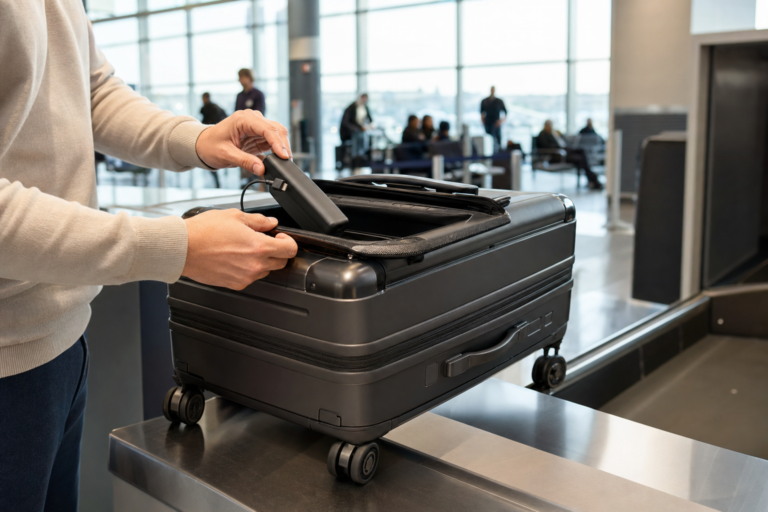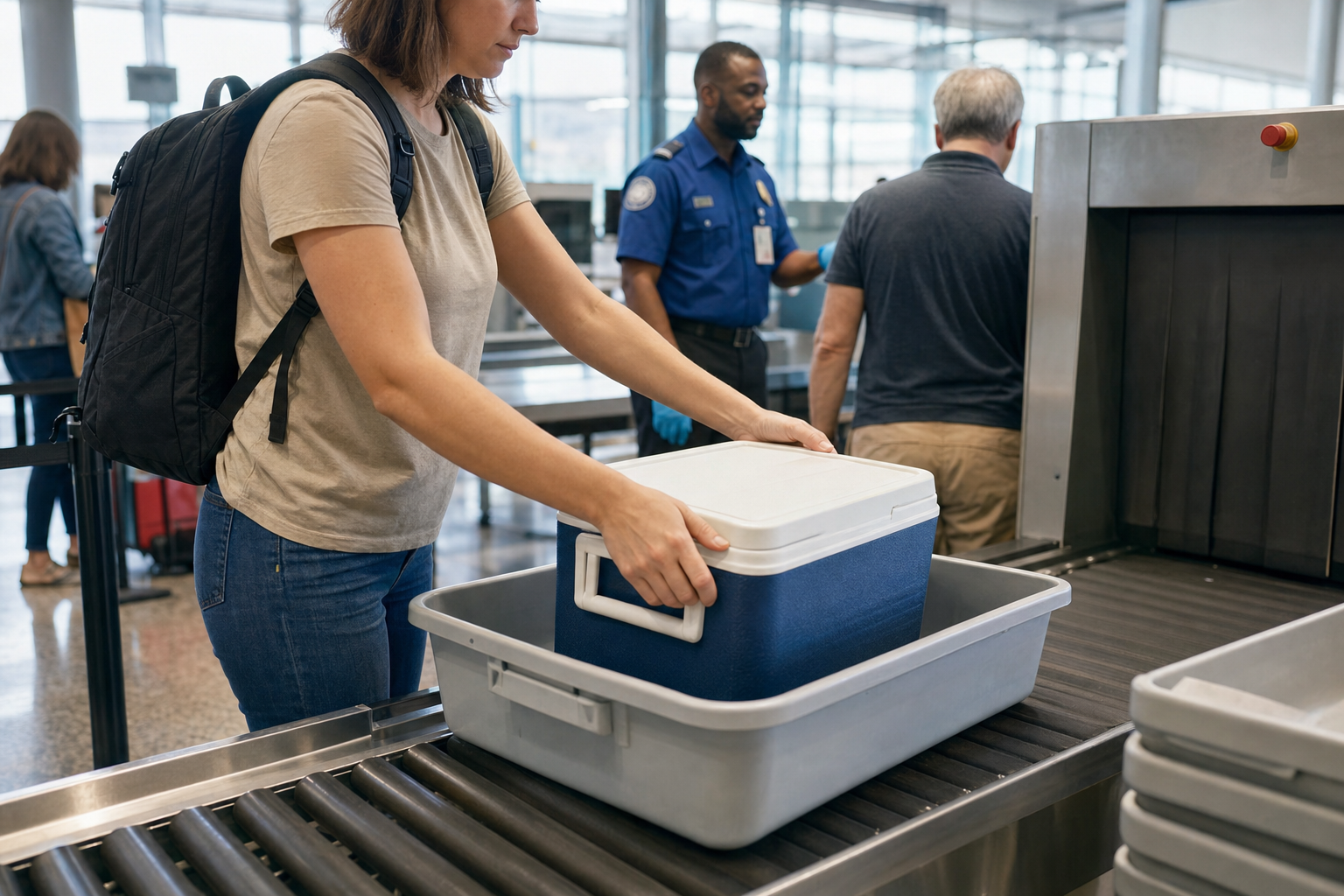
Yes. You can generally bring a cooler on a plane as carry-on luggage in the United States if it meets your airline’s size, weight and baggage-allowance rules. Transportation Security Administration rules govern what can pass through the checkpoint, while the airline decides whether the cooler counts as a personal item, carry-on bag or checked bag. The food inside must also meet security rules, and agricultural or customs rules may apply at your destination.
When a cooler can be a carry-on bag
An empty cooler can generally be taken through security and packed in either carry-on or checked baggage. A compact hard-sided cooler, soft cooler or insulated backpack may be accepted, but its exterior dimensions matter. Measure the fully packed cooler at its widest points, including handles, wheels, pockets and latches. Unlike a soft bag, a rigid cooler cannot be compressed to fit a baggage sizer.
Your airline, not the Transportation Security Administration, decides whether it can go in the cabin. The cooler normally counts as one of your allowed bags. If it goes in the overhead bin, it will usually count as your carry-on bag. A small cooler backpack may count as a personal item only when it fits completely under the seat and meets the airline’s personal-item limits.
For example, American Airlines lists a maximum carry-on size of 22 by 14 by 9 inches, including handles and wheels. Frontier Airlines allows a carry-on bag up to 24 by 16 by 10 inches and no heavier than 35 pounds, including handles, wheels and straps. These are examples rather than universal limits, so check every operating airline on your itinerary. A regional or partner airline may apply different limits.
Also check what your fare includes. Some low-cost fares include only a personal item and charge for an overhead-bin bag. Clearing security does not guarantee that an oversized, overweight or unpaid cooler will be accepted at the gate.
Rules for food ice and freezer packs
Security screening focuses mainly on the contents. Solid foods, including meat, seafood, vegetables, sandwiches and baked goods, are generally permitted in both carry-on and checked baggage. Foods that are liquid, creamy, spreadable or gel-like must normally comply with the carry-on liquids rule: containers of no more than 3.4 ounces, or 100 milliliters, placed in a single quart-sized bag. A larger item may be allowed if it is frozen solid when presented for screening.
Use these rules for common cooling methods:
- Empty cooler: Generally permitted through security, subject to airline baggage limits.
- Frozen solid food: Generally permitted. Pack it securely so that it will not leak as it warms.
- Frozen gel or freezer packs: Permitted when completely frozen solid at the checkpoint.
- Partially thawed packs: If a pack is slushy, soft or has liquid inside, it must comply with the standard carry-on liquids restrictions unless a specific exception applies.
- Loose ice: It can pass through screening when frozen, but any meltwater or liquid at the bottom of the cooler can cause the item to be refused at the checkpoint.
- Sauces, dips and similar foods: Containers larger than 3.4 ounces generally cannot go through the checkpoint unless they are frozen solid or qualify for an exception.
Putting an oversized liquid container beside frozen food does not make the liquid permissible. The liquid or gel itself must meet the applicable carry-on rule. For this reason, a cooler packed with ordinary ice can be impractical if the ice begins melting before you reach security.
There are separate screening accommodations for medically necessary liquids and for breast milk, infant formula, toddler drinks and baby or toddler food. Related cooling accessories, including ice packs and freezer packs, may be allowed in reasonable quantities even if they are not fully frozen. Tell the Transportation Security Administration officer about these items at the start of screening; additional inspection may be required.
Dense frozen food and freezer packs can make the X-ray image difficult to read. Pack the cooler in orderly layers, keep it easy to open and be ready to remove food or containers if requested. The officer at the checkpoint makes the final screening decision.
Using dry ice or checking a cooler
Dry ice is allowed for cooling non-hazardous perishables, but it is regulated as a hazardous material. Federal Aviation Administration guidance limits passengers to 2.5 kilograms, or 5.5 pounds, per package and per passenger. Airline approval is required before travel.
A dry-ice container must not be airtight. It must allow carbon dioxide gas to vent as the dry ice changes from a solid to a gas. Do not tape, lock or otherwise seal a hard cooler in a way that prevents venting.
For checked baggage containing dry ice, the outside of the package must be marked “Dry Ice” or “Carbon Dioxide, Solid” and show the net quantity of dry ice, or state that it contains 2.5 kilograms or less. Airline requirements can be more restrictive, so contact the carrier before departure rather than waiting until check-in or the gate.
A cooler that does not qualify as cabin baggage may be checked if the airline accepts its size, weight and packaging. It counts as checked baggage, and standard, oversize or overweight fees may apply. Perishable items can be affected by delays and rough handling, so do not rely on checked baggage for food that cannot safely tolerate a long delay.
For a checked cooler, use leak-resistant food packaging and secure a removable lid or weak latches with straps that can be removed for inspection. Put identification both inside and outside the cooler. Do not permanently tape, shrink-wrap or seal the cooler before check-in, particularly when departing Hawaii, where agricultural inspectors may need access to baggage before travel to the mainland, Alaska or Guam.
Food entry rules and a packing checklist
Security approval does not mean food may legally enter your destination. Countries and territories can restrict meat, seafood, dairy products, fruit, vegetables, seeds and other agricultural goods. Check the destination government’s import rules and any rules that apply at a connection where you clear customs or immigration.
When entering the United States, declare all food, plants, agricultural products and wildlife products. A U.S. Customs and Border Protection agriculture specialist or officer makes the final decision on admission. Original packaging and receipts can help show an item’s country of origin, but they do not guarantee entry.
Rules also apply on some domestic routes. The U.S. Department of Agriculture restricts or prohibits many agricultural items moving from Hawaii, Puerto Rico and the U.S. Virgin Islands to the mainland. From Hawaii, for example, most fresh fruits and vegetables are restricted, and travelers must present food, plants and other agricultural items for inspection before departure.
Use this checklist before leaving for the airport:
- Measure the fully packed cooler, including handles, wheels and attachments.
- Weigh it and decide whether it will be a personal item, carry-on bag or checked bag.
- Check baggage rules and fare allowances for every operating airline.
- Freeze food and gel packs completely before travel.
- Remove all loose meltwater before entering the security line.
- Separate sauces, dips and other liquid or gel-like foods that do not meet carry-on limits.
- Pack the cooler so that an officer can inspect it easily.
- Get airline approval before using dry ice.
- Check agricultural and customs restrictions for your destination and any relevant connection.
- Bring removable straps or other suitable fasteners in case the cooler must be checked.
If you are unsure at the airport, treat the cooler as luggage first and a food container second: it must pass security, comply with the airline’s baggage policy and satisfy the applicable food-entry rules independently.