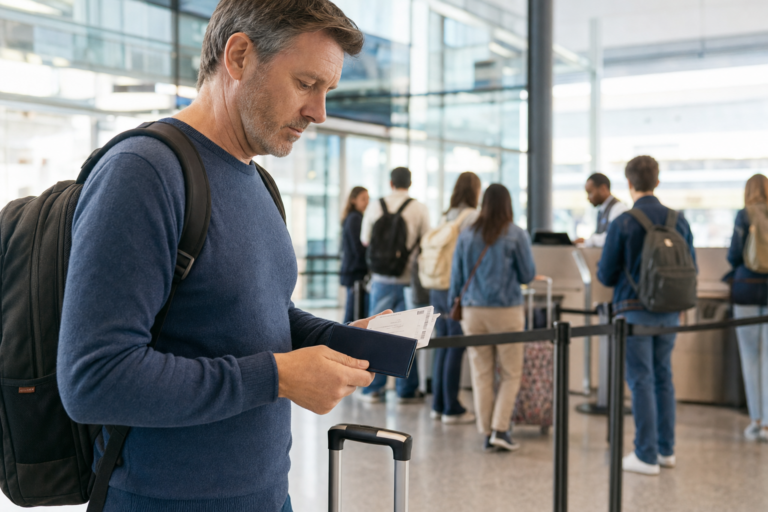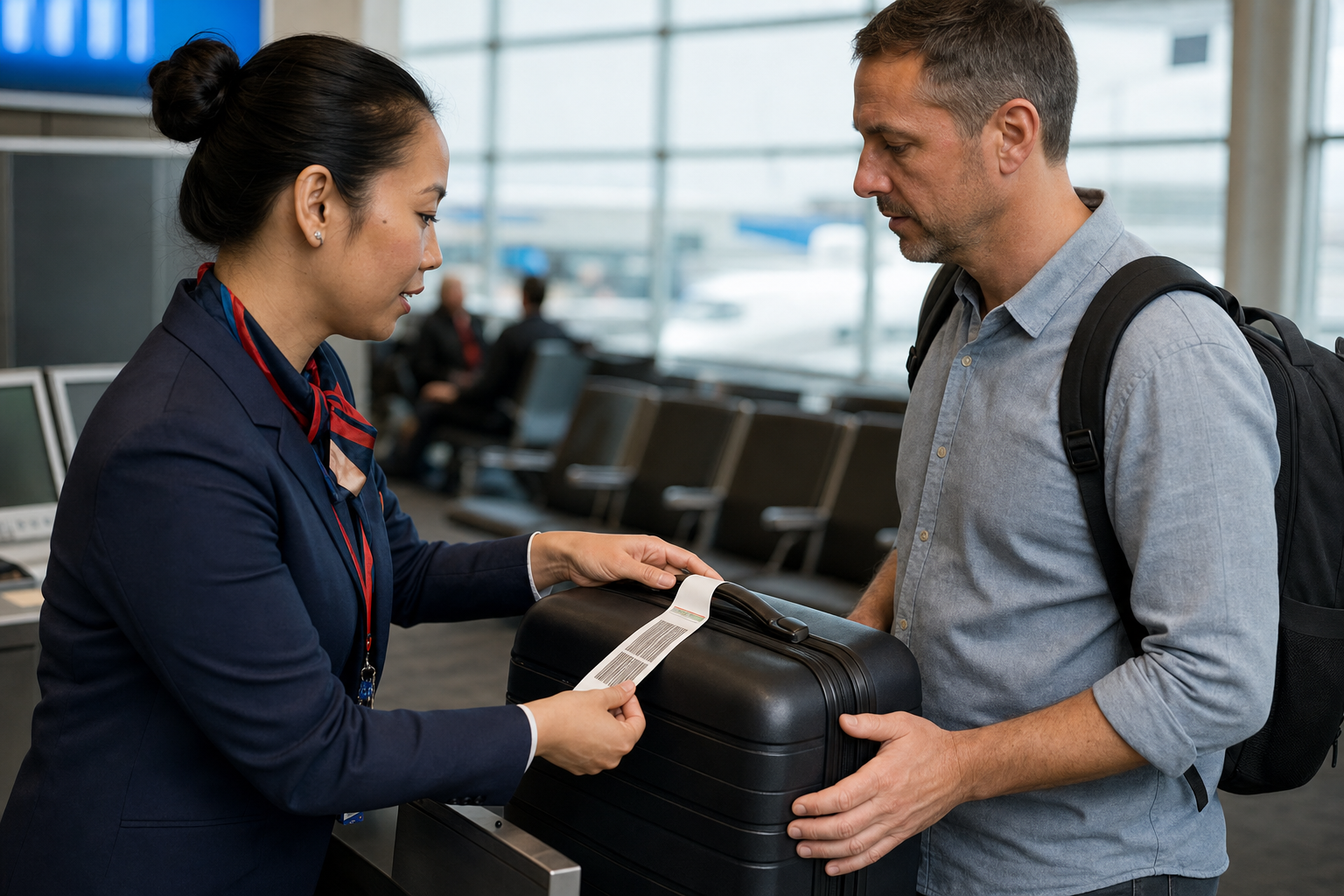
If you must gate check a carry on, first establish whether the airline is checking it because cabin space has run out or because the bag does not meet your fare, size, weight or item allowance. A bag checked because the bins are full or the aircraft cannot accommodate it is often accepted without an added charge, but confirm this before handing it over. Remove batteries and battery-powered devices that must stay in the cabin, medication, identification, valuables and fragile electronics; verify the destination on the tag; ask where you will collect the bag; and keep the claim receipt.
This guide applies principally to flights involving the United States. The operating airline, aircraft and itinerary determine the carry-on allowance, any charge, the type of tag used and whether you retrieve the bag planeside or at baggage claim. On a codeshare flight, the airline operating the aircraft is especially important.
Use this rapid gate side checklist
When boarding is underway, work through these steps in order:
- Ask why the bag is being checked. Ask whether the issue is full overhead bins, a small aircraft, the bag’s dimensions or weight, your fare, or too many cabin items.
- Confirm any charge. If your bag meets the published rules and is being checked for space or aircraft reasons, ask whether it is being accepted without an added fee. If you are charged, ask what rule and fee applies and keep the receipt.
- Remove cabin-only items. Take out power banks, spare batteries, e-cigarettes and vaping devices. Also remove lithium-battery-powered electronics, such as a phone, tablet, camera or laptop, when practical.
- Keep essentials with you. Remove medication, medical supplies needed during the journey, passports, keys, wallets, travel documents and anything you may need during a delay.
- Protect valuables. Move cash, jewelry, cameras, hard drives, work papers and fragile items into your personal item or pockets.
- Read the tag. Check your name, flight details and the three-letter airport code before the bag is taken away.
- Ask where to collect it. Confirm whether it will be returned on the jet bridge, in a planeside collection area, at a connection, or at baggage claim.
- Keep proof. Photograph the tag after it is attached and retain the barcode claim receipt until you have the bag back and have checked it.
Establish whether this is a space problem or an allowance problem
An airline can require a carry on to be checked even if it meets the stated dimensions. Safe stowage, cabin space and the aircraft’s particular overhead bins all matter. The Department of Transportation notes that full flights can run out of room for full-size cabin bags and advises passengers to pack so critical, fragile and valuable belongings can be removed quickly if a bag must be gate checked.
| Reason given | What it normally means | What to ask |
|---|---|---|
| Overhead bins are full | Your bag may comply, but cabin capacity has run out. | Confirm that the check is without an added charge and ask where it will be returned. |
| Small regional aircraft or limited bins | The bag cannot be safely stowed on that aircraft. | Ask whether it is a planeside or valet bag and whether you collect it after landing. |
| Bag is too large or heavy | The airline is enforcing its published limits. | Ask which limit applies and whether a checked-bag, oversize or gate fee applies. |
| Fare includes only a personal item | Your ticket does not include a full-size cabin bag. | Ask for the applicable carry-on or checked-bag charge before paying. |
| Too many cabin items | You exceed the number of items permitted onboard. | Ask which item must be checked and whether combining items would solve the issue. |
A few apparently empty bins do not prove that the check is unnecessary. Some spaces are unsuitable for roller bags, reserved for equipment, or needed for passengers still boarding. Gate staff may also begin checking bags before every bin is visibly full to avoid a late departure.
If you think a charge is incorrect, show that the bag fits the sizer, if one is available, and show the fare terms or boarding-pass information indicating that a carry on is included. Ask for the reason and a receipt, but do not hold up boarding. You can submit a documented refund request to the airline after the flight if necessary.
Remove batteries, medication and valuables before handing over the bag
Once a bag is tagged for the hold, it is checked baggage. That changes what may safely or legally remain inside it and increases the risk that an important item will be unavailable during a delay.
Batteries and electronic devices
Remove every power bank or portable charger, spare lithium battery, electronic cigarette and vaping device. These items must not travel in checked baggage. Protect spare battery terminals from short circuiting by using original packaging, a battery case, a separate plastic bag or nonconductive tape over exposed terminals.
The Federal Aviation Administration says that passengers asked to check a carry on at the gate or planeside should also remove lithium-battery-powered devices and keep them in the cabin. Its carry-on baggage guidance specifically lists power banks, vapes, phones and laptops. If a device cannot be removed, it should be completely switched off, protected against damage and accidental activation, and permitted by the airline’s policy.
For a power bank, see how to carry a power bank on a plane. A small baggage tracker with an installed battery may generally remain in checked luggage if it meets the applicable battery limits, but an airline can impose stricter conditions. Smart luggage with a removable lithium battery normally must have that battery removed before the bag is checked. For the practical rules on trackers, see this guide to AirTags in checked luggage.
If you notice that a power bank, spare battery or vape is still inside after giving up the suitcase, tell the gate agent immediately. If you have already boarded, alert a flight attendant rather than trying to leave the aircraft or access the hold yourself.
Medication and medical supplies
Keep prescription medicine, rescue medication, insulin, syringes, auto-injectors and supplies needed during the flight or connection with you. Carry enough for a reasonable unexpected delay. In the United States, medically necessary liquids, gels and aerosols may be brought through security in quantities above 3.4 ounces or 100 millilitres when declared for screening, so they should not be surrendered merely because a roller bag is being checked.
If you have an assistive device or an item containing essential medical supplies, identify it to the agent before it is handled as ordinary baggage. Ask for the airline’s disability or special-assistance representative if an essential item could be separated from you.
Fragile, valuable and critical belongings
Move passports, identification, keys, cash, jewelry, glasses, cameras, hard drives, work documents and irreplaceable items into your personal item or pockets. Even when an electronic device could be transported in checked baggage under battery rules, keeping it with you is usually safer. Airlines’ domestic contracts of carriage often exclude or limit compensation for fragile articles, electronics and valuables.
A small packable tote makes this easier. Keep it near the top of your roller bag with medication, chargers, documents and essential clothing, so you can transfer critical items without unpacking in the boarding lane.
Read the tag and know where the bag will be returned
Do not leave the gate until you understand the tag. A standard baggage tag may send the suitcase through the normal baggage system, including to a connecting flight. It may be delivered at baggage claim at the airport printed on the tag, but you should confirm the procedure rather than assume it.
A valet, gate-claim or planeside tag can mean something different. On many smaller aircraft, passengers leave roller bags near the aircraft door and collect them on the jet bridge or in a designated area after landing. Such bags may not go to the carousel.
Tag colours and labels are not consistent between airlines. Ask a complete question: “Do I wait on the jet bridge after this flight, or will this go to baggage claim at my final destination?” If you have a connection, also ask whether you must collect the bag after the first segment and take it to the next gate.
Verify the airport code yourself. For example, Portland can mean PDX in Oregon or PWM in Maine. On a connecting itinerary, ask whether the printed code is your connection airport or final destination. If the tag is wrong, stop the process before the bag is taken down the stairs or belt. If it has already gone, ask the agent to contact baggage staff, document the error and give you a corrected receipt.
Follow the right procedure in common situations
Scenario one: a compliant roller bag on a full flight
Hypothetical example: Your suitcase meets the airline’s carry-on limits and your fare includes it, but the agent announces that remaining roller bags must be checked because the bins are full.
This is an operational gate check. Confirm that there is no added charge, remove the items that must remain in the cabin, and inspect the tag. The bag may receive a standard tag and go to baggage claim, including at the final airport on a through itinerary, but ask the agent exactly where it will be returned.
Scenario two: a bag outside the size, fare or item allowance
Hypothetical example: Your ticket includes only an under-seat personal item, or your roller bag does not fit the sizer when its wheels and handles are included. The gate agent requires it to be checked.
This is allowance enforcement, not simply a shortage of bin space. The carrier may charge the applicable carry-on, checked-bag, oversize or gate fee. A bag accepted by a different airline, or on an earlier segment, is not automatically allowed on this aircraft or fare.
Ask what rule applies before paying. If dimensions are the issue, removing a jacket will help only if the closed bag then fits fully in the sizer. If the fare excludes a carry on, a bag’s physical ability to fit overhead does not create an allowance.
Scenario three: a regional-aircraft valet bag
Hypothetical example: Your legal roller bag is accepted at the gate, but the regional aircraft’s bins accommodate only personal items or smaller suitcases. You receive a planeside tag.
Remove restricted batteries and essentials, leave the bag only where instructed near the aircraft, and confirm whether to wait on the jet bridge after arrival. Do not follow the crowd into the terminal until you know whether the bag is being returned planeside.
Take extra care with connections and international arrivals
For a domestic connection, a standard tag showing the final airport usually means the airline will transfer the bag. A planeside or valet tag may require you to retrieve it after each flight. If your connection is short, tell the gate agent and confirm the collection point before you board.
With separate tickets, different airlines or a change of operating carrier, do not assume the first airline can tag the bag through. Check the printed airport code and ask whether you must claim and recheck it during the connection.
When arriving in the United States from abroad, travellers normally collect checked baggage at their first United States port of entry, complete customs processing and then place the bag on the connecting-baggage belt if directed. Travellers arriving from an airport with United States Customs and Border Protection preclearance normally do not clear customs again on arrival. Follow the instructions at the arrival airport even if the original bag tag shows your final city.
International baggage rules can apply to a domestic flight that is part of the same international journey. Keep every baggage tag, boarding pass and receipt until the trip is complete.
Report a delayed, missing or damaged bag promptly
If a standard gate-checked bag does not appear at baggage claim, go to the operating airline’s baggage-service office before leaving the airport. If a planeside bag does not appear on the jet bridge, tell arriving gate staff immediately. Do not assume it was sent to baggage claim without confirmation.
Provide the claim receipt, boarding pass, identification and a description or photograph of the suitcase. If you lost the receipt, report the problem anyway; the airline may be able to find the record through your reservation or baggage scan history. Ask for a written report number and the method for tracking the claim.
Keep receipts for reasonable, necessary purchases made because of a delay. The Department of Transportation explains that airlines must compensate passengers for reasonable, verifiable and actual incidental expenses caused by delayed baggage, subject to applicable liability limits; it is not an automatic daily allowance. Its guidance on lost, delayed and damaged baggage also explains that airlines cannot exclude liability for damage to wheels, handles, straps and other checked-bag components merely as a contract term.
Inspect the bag as soon as you receive it, including the wheels, handles, shell, zipper and contents. Photograph visible damage at the carousel or jet bridge and report it before leaving the airport whenever possible. For international travel, the Montreal Convention generally requires written notice within seven days for baggage damage and within 21 days for baggage delay. For a domestic itinerary, check the operating airline’s contract of carriage because its claim deadline can differ.
If you discover damage after leaving, take dated photographs, avoid repairs until the airline has responded, and submit its online claim promptly. Keep the bag, tag, claim receipt and proof of purchase if available, as the airline may request an inspection or evidence of value.