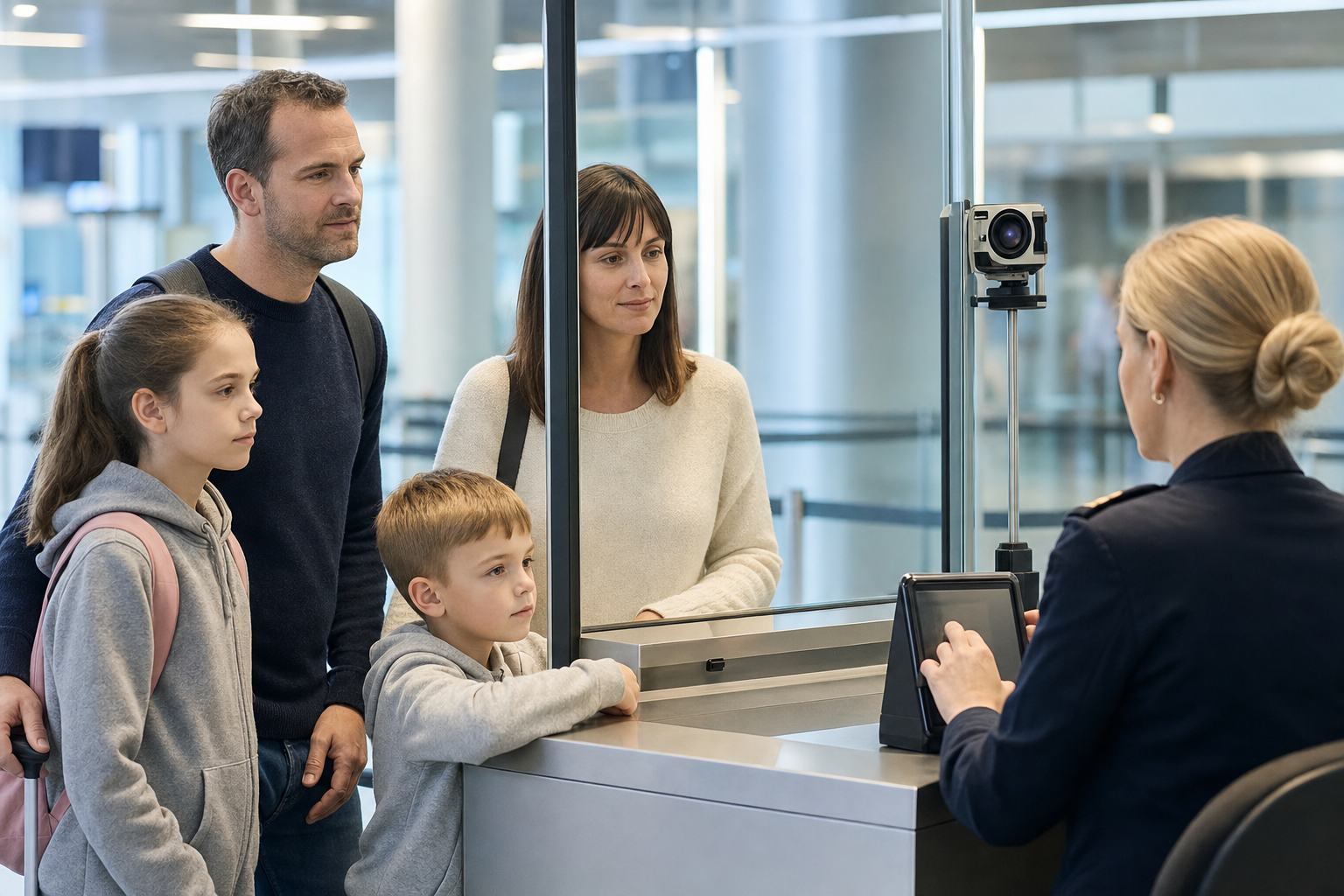
Children younger than twelve do not have to provide fingerprints for the European Entry/Exit System (EES). A child who is otherwise covered by EES can still have a facial image recorded, passport details checked and an individual digital file created. From the child’s twelfth birthday, fingerprints may be required, but the procedure differs depending on whether the child is travelling without a visa or holds a short-stay visa.
EES has been fully operational since 10 April 2026. It records eligible non-European Union nationals visiting for a short stay of up to 90 days in any 180-day period when they cross the external borders of the 29 European countries using the system. This generally includes children travelling on American, British, Canadian or Australian passports for visa-free holidays and other short visits.
How EES fingerprint rules apply by age
Children younger than twelve
A child who is younger than twelve when the border procedure takes place is exempt from the EES fingerprint requirement. The child does not need to press any fingers against an EES scanner, even if other members of the family must do so.
This is only a fingerprint exemption, not a complete exemption from EES. Border authorities can create an individual file containing the child’s name, date of birth, nationality, travel-document information and facial image. The system also records the date and place of each covered entry and exit, as well as any refusal of entry.
Babies and toddlers are covered by the same rule. They do not provide fingerprints, but officials may need to obtain a usable facial image. A parent or guardian might be asked to hold the child, adjust the child’s position or remove something obscuring the face. The exact photography method depends on the equipment and staff at that particular airport, seaport or land crossing.
Children aged twelve and older
The fingerprint exemption ends on the child’s twelfth birthday. A visa-exempt child aged twelve or older should normally be prepared to provide four fingerprints, where physically possible, as well as a facial image.
Age is assessed when the border check occurs. A child who travelled at age eleven without providing fingerprints may therefore be required to provide them on a later trip after turning twelve. Families travelling close to a birthday should plan according to the child’s age on the date of entry or departure, not the age when the trip was booked.
A person who cannot physically provide fingerprints may qualify for a separate exemption. If the difficulty is temporary, officials can record that fact and may require the fingerprints during a later entry or exit procedure.
How a short stay visa changes the procedure
The position for a child holding a short-stay Schengen visa requires an important qualification. Visa applicants younger than twelve are generally exempt from providing fingerprints during the visa application process. A child whose visa was issued before turning twelve may therefore have no fingerprints stored in the Visa Information System, usually called VIS.
The same can apply when fingerprints were not collected for another permitted reason, such as physical impossibility. It is therefore incorrect to assume that every child with a short-stay visa already has fingerprints in VIS.
When a visa holder does have fingerprints stored in VIS, border authorities can compare a live scan with those existing records when verification is required. The fingerprints are not normally stored again in EES. EES records the visa holder’s facial image and the relevant passport, visa, entry and exit information.
If the child has no fingerprints in VIS, officials cannot verify the child against fingerprint records that do not exist. They can instead use the available passport details, visa information, facial image and other identity checks. Additional checks may be needed if identity cannot be confirmed immediately. Turning twelve after a visa was issued does not retroactively place fingerprints in VIS.
This distinction also helps explain the difference between collection and verification. Collection means adding biometric data to the relevant system. Verification means comparing the traveller at the border with biometric data already held. On a later EES crossing, an officer may take a live facial image or scan fingerprints to verify identity without necessarily creating a completely new biometric record. What is required depends on the traveller’s visa status, age, existing records and the operational needs of that border check.
What families can expect at the border
During a child’s first covered EES crossing, officials may scan the passport, check personal details, take a facial image and collect fingerprints when the child is required to provide them. Each child has an individual record rather than being included in a parent’s file.
Some crossings use kiosks or other self-service equipment before the family reaches a staffed passport desk. At others, a border officer completes most or all of the process. Kiosk availability, family lanes, accessibility arrangements and help for young children vary considerably between specific border crossings. Families should follow local signs and staff instructions rather than assume that the procedure used at one airport will be repeated elsewhere.
On a later crossing, authorities will normally locate the existing record and verify the traveller’s identity. This may involve a live facial image, a fingerprint comparison where applicable or checks using passport and biographical information. Officials may also update information when necessary. Every covered entry and exit is recorded even when the traveller already has an individual file.
EES is mainly encountered when crossing an external border of the countries using the system, rather than during every journey between those countries. On an itinerary involving a connection, the relevant arrival check is usually at the first airport where the family enters the EES area. Families planning a transfer can read Does EES Apply to Connecting Flights in Europe.
Processing a family can take longer than processing one adult, particularly when several travellers need first-time registration or a young child has difficulty facing the camera. There is no single standard processing time. Allow a sensible margin for check-in, passport control and onward connections, especially during school holidays and other busy periods.
The optional Travel to Europe mobile application allows eligible travellers with biometric passports to pre-register certain information within 72 hours of reaching a participating crossing. Availability and functions vary by country and crossing, and using the application does not replace the official border check.
Who is outside EES and how families should prepare
Age alone does not determine whether EES applies. A child’s citizenship, residence status, travel document and reason for travelling must also be considered. Children who are commonly outside EES registration include:
- Citizens of European Union countries, Iceland, Liechtenstein, Norway and Switzerland.
- Non-European Union nationals holding a qualifying residence permit or long-stay visa.
- Qualifying non-European Union family members of an EU, Icelandic, Liechtenstein, Norwegian or Swiss citizen who hold the required residence card or permit.
- Citizens of Andorra, Monaco and San Marino, and holders of passports issued by Vatican City State or the Holy See.
Other specialist exemptions exist. A family relying on residence rights or another exemption should carry the child’s original passport and the document proving that status. A visa-free passport by itself does not prove a residence-based exemption.
Cyprus and Ireland do not use EES, although their citizens are EU citizens and are outside EES registration. A residence permit or long-stay visa issued by Cyprus or Ireland does not necessarily provide the same EES exemption when its holder travels to one of the 29 countries using the system. Families in this position should confirm the effect of their particular document before departure.
Dual nationality also matters. A child who is both American and an EU citizen should normally present the appropriate EU passport when entering under EU citizenship rights. The passport shown to the airline should be consistent with the status and documents the family plans to present at the border.
EES is not an advance travel-authorisation application, and families do not pay a separate EES registration fee before travelling. Registration occurs as part of the border procedure. Further guidance is available in Do Americans Need to Register for EES Before Travel.
The European Travel Information and Authorisation System, known as ETIAS, is separate from EES. As of 13 September 2026, ETIAS is not operating, and the European Union says it is scheduled to begin in the last quarter of 2026. Travellers do not yet need to submit an application. Families should avoid unofficial websites claiming that they can register a child for EES or obtain an ETIAS authorisation before official applications open.
Before travelling, check each child’s passport, carry any residence or family-status documents, explain that a border officer may take a photograph and prepare children aged twelve or older for possible fingerprint scans. If the child’s citizenship, visa history or residence status is complicated, ask the relevant destination country’s consulate which documents should be presented.