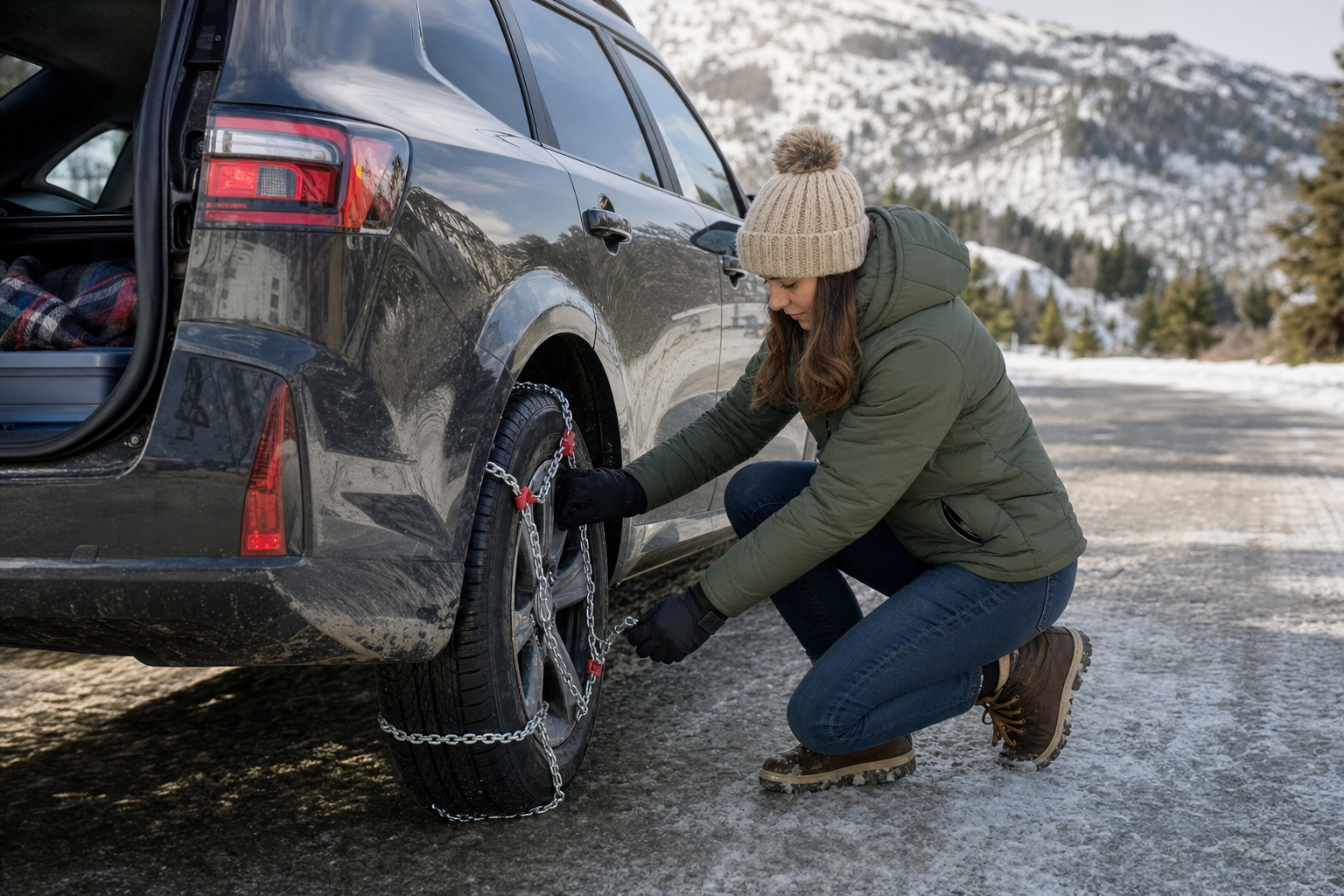
Yes. If you enter a posted California chain-control area, you must carry a lawful, correctly sized set of tire traction devices even when your vehicle has all-wheel drive (AWD) or four-wheel drive (4WD). A qualifying AWD or 4WD passenger vehicle may be allowed to continue without installing the devices under some conditions, but the exception depends on the posted restriction, suitable snow-tread tires, vehicle weight and whether you are towing.
The safest practical rule is to carry devices for one drive axle, confirm that they fit your exact tire size and know how to install them. Roadside signs and instructions from the California Department of Transportation, commonly called Caltrans, or the California Highway Patrol take priority over navigation apps, traffic reports and earlier advice.
How California chain controls apply to AWD vehicles
California does not have a fixed winter date on which every passenger vehicle must carry chains. The legal requirement applies when a road is operating as a designated chain-control area. Conditions can change quickly, so carrying compatible devices throughout a mountain trip is sensible even when controls are not active at departure.
Caltrans and the California Highway Patrol use R-1, R-2 and R-3 as shorthand for three restriction levels. Caltrans notes that these labels may appear in traffic reports but are not necessarily displayed on roadside signs. Read the full wording on the sign at your location.
| Control level | Rule for an AWD or 4WD passenger vehicle | Must devices be carried? |
|---|---|---|
| R-1 | You may proceed without installing devices only if the vehicle is under the applicable 6,000-pound threshold, has qualifying snow-tread tires on at least two drive wheels and is not towing. AWD alone does not provide an exception. | Yes |
| R-2 | You may proceed without installation only if AWD or 4WD is engaged, the vehicle is under the applicable 6,500-pound threshold, qualifying snow-tread tires are fitted to all four wheels and you are not towing. | Yes |
| R-3 | Traction devices must be installed on the drive wheels. There is no AWD or 4WD exception. | Yes |
R-1 and R-2 are the conditions drivers encounter most often. Caltrans says a highway will frequently close before R-3 is imposed, but AWD does not guarantee that you will be allowed to continue.
Actual signs may say “Chains Required,” “Autos & Pickups Snow Tires OK Carry Chains,” “4-W Drive With Snow Tires OK Carry Chains,” “No Exceptions” or “End Chain Control.” These names appear on Caltrans’ current sign-specification page. The sign and checkpoint instructions in front of you govern, even if an online report describes the restriction differently.
Which tires vehicles and traction devices qualify
For California chain controls, a qualifying snow-tread tire has a sidewall marking such as M-S, M+S, M/S or Mud and Snow. Caltrans also requires at least 6/32 inch of tread depth for the snow-tire exception. Check the actual sidewall and tread rather than relying on a sales description.
An all-season, all-weather or all-terrain tire may satisfy that definition if it has the required marking and sufficient tread. However, meeting the chain-control definition does not mean that every qualifying tire provides the same grip as a dedicated winter tire. If you regularly travel in the mountains, compare the practical differences between all-weather tires and winter tires.
Studded snow tires are permitted in California from November 1 through April 30. They are not legally treated as tire traction devices, so they do not remove the obligation to carry chains or another qualifying device in a chain-control area.
Do not assume that every product advertised as an emergency traction aid satisfies the rules. Conventional link chains and cable chains are generally lawful options for passenger vehicles when correctly fitted. California defines tire traction devices more broadly, but they must have an appropriate design, adequate structural integrity and permanent manufacturer identification. Caltrans does not recommend or approve particular consumer brands.
Requirements can also differ by location. Yosemite National Park accepts correctly sized chains, cables and tire socks, but states that plastic devices, straps and similar emergency or alternative products do not meet its legal requirement. Before travelling, verify that your chosen device is accepted on your route as well as permitted by your vehicle manufacturer. For an overview of the main formats, see this comparison of snow chains, cables and snow socks.
Why weight and towing can remove the exception
The two restriction levels have different published thresholds. Caltrans describes the R-1 exception as applying to passenger vehicles and light-duty trucks under 6,000 pounds gross weight. Its detailed guidance describes the R-2 AWD or 4WD exception as applying below 6,500 pounds gross weight.
Official materials do not always use weight terminology consistently. Yosemite describes a vehicle as “weighing less than” the applicable limit, while some legal and government material may refer to unladen weight. Neither term should automatically be confused with the gross vehicle weight rating, which is the manufacturer’s maximum permitted loaded weight rather than the vehicle’s measured weight.
This distinction matters for large pickups, sport utility vehicles and battery-electric vehicles. Passengers, luggage and other cargo increase actual gross weight. If your vehicle is close to either threshold, do not rely on a rough online specification or assume that the number printed beside “GVWR” proves eligibility. Check the relevant figures for your exact model and load, and use the conservative interpretation if you cannot establish that the posted exception applies. Caltrans or California Highway Patrol personnel at the checkpoint have the final say about entry.
Towing removes the normal passenger-vehicle exception. When chain controls are active, a tow vehicle must have traction devices installed on one drive axle, including when it has AWD or 4WD. If the trailer has brakes, at least one trailer axle must also be chained. This applies to utility trailers, boats and small travel trailers as well as larger combinations.
Where to install devices and how to prepare
Traction devices belong on the drive axle. On an AWD or 4WD vehicle, Caltrans permits installation on either drive axle and generally prefers the rear axle unless the vehicle manufacturer directs you to use the front. Under R-3, a four-wheel-drive vehicle must have devices on two drive wheels.
The owner’s manual is the primary fitment guide. Some vehicles have little clearance around the tire, suspension, brakes or wheel well. A manufacturer may prohibit conventional link chains for a particular wheel and tire combination while allowing low-clearance cables or another specified device.
A manufacturer’s restriction does not create an exemption from chain controls. If ordinary chains are prohibited, identify a lawful alternative that the manual permits before travelling. If your vehicle cannot safely accept any qualifying device, do not enter an area where installation is required. Delay the trip, use another properly equipped vehicle or choose available public transport.
- Check every tire. Confirm the required mud-and-snow marking and at least 6/32 inch of tread.
- Match the tire size. Use the size printed on the tire currently fitted, not merely the original size in a vehicle brochure.
- Read the manual. Confirm the approved device type, installation axle, clearance requirements and speed limit.
- Practise before travelling. Fit the devices at home so that you are not learning beside a snowy road.
- Pack useful equipment. Bring waterproof gloves, a kneeling pad, a flashlight and warm outer clothing.
- Account for a trailer. Carry enough devices for the tow vehicle and any braked trailer axle that must be chained.
- Check current conditions. Review Caltrans QuickMap before departure and again at a safe stop during the journey.
- Allow extra fuel or battery range. Cold temperatures, queues, checkpoints and detours can increase energy use.
When installation is required, pull completely off the road in the designated turnout or chain-installation area. Never stop in a live traffic lane. Follow the device manufacturer’s instructions, drive at the stated safe speed and stop if a device becomes loose or begins striking the vehicle. Continue beyond the “End Chain Control” sign before pulling into a safe area to remove the devices.
For most AWD drivers visiting Tahoe, Yosemite or another California mountain area, carrying properly fitted and legally suitable traction devices is essential. Install them whenever your vehicle does not meet every part of the posted exception or when Caltrans or California Highway Patrol personnel direct you to do so.