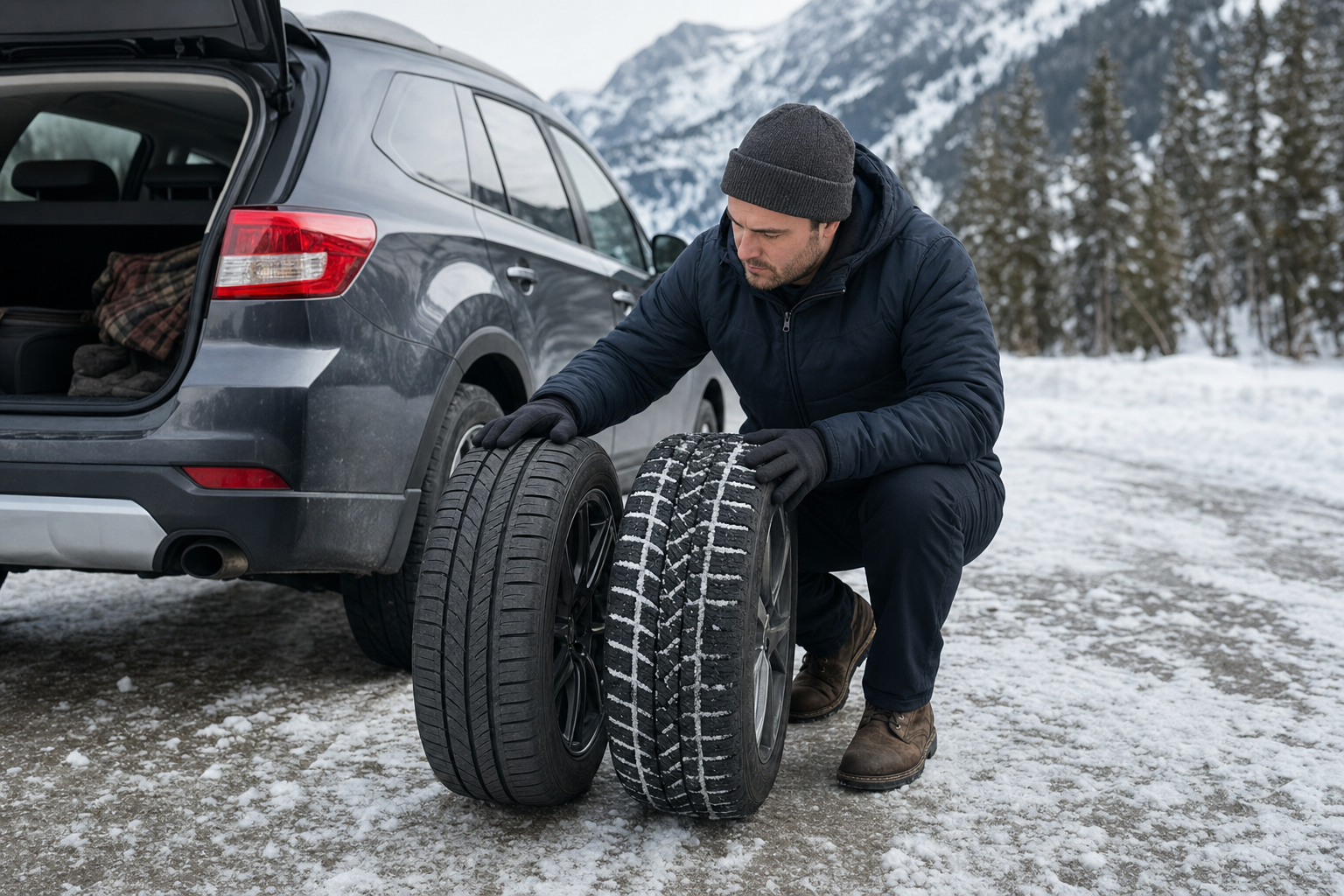
Choose all-weather tires if you want one year-round set, snowfall is occasional, roads are cleared reliably and you can postpone travel during severe storms. Choose dedicated winter tires if you regularly face ice, packed or deep snow, mountain roads or obligations that require you to drive during bad weather. Winter tires generally provide the greater safety margin in difficult conditions, while all-weather tires offer greater convenience.
How the two tire types perform in winter
All-weather tires are designed to remain on the vehicle throughout the year while offering more winter capability than conventional all-season tires. In United States retail usage, the term commonly describes year-round tires that carry the Three-Peak Mountain Snowflake symbol. However, naming conventions can vary, so check the sidewall and the manufacturer’s specifications rather than relying only on the words used in an advertisement. For a closer comparison with ordinary all-season tires, see whether all-weather tires are worth it compared with all-season tires.
Dedicated winter tires use tread patterns, biting edges and rubber compounds intended for low temperatures, snow and ice. Their specialization usually improves acceleration, braking and cornering when traction is scarce. The trade-off is that they are not intended to remain installed through warm weather, when they may wear faster and feel less responsive than a suitable year-round or summer tire.
| Condition | All-weather tires | Dedicated winter tires |
|---|---|---|
| Deep or packed snow | Capable, but normally offer less grip than winter tires | Usually the stronger choice |
| Ice | Provide some winter capability but remain limited | Usually offer a significant advantage, especially ice-focused models |
| Slush and wet snow | Often effective in mixed winter weather | Generally strong, although performance varies by model |
| Cold, dry pavement | Suitable for continued year-round use | Good cold-weather grip, but steering may feel softer |
| Cold rain | Can perform well, depending on the model | Performance varies considerably by design |
| Warm pavement | Designed to remain in service | Can wear quickly and respond less precisely |
A Tire Rack comparison published on May 4, 2026 tested all-season, all-weather and winter tires on a Toyota Camry using the common 215/55R17 size. Testing took place in near-freezing conditions and included snow, ice, wet-road performance and everyday road driving. The dedicated winter models generally had a clear advantage on snow and ice, while wet performance depended more heavily on the individual model.
That result illustrates the category-level trade-off, but it does not prove that every winter tire beats every all-weather tire in every measurement. Compare independent test results for the specific models and sizes you are considering. Noise, comfort, wet braking, steering response, tread life and fuel use can differ substantially within each category.
What the Three Peak Mountain Snowflake symbol proves
The Three-Peak Mountain Snowflake symbol, often abbreviated as 3PMSF, appears as a snowflake inside a three-peaked mountain. Under the current federal standard for light-vehicle radial tires, a qualifying snow tire must reach a required traction index in a standardized test conducted on medium-packed snow and display the Alpine symbol on at least one sidewall.
This makes the symbol more informative for snow use than an M+S marking, meaning mud and snow. An M+S designation is generally based on tread geometry rather than the same performance test. It should not be treated as proof that a tire will match a Three-Peak Mountain Snowflake tire in severe snow.
The symbol is still a qualification threshold rather than a complete winter-performance rating. It does not tell you which qualifying tire has the shortest ice-braking distance, the best slush resistance or the most predictable emergency handling. It also does not measure dry handling, road noise, fuel economy, warm-weather durability or tread life.
Both year-round all-weather tires and dedicated winter tires may carry the symbol. Therefore, its presence does not make the two categories equivalent. It confirms that a tire meets the applicable snow-traction requirement, while comparative testing can reveal how much additional capability a dedicated winter model provides.
Install four matching winter-capable tires rather than mixing categories between the front and rear axles. A major difference in available grip can make a vehicle less predictable during braking or cornering. The size, load index and speed rating should meet the vehicle manufacturer’s requirements unless the manufacturer specifically approves an alternative winter fitment.
Costs include storage changeovers and tire life
A single all-weather set creates the lowest logistical burden. You buy four tires, rotate them as directed and leave them installed all year. You avoid seasonal installation appointments, storage charges and the possibility of an early snowstorm arriving before your winter tires are fitted.
A dedicated winter setup requires a second set of tires and often a second set of wheels. Separate wheels increase the initial expense and may need compatible tire-pressure monitoring system sensors. However, they can simplify seasonal changes and avoid repeatedly mounting and removing tires from the same wheels. Ask a tire shop for a complete quote covering wheels, sensors, balancing, installation and any required sensor relearning.
- One all-weather set: Lower initial and recurring costs, but every mile is placed on the same four tires.
- Two sets: Higher initial cost and possible changeover fees, but annual mileage is divided between the sets.
- Storage: Unused tires need a cool, dry and clean location away from sunlight, heat and ozone-producing equipment.
- Age: Tires deteriorate even when tread remains. Some vehicle and tire manufacturers recommend replacement after six to ten years.
Winter tires can wear rapidly if left on during warm weather, so follow the tire manufacturer’s temperature or seasonal guidance. All-weather tires avoid seasonal removal, but they still need sufficient tread before winter begins. The National Highway Traffic Safety Administration says tires should be replaced when tread reaches 2/32 inch. That legal or safety minimum should not be treated as an ideal target for snow and slush, where deeper tread is valuable.
Check cold tire pressure at least monthly, including the spare if the vehicle has one. Use the pressure printed on the vehicle’s tire-information placard or specified in the owner’s manual, not the maximum pressure molded into the tire sidewall. Rotate the tires as directed and have unusual vibration, pressure loss or uneven wear investigated promptly.
Which option best fits your driving
| Driving situation | Usually the better fit | Why |
|---|---|---|
| Occasional light snow with flexible travel | All-weather tires | Useful winter preparation without seasonal changes |
| Snowy city with reliable plowing | Either option | Choose convenience or a larger winter safety margin |
| Regular mountain travel | Winter tires | Steep grades and rapidly changing conditions increase the value of maximum grip |
| Frequent ice or deep snow | Winter tires | Better suited to repeated low-traction driving |
| No practical storage space | All-weather tires | One capable set may be the realistic choice |
| Travel is unavoidable during storms | Winter tires | Additional snow and ice capability becomes more valuable |
All-wheel drive does not eliminate the need for appropriate tires. It can help a vehicle accelerate, but the tires still provide the grip needed to stop and turn. An all-wheel-drive vehicle on unsuitable tires may be less controllable than a two-wheel-drive vehicle equipped with quality winter tires.
Check the rules for every route you plan to use. As of September 2026, Colorado’s Passenger Vehicle Traction Law requires an all-wheel-drive or four-wheel-drive vehicle to have at least 3/16-inch tread and qualifying mud-and-snow, winter or manufacturer-rated all-weather tires. A vehicle that does not satisfy that combination must use chains or an approved alternative traction device. Under the more restrictive Passenger Vehicle Chain Law, every vehicle must use chains or an approved alternative traction device.
Qualifying tires alone are therefore not sufficient for every passenger vehicle under Colorado’s active Traction Law. Requirements also vary among states, roads and weather conditions, and legal compliance does not necessarily provide the best available winter performance. If mountain travel is planned, compare snow chains, cables and snow socks before the first storm.
If your winters are moderate, you can avoid driving in severe weather and you value year-round simplicity, begin by looking for vehicle-approved all-weather tires carrying the Three-Peak Mountain Snowflake symbol. If you regularly encounter ice, unplowed roads, mountain passes or unavoidable storm travel, budget for four dedicated winter tires and arrange installation before seasonal demand peaks.