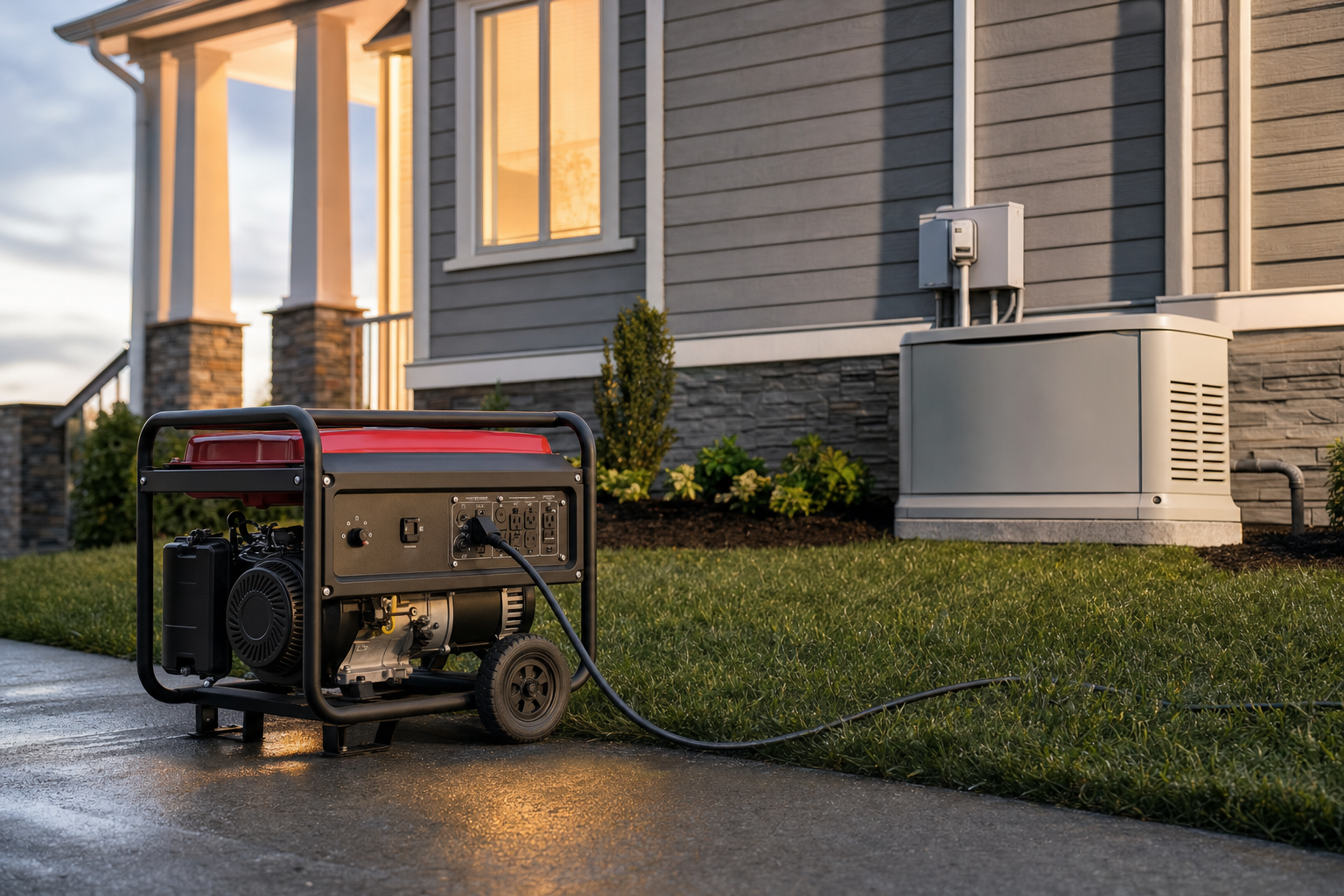
For most homeowners, a portable generator is the lower-cost option for running selected essentials during an outage, while a standby generator costs much more but starts automatically and can support more of the home. The better choice depends less on the label “whole-house” and more on your outage frequency, electrical loads, fuel plan, budget and ability to set up or refuel equipment safely.
How portable and standby generators compare
| Factor | Portable generator | Standby generator |
|---|---|---|
| Typical role | Selected appliances or essential circuits | Most or all household circuits, depending on sizing |
| Startup | Manual setup and starting | Automatic after a utility outage |
| Fuel | Usually gasoline, propane or both; some models can also use natural gas | Usually a permanent natural-gas connection or an onsite propane tank |
| Connection | Extension cords, or a professionally installed inlet and transfer arrangement | Professionally installed automatic transfer switch |
| Noise | Often louder and operated nearer to the home during use | Usually enclosed and quieter, but still audible outdoors |
| Storage | Secure, dry storage is needed between outages | Permanently installed outdoors |
| Upfront cost | Usually hundreds to a few thousand dollars, plus electrical work if needed | Usually several thousand dollars for equipment, plus substantial installation costs |
Capacity matters, but it should not be the only deciding factor. A large portable generator connected through an approved transfer system can run many essentials, such as a refrigerator, freezer, lights, furnace controls, a sump pump or a well pump. It can do so only when the combined running load and the temporary starting demand of motors remain within the generator’s rated limits.
A standby unit principally buys convenience, capacity and continuity. Its automatic transfer switch senses a qualifying utility outage, disconnects the home from the utility supply and transfers selected loads to generator power after the generator starts. This can be especially useful during overnight outages, when nobody is home, or when no one in the household can safely move a heavy generator and fuel containers.
“Whole-house” does not mean every electrical appliance will necessarily run at once. Central air conditioning, heat pumps, electric resistance heating, water heaters, ranges, clothes dryers and well pumps can create large loads or motor-starting surges. Ask a qualified installer for a load assessment and a clear explanation of whether the proposed system will cover all loads or use load-management controls.
What ownership looks like during an outage
With a portable generator, preparation is physical work. You must take the machine from storage, move it to a safe outdoor location, protect it from unsuitable weather without enclosing it, connect approved equipment and start it. During the outage, you need to monitor fuel, manage which appliances operate together, and shut the engine down and allow it to cool before refuelling.
Fuel planning can become difficult during a regional emergency. Gas stations may lose power or face delivery disruptions, and gasoline requires careful storage and rotation. Propane does not degrade in storage in the way gasoline can, which can make it useful for backup fuel. Dual-fuel generators offer flexibility, although their output and runtime can differ by fuel. The guide to choosing a dual-fuel or tri-fuel generator for home backup explains these trade-offs in more detail.
A standby generator removes most immediate setup. Many models run scheduled exercise cycles and can start without someone going outside. A natural-gas model avoids onsite refuelling while gas service remains available. A propane system can run from a large tank, but runtime still depends on tank size, generator load, outdoor temperature and the availability of fuel delivery.
Neither option is maintenance-free. A portable generator needs periodic test runs and maintenance specified in its manual, including oil and fuel-system care where applicable. An electric-start model also has a battery that needs attention. Standby systems need scheduled inspection and service, including oil and filter changes, battery checks and checks for fuel or oil leaks. Automatic operation is useful only when the generator, transfer equipment and fuel supply are ready.
Noise deserves practical consideration. Portable generators can be intrusive because they must operate outdoors and may be located relatively close to the home. Standby enclosures reduce sound but do not make the equipment silent. Before buying either type, check local noise rules, property-line restrictions, homeowners association requirements and whether the property has a safe operating or installation location.
Safe placement and electrical connection are essential
The U.S. Consumer Product Safety Commission says a portable generator must operate outdoors at least 20 feet from homes and buildings, with exhaust directed away from windows, doors and vents. Never run one in a garage, basement, crawlspace, shed, porch or other enclosed or partly enclosed area, even when doors or windows are open. Carbon-monoxide shutoff technology is worth considering, but it does not make unsafe placement safe.
Install working carbon-monoxide alarms on every level of the home and outside sleeping areas, following the alarm manufacturer’s instructions. If an alarm sounds, get everyone outside to fresh air immediately and call emergency services. Do not assume that a headache, nausea, dizziness or confusion during an outage is simply fatigue; these can be signs of carbon-monoxide poisoning.
Do not plug a generator into a household wall outlet or improvise a connection to the electrical panel. That can backfeed electricity onto utility lines, endangering line workers and damaging equipment. If you want a portable generator to power hardwired equipment such as a well pump, furnace or selected circuits, ask a qualified electrician about a code-compliant inlet and transfer switch or other approved transfer equipment. This article intentionally does not provide wiring instructions.
Standby generators also require professional installation. The work may involve permits, electrical work, a transfer switch, gas or propane piping, a stable base and compliance with local codes and the manufacturer’s required clearances. Do not rely on a generic clearance measurement: the applicable spacing can vary by generator model, its listing, nearby openings and local rules.
Plan loads before an outage rather than guessing in the dark. List essential equipment, note its running and starting requirements, and decide what can stay off. Ready.gov recommends planning for individual needs, including electrically powered medical equipment and refrigerated medicines. If food safety is your main concern, review how long food stays safe in a fridge without power before choosing backup capacity.
Which generator fits your outage profile
Occasional short outages
A portable generator can be a sensible choice when outages are uncommon, normally last hours rather than days, and an able adult will be available to deploy it. It is often good value when the priority is refrigeration, lights, device charging, a sump pump or limited heating-system support. A portable power station is another option for quiet indoor use with modest loads; compare a portable power station vs generator for winter outages.
Frequent multi-day outages
A standby generator becomes easier to justify when storms regularly cause long outages. Automatic starting, a fixed fuel connection and greater capacity reduce repeated setup and refuelling work. A large portable generator can still be economical, but calculate the fuel required, where it can be stored legally and safely, and who will operate and refuel the machine in poor weather.
Homes with wells or electric-dependent heating
Get a professional load assessment before selecting either type. Well pumps, sump pumps, furnace blowers, boiler controls, heat pumps and electric resistance heating have very different requirements. A large portable generator may cover carefully selected essentials, while homes dependent on several high-demand systems may benefit from standby capacity and automatic load management. Keep a backup heating and water plan because any generator can fail or run out of fuel.
Households unable to deploy a portable generator
A standby generator may be the more practical option for people with limited mobility, frequent travellers and households dependent on powered medical equipment. Automatic startup can matter more than maximum wattage in these situations. Even so, households that rely on medical devices should maintain a device-specific emergency plan and contact the device supplier or healthcare team for backup-power guidance.
For equipment alone, Consumer Reports lists portable generators broadly from $400 to $2,700 and home standby generators from $3,500 to $6,000. Installation changes the comparison sharply: standby-generator installation can add several thousand dollars and may exceed $10,000 on complicated sites. Panel upgrades, permits, gas-meter capacity, trenching, propane tanks and site access can all change local quotes.
Compare total ownership cost rather than generator price alone. Include the electrical connection, fuel storage or gas work, permits, maintenance, replacement batteries, fuel consumed during long outages and the value of automatic operation. Obtain at least three itemised local quotes for a standby system, or an electrician’s quote for a portable-generator connection, before deciding whether the added convenience justifies the cost.
Sources
- U.S. Consumer Product Safety Commission generator safety guidance
- Occupational Safety and Health Administration portable generator safety guidance
- Ready.gov emergency preparedness information for power outages
- Consumer Reports portable and standby generator comparison
- Generac standby generator clearance requirements