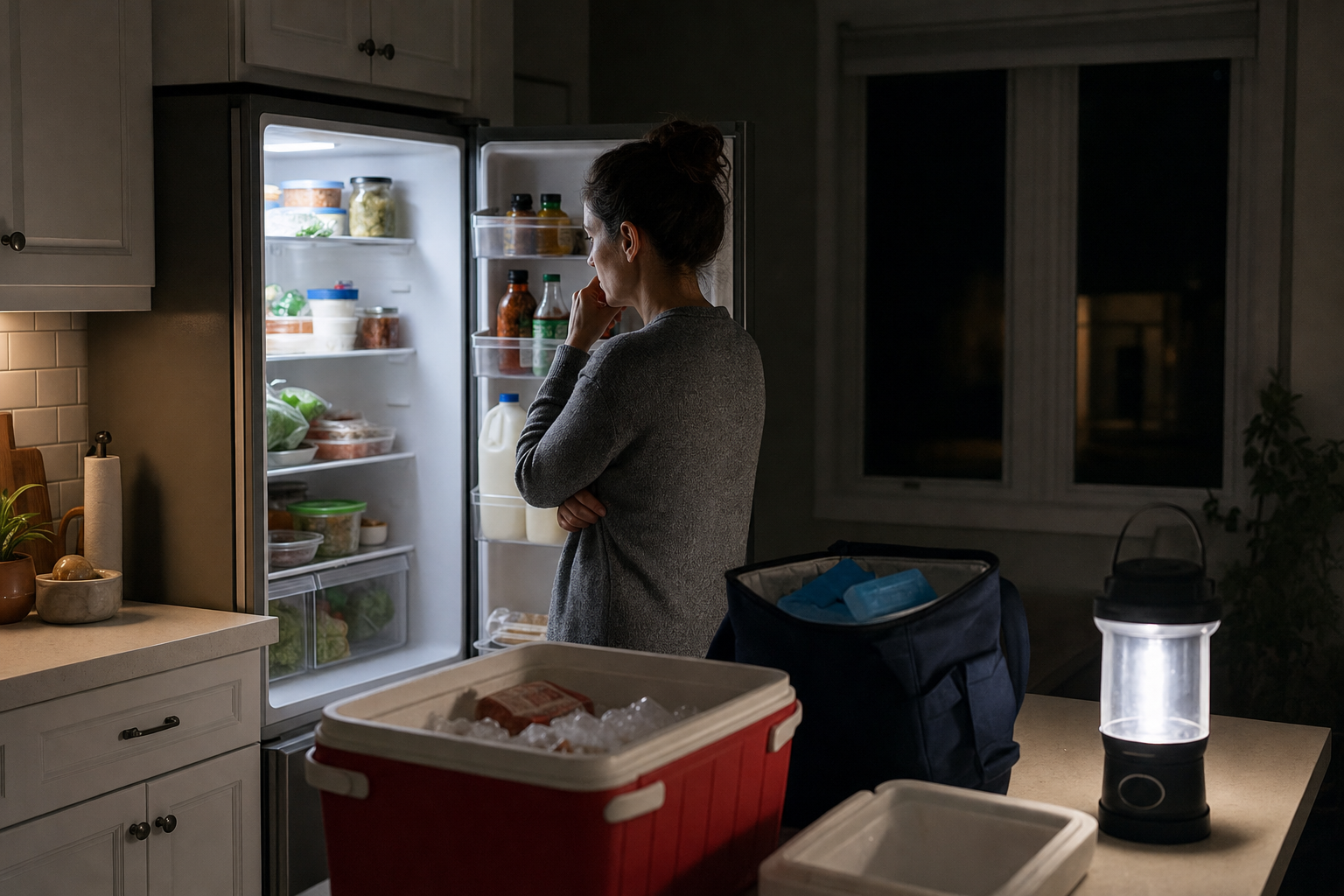
An unopened refrigerator generally keeps perishable food safe for up to four hours during a power outage. A closed full freezer can hold a safe temperature for about 48 hours, while a half-full freezer lasts about 24 hours. After those periods, check temperatures and ice crystals rather than relying on smell, appearance or taste. Never taste questionable food to test whether it is safe.
These estimates assume the appliances were cold before the outage and their doors remained closed. Frequent door opening, a warm room or an appliance that was already too warm can shorten the safe period. Refrigerators should normally be kept at 40°F (4°C) or below, and freezers at 0°F (-18°C) or below.
Apply the four hour rule and the hot weather exception
The four-hour refrigerator rule is the simplest starting point. If the power has been off for no more than four hours and the refrigerator door stayed closed, refrigerated food is generally safe. If the outage reaches four hours, move perishable food to a cooler with enough ice or frozen gel packs to maintain a temperature of 40°F or below.
| Situation | Recommended action |
|---|---|
| Closed refrigerator without power for four hours or less | Food is generally safe if the appliance was properly cold before the outage. |
| Refrigerator without power for more than four hours | Discard vulnerable perishables unless you can establish that they stayed at a safe temperature. |
| Perishable food above 40°F for more than two hours | Discard it unless the federal food-safety chart specifically identifies the item as safe to keep. |
| Perishable food exposed to temperatures above 90°F (32°C) for more than one hour | Discard it. The one-hour limit replaces the usual two-hour limit in hot conditions. |
| Closed full freezer without power for about 48 hours | Check individual packages when power returns. |
| Closed half-full freezer without power for about 24 hours | Check individual packages when power returns. |
| Frozen food still containing ice crystals or measuring 40°F or below | It can generally be cooked or refrozen, although its quality may decline. |
The one-hour hot-weather limit is especially important when food has been removed from the refrigerator, placed in a warm vehicle or left in a room that is above 90°F. Do not automatically assume that the unopened refrigerator’s four-hour protection applies once food is outside the appliance or exposed directly to high heat.
Cooking does not reliably rescue food that has been too warm for too long. Some microorganisms can produce toxins that may remain after cooking. Food can also contain harmful organisms while looking and smelling normal, so the absence of spoilage is not evidence that it is safe.
Which refrigerated and frozen foods to discard
If refrigerated food has been above 40°F for more than two hours, or more than one hour in temperatures above 90°F, use the federal food-safety chart to evaluate it. When the temperature history is unavailable after an outage exceeding four hours, take a conservative approach with vulnerable perishables.
- Discard meat and seafood: This includes raw or cooked meat, poultry, fish, seafood, deli meat, bacon, sausage, hot dogs, meat salads, gravy, stuffing, broth and opened canned meat or fish.
- Discard most dairy and egg products: Milk, cream, yogurt, sour cream, buttermilk, soft cheese, shredded cheese, shell eggs, cooked eggs, liquid egg products, custards, puddings and quiche should be discarded. Butter, margarine, hard cheese and processed cheese can generally be kept.
- Discard prepared food: Throw away leftovers, soups, stews, casseroles, pizza, cooked rice, cooked pasta, cooked potatoes, fresh pasta and refrigerated meal salads when they have been warm beyond the safe limit.
- Separate whole produce from cut produce: Whole, uncut fruit and vegetables can generally be kept. Discard cut fruit, cut vegetables, packaged pre-washed greens, cooked vegetables, baked potatoes and opened vegetable juice.
- Check condiments individually: Peanut butter, jelly, mustard, ketchup, relish, pickles, olives, soy sauce, barbecue sauce and vinegar-based dressings can generally be kept. Discard creamy dressings, opened pasta sauce, fish sauce and oyster sauce. Opened mayonnaise, tartar sauce and horseradish should be discarded if held above 50°F (10°C) for more than eight hours.
- Keep many bread and pantry items: Bread, rolls, muffins, plain cakes, tortillas, flour, cornmeal and nuts do not require the same treatment as meat, dairy, eggs and leftovers.
For frozen food, inspect each package. Meat, seafood, egg products, casseroles and prepared meals that still contain ice crystals or measure 40°F or below may generally be cooked or refrozen. Refreezing may affect flavor and texture, but it does not by itself make qualifying food unsafe.
Discard thawed ice cream and frozen yogurt even if some ice crystals remain. Frozen meat, seafood, prepared meals and foods with custard or cheese fillings should be discarded when they have been above 40°F for more than two hours, or beyond the one-hour limit in temperatures above 90°F. Frozen fruit, bread, plain cakes, pie crusts, flour and nuts are less vulnerable and can generally be refrozen, although their quality may suffer.
What to do when the outage duration is unknown
If you do not know when the power failed, check appliance and food temperatures immediately. A thermometer reading taken while the power is still off may provide useful evidence. However, if power has already returned, a refrigerator that now reads 40°F or below does not prove that its contents remained cold throughout the outage. Food may have warmed and then cooled again.
- Establish whether power has returned. If the appliance is already cooling again, do not treat its current air temperature as a complete record of the outage.
- Look for reliable evidence. Use outage notifications, appliance thermometers with maximum-temperature memory, smart-home records or a known outage start time. A single later reading is not enough to reconstruct an unknown temperature history.
- Discard uncertain refrigerated perishables. If you cannot establish that meat, seafood, milk, eggs, leftovers, cut produce and similar foods stayed within safe time and temperature limits, throw them away.
- Inspect frozen packages individually. Food that still contains ice crystals or measures 40°F or below can generally be cooked or refrozen. Follow the special rule for ice cream and frozen yogurt, which should be discarded after thawing.
- Keep foods that do not require continuous refrigeration. Items such as butter, hard cheese, whole produce, bread, peanut butter, mustard, pickles, flour and nuts may still be usable if they have not been contaminated.
Do not wait for an appliance to become cold again before sorting its contents. Waiting can erase useful clues by cooling food that was previously too warm. When no reliable timing or temperature information exists, discarding vulnerable perishables is safer than trying to judge them by touch or smell.
How to protect food during a longer outage
Keep refrigerator and freezer doors closed as much as possible. Decide what you need before opening a door, remove everything in one quick trip and close it firmly. Every unnecessary opening allows cold air to escape.
- Record the start time. Make a note on your phone or paper as soon as the outage begins.
- Use appliance thermometers. Keep one thermometer in the refrigerator and another in the freezer before an emergency occurs.
- Prepare a cooler. At the four-hour point, move refrigerated perishables to a cooler with ice or frozen gel packs. Use a thermometer to confirm that the cooler remains at 40°F or below.
- Group frozen packages together. Closely packed food retains cold longer. Frozen water containers or gel packs can fill empty freezer space.
- Handle dry ice carefully. Wear insulated gloves, provide ventilation and follow the supplier’s directions. Never touch dry ice with bare skin or seal it in an airtight container.
Do not place perishable food outdoors simply because the weather feels cold. Temperatures can fluctuate, sunlight can warm food, and animals or dirty water may contaminate it. Use a properly packed cooler instead.
If flooding accompanied the outage, discard food that contacted floodwater unless it is in an undamaged, commercially sealed all-metal can or suitable retort pouch that can be cleaned and sanitized correctly. Containers with screw caps, snap lids, pull tops or crimped caps are not waterproof. Whole produce exposed to floodwater should also be discarded.
Households that experience frequent winter outages may benefit from backup electricity for refrigeration and other essential equipment. Our guide to portable power stations and generators for winter outages explains the practical differences.