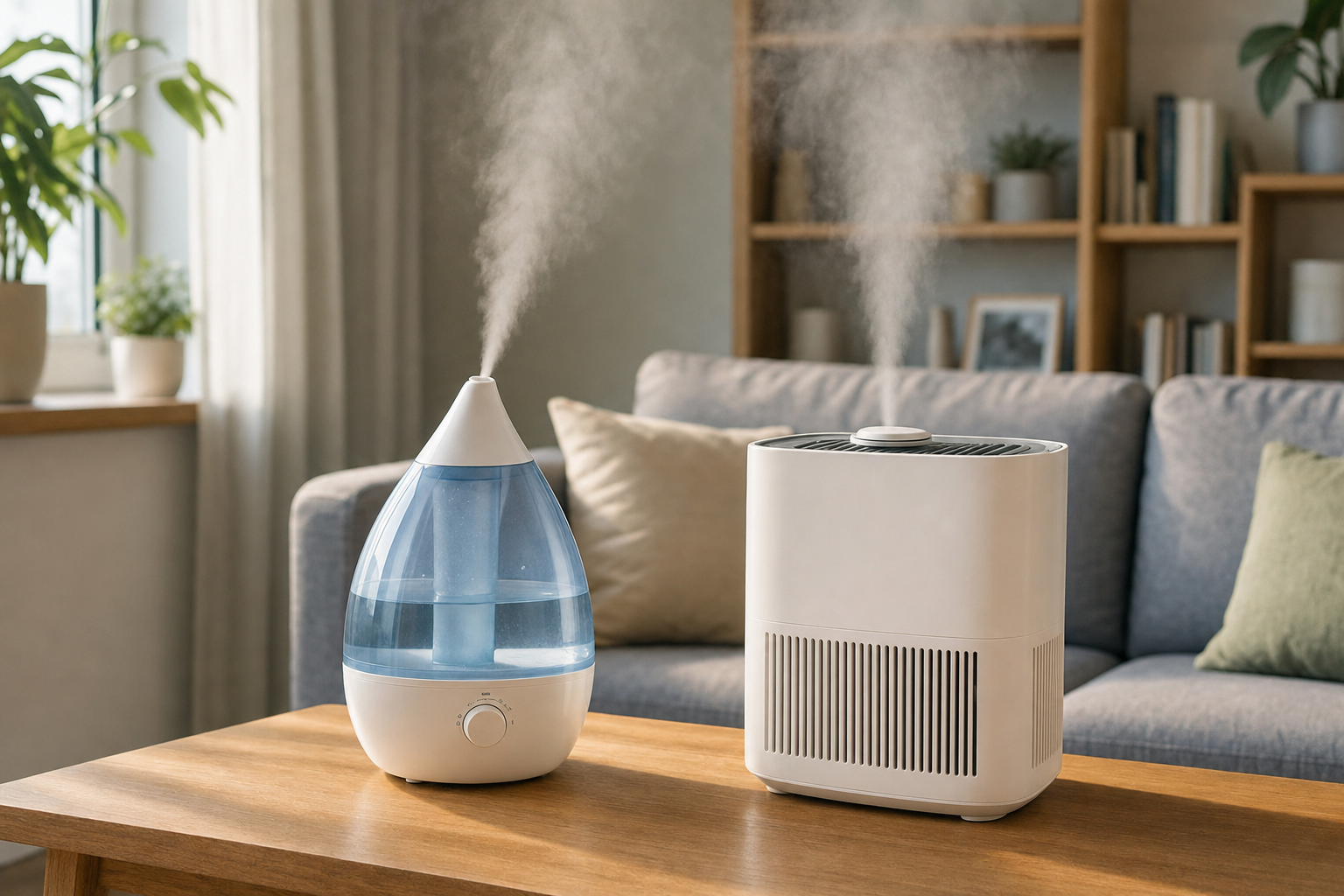
For most shoppers, the choice comes down to noise, water quality and maintenance. Choose an ultrasonic humidifier if quiet operation matters most and you are prepared to use distilled or other low-mineral water. Choose an evaporative humidifier if you want to use tap water while reducing the chance of airborne mineral dust, provided you can accept fan noise and the cost of replacement wicks. Neither type is maintenance-free: both need regular emptying, drying and cleaning.
Ultrasonic and evaporative humidifiers at a glance
| Buying consideration | Ultrasonic | Evaporative |
|---|---|---|
| How it works | Ultrasonic vibrations turn water into a visible cool mist | A fan moves air through a wet wick or filter, releasing invisible water vapor |
| Hard tap water | Can create scale and airborne white mineral dust | Generally does not disperse substantial mineral dust, but minerals shorten wick life |
| Bedroom noise | Usually quieter, though some models have a small fan and may gurgle | Fan creates continuous airflow noise |
| Room distribution | Mist direction and placement matter | The fan helps circulate humidified air |
| Humidity control | Can raise humidity quickly; use a humidistat or hygrometer | Evaporation slows as room humidity rises, but humidity still needs monitoring |
| Routine cleaning | Tank, base, mist outlet and ultrasonic transducer area | Tank, base, wick holder and air-intake area |
| Recurring purchases | Distilled water or manufacturer-approved demineralization cartridges, if applicable | Replacement wicks or filters |
| Best fit | Quiet rooms and households willing to manage water minerals | Hard-water areas and shoppers concerned about white dust |
How the two cool mist technologies work
An ultrasonic humidifier uses a rapidly vibrating component to create tiny water droplets. These droplets leave the machine as a visible plume. Because the design does not rely on the larger fan used in an evaporative humidifier, ultrasonic models are often the quieter choice for bedrooms, nurseries and home offices.
The tradeoff is water quality. The U.S. Environmental Protection Agency says ultrasonic humidifiers can disperse minerals and microorganisms from their water tanks into indoor air. Minerals from tap water may settle on furniture, electronics and other surfaces as white dust, and they can also create scale inside the machine. Distilled water is the most reliable option for reducing minerals. Water labelled spring, artesian or mineral water is not a substitute, because it has not necessarily been demineralized.
An evaporative humidifier draws water into an absorbent wick, belt or filter. A fan pulls dry room air through the wet material and releases invisible water vapor. The Environmental Protection Agency says evaporative humidifiers are not expected to disperse substantial amounts of minerals into the air. Instead, minerals largely remain in the wick or the unit.
That makes evaporative technology useful in hard-water areas, but it does not remove mineral maintenance. Deposits can make a wick stiff or reduce its ability to absorb water, so replacement is part of normal ownership. Some manufacturer instructions also warn that sodium in chemically softened water can harden wicks. A water softener is not the same as distillation or demineralization.
If you are unsure what your local water means for an ultrasonic machine, see whether you can use tap water in a humidifier.
Match the humidifier to your room and routine
For a quiet bedroom
Ultrasonic is usually the better starting point for light sleepers. Look beyond claims such as “sleep mode,” however. Check whether the display and indicator lights can be switched off. Filling, dripping and occasional gurgling may still be audible, and some ultrasonic models use a small circulation fan.
An evaporative model can still suit a bedroom if you like steady background fan noise or plan to run it on a low setting. Lower fan speeds usually reduce moisture output, so it may take longer to change the humidity in a dry room.
For room coverage
Treat a manufacturer’s room-size claim as a comparison tool rather than a guarantee. Performance depends on moisture output, ceiling height, air movement, open doors, outdoor conditions and the room’s starting humidity. An evaporative unit’s fan can help distribute moisture, while an ultrasonic mist plume needs careful placement so it does not settle on a wall, bed, wood surface or electronic device.
Do not choose an oversized unit only to avoid refilling it. Either technology can make a closed room too humid. The Environmental Protection Agency advises keeping indoor relative humidity at no more than 50%. The U.S. Consumer Product Safety Commission advises a range of 30% to 50% where possible. Use a separate hygrometer to check the room, even if the humidifier has a built-in humidity sensor. If you see condensation on windows, walls or nearby surfaces, lower the setting, reduce use or move the unit.
For seasonal guidance, read what indoor humidity should be in winter.
For easier cleaning
Neither technology wins automatically. An ultrasonic model avoids disposable wicks, but its tank, base, mist channel and transducer area can collect film or scale. An evaporative machine adds a wick holder and air-intake area to the cleaning list, and its wick may need replacing rather than washing.
Prioritize access over a long feature list. A wide tank opening, a smooth base and removable components are more useful than a narrow tank that cannot be reached with a cloth or brush. Read the manual before putting any part in a dishwasher or using vinegar, bleach, hydrogen peroxide or another cleaner.
The Environmental Protection Agency recommends emptying portable humidifier tanks, wiping surfaces dry and refilling with fresh water daily. It also recommends cleaning portable humidifiers every third day. Unplug the unit first, follow the manufacturer’s instructions for cleaning products and rinse thoroughly before use. Before the heating season, use this guide to clean a humidifier after storage.
Calculate ownership cost and check useful features
Do not assume that a filter-free ultrasonic model is always cheaper, or that an evaporative model always saves money because it can use tap water. Your total cost depends on water use, local distilled-water prices, wick life, electricity use and how many months you run the machine.
- Measure water consumption. Track how many gallons the unit uses over several representative days. Tank capacity is not the same as daily consumption unless you empty a full tank every day.
- Calculate ultrasonic water cost. Multiply gallons used per day by operating days and the local price per gallon of distilled water. Add any manufacturer-approved demineralization cartridges.
- Calculate evaporative wick cost. Divide operating days by the expected wick life, round up and multiply by the cost per replacement set. Check how many wicks the machine uses and whether an initial set is included.
- Compare electricity if needed. Multiply wattage by daily operating hours and operating days, divide by 1,000 and multiply by your electricity price per kilowatt-hour.
Wick life is not fixed. For example, Vornado advises replacing certain evaporative humidifier wicks every four to eight weeks, depending on use. Water hardness and operating conditions can shorten that interval. Use the manual for the exact model you are considering, and check the availability and price of its replacement wick before buying.
Finish your comparison with this checklist:
- Humidistat: Adjusts or stops output around a chosen humidity level. Confirm that it controls operation rather than simply displaying humidity.
- Automatic shutoff: Stops operation when water is depleted or a tank is removed.
- Easy-to-clean tank: Look for a wide opening, smooth interior and access to all water-contact surfaces.
- Adjustable output: Multiple mist or fan settings make it easier to match the room.
- Dark sleep mode: Turns off bright displays as well as reducing noise where possible.
- Available replacement wicks: Check the model number, pack quantity and availability before buying an evaporative unit.
- Practical refill design: Make sure a filled tank is easy to carry, or choose a top-fill model that can be refilled in place without splashing.
Choose ultrasonic if low noise outweighs the inconvenience and ongoing expense of low-mineral water. Choose evaporative if avoiding airborne mineral dust matters more than fan noise and wick replacements. In either case, allow time for cleaning and monitor indoor humidity rather than treating those tasks as optional extras.