To clean a humidifier after storage, keep it unplugged while you inspect it, discard used filters or cartridges, remove mineral scale, disinfect only as the manufacturer directs or as the Environmental Protection Agency advises, rinse every water-contact surface thoroughly and let all parts dry before reassembly. Do not simply fill a stored unit and switch it on: residue, trapped moisture, damaged seals or an old wick can make it leak, smell or perform poorly.
This guide covers portable ultrasonic, evaporative and warm-mist room humidifiers. It does not apply to furnace-mounted humidifiers or continuous positive airway pressure humidifiers, which have different maintenance instructions.
Inspect the stored humidifier before cleaning
Find the model number and locate the exact owner’s manual before taking the humidifier apart. Parts that look washable may contain electronics, special coatings or openings that must remain dry. The manual determines whether vinegar, hydrogen peroxide, diluted bleach or another product is permitted, and which parts, if any, can go in a dishwasher.
Place the unplugged humidifier on a waterproof counter and work through this inspection:
- Power cord and plug: Fully extend the cord and look for cuts, crushed areas, exposed wire, discoloration or damaged prongs. Do not use the humidifier if the cord or plug is damaged. Have it repaired with the proper replacement part by a qualified repair service.
- Tank: Check for cracks, distorted plastic, stubborn odours, cloudy films and growth around corners or seams. Replace a cracked tank rather than trying to patch it.
- Cap and seals: Confirm that the cap threads correctly and that each rubber gasket, valve and seal is present, flexible and seated properly. A missing, twisted or hardened seal can cause leaking or overflow.
- Base and reservoir: Look for white or brown scale, slippery film, dust, insects, corrosion and visible mould. Examine narrow channels, floats and water valves without forcing delicate pieces.
- Working components: Inspect an ultrasonic humidifier’s nebulizer for hardened deposits, an evaporative unit’s fan intake for dust and a warm-mist heating element for crusty scale.
A small amount of accessible surface residue can normally be cleaned according to the manual. Do not use a humidifier if corrosion affects electrical areas, if plastic is badly degraded, or if mould or residue remains in inaccessible passages that cannot be cleaned as directed. Consider replacement if suitable parts are unavailable.
Use this recommissioning cleaning checklist
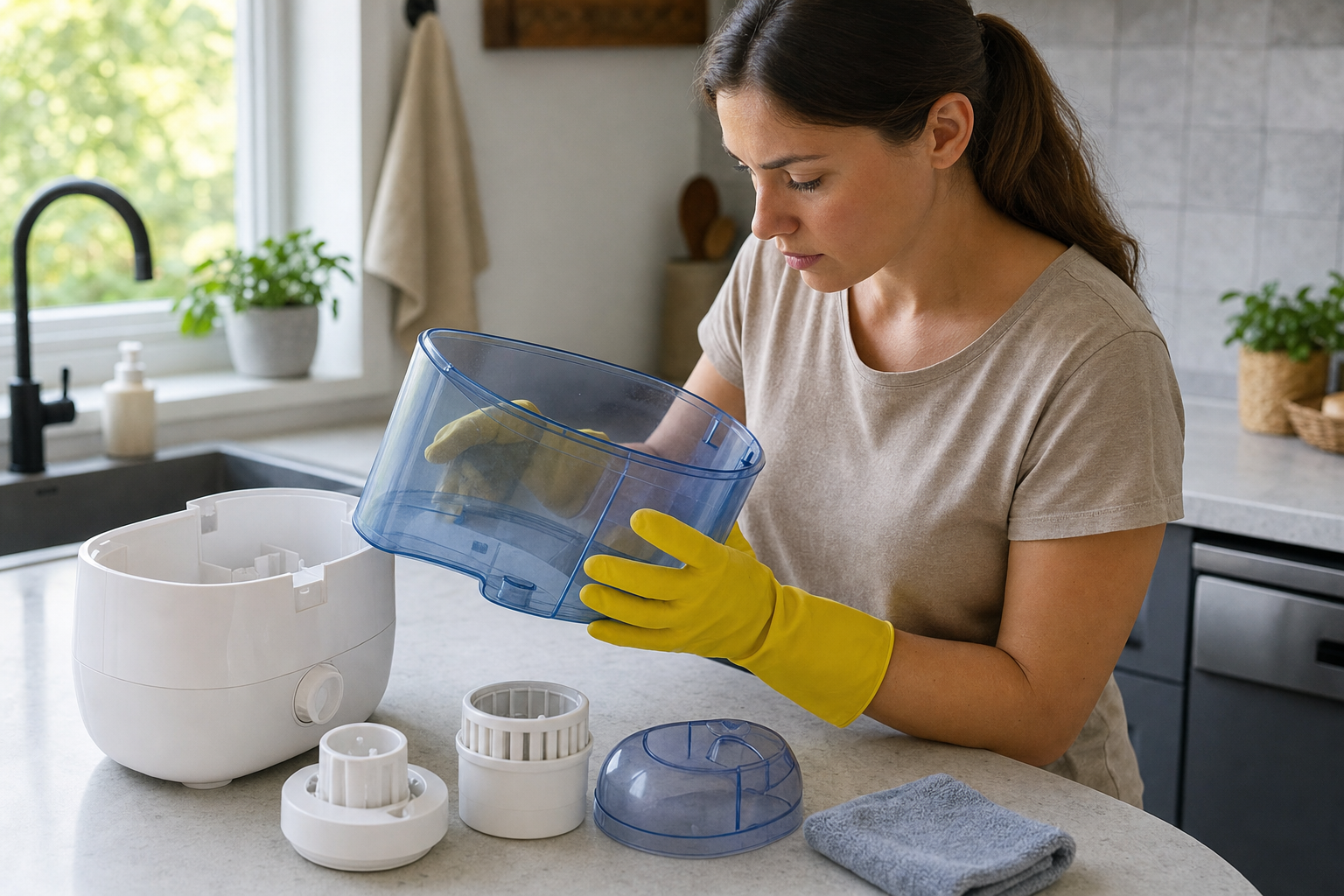
- Unplug and disassemble the unit. Remove the tank, cap, mist outlet, tray, float and other user-removable pieces shown in the manual. Wipe storage dust from the exterior. Never immerse the electrical base, motor, cord, plug or control panel.
- Discard old consumable parts. The Environmental Protection Agency advises disposing of used demineralization cartridges, cassettes and filters before storage. If one was left in the humidifier, replace it now with the correct model-specific part unless the manual explicitly identifies it as washable and reusable.
- Wash permitted removable pieces. Use the method specified by the manufacturer. Do not assume that a tank, cap or tray is dishwasher-safe. Avoid abrasive pads that could scratch plastic or damage a heating element, nebulizer or protective finish.
- Remove mineral scale. Descaling dissolves the hard deposits left by minerals in water. Many manufacturers specify distilled white vinegar for this job, but the amount, soaking time and components that may be treated vary by model. Never run the humidifier while it contains a descaling solution unless the manual expressly instructs you to do so.
- Empty and rinse after descaling. Rinse treated surfaces until loosened deposits and vinegar odour are gone. Keep water away from vents, switches and openings leading into the electrical section.
- Disinfect separately when needed. Disinfection is not the same as descaling. Follow the manual’s exact disinfectant, dilution, contact time and component instructions. When the manufacturer gives no cleaning-product recommendation, the Environmental Protection Agency advises cleaning water-contact surfaces with a three percent hydrogen peroxide solution.
- Rinse thoroughly. Cleaning or disinfecting chemicals left in a humidifier can be dispersed into the room during use. Where appropriate, rinse the tank with several changes of clean water, until there is no chemical smell, foam or visible residue.
- Air-dry the parts. Drain them, wipe accessible surfaces and leave everything open until dry. The Centers for Disease Control and Prevention advises letting portable humidifiers air-dry after cleaning.
Never mix cleaning chemicals. Do not combine vinegar or another acid with chlorine bleach, and do not mix bleach with other cleaners or disinfectants. Complete one process, discard the liquid and rinse thoroughly before beginning another. Use products at the concentration specified by the manufacturer or product label; stronger solutions can damage the humidifier and leave difficult-to-rinse residue.
Adjust the process for your humidifier type
| Humidifier type | Parts needing attention | Storage restart priorities |
|---|---|---|
| Ultrasonic | Nebulizer, reservoir, float, mist channel and optional demineralization cartridge | Use a soft cloth or supplied brush on the fragile nebulizer. Replace an old cartridge and keep water out of fan or control openings. |
| Evaporative | Wicking filter, reservoir, float and fan intake | Install a new wick of the correct size when the old one was used before storage. Do not soak the wick in vinegar, bleach or another cleaner unless its instructions specifically allow it. |
| Warm mist | Heating element, heating chamber, tray, chimney and tank | Make sure the unit is unplugged and completely cool. Descale the heating element gently, and never rinse a partly enclosed electrical heating assembly under running water unless the manual permits it. |
Ultrasonic models can lose mist output when minerals coat the vibrating nebulizer. They can also disperse minerals from water into the room as white dust, so water choice is particularly important. See whether you can use tap water in a humidifier before selecting water for the season.
Evaporative humidifiers pull air through a wet wick. A used wick that is hard, discoloured, musty or misshapen should be replaced rather than treated with household chemicals unless its manufacturer specifically says otherwise. If you are deciding whether the ongoing filter maintenance suits you, compare the practical differences between evaporative and ultrasonic humidifiers.
Warm-mist models collect scale around their heating chambers. Let a recently operated unit cool before touching internal parts, and keep it beyond the reach of children and pets because hot water and steam can cause burns.
Reassemble carefully and start an in-season routine
When every part is clean and dry, reinstall floats, seals, caps, trays and mist channels in the order shown in the manual. Fit a new wick, filter or cartridge where required. Make sure tank valves move freely and seals have not twisted out of position.
Fill the tank with the recommended water, set the unit on a firm, level, waterproof surface and check for drips before plugging it in. Run it initially while you are nearby. Stop immediately if water reaches the cord or controls, the unit leaks, produces an electrical or persistent musty smell, makes unusual noises or fails to operate normally.
Once the humidifier is back in service, use this basic schedule unless its manufacturer requires more frequent care:
- Empty standing water daily, wipe accessible wet surfaces dry and refill with fresh water.
- Clean the portable humidifier at least every third day, following Environmental Protection Agency guidance and the model’s instructions.
- Let cleaned parts air-dry rather than closing the empty unit while it is damp.
- Inspect the wick or cartridge regularly and replace it according to its condition, water quality and the manufacturer’s interval.
- Reduce output if nearby surfaces become damp or condensation appears.
Do not let indoor relative humidity exceed 50 percent, and use a hygrometer rather than relying on how the room feels. If water condenses on windows, walls or nearby surfaces, lower the setting, move the humidifier or use it less often. For a more detailed seasonal target, see what indoor humidity should be in winter in a U.S. home. If the recommissioned unit cannot remain clean, dry and leak-free, replace it before winter use rather than operating a questionable appliance.
Sources
- United States Environmental Protection Agency: Use and Care of Home Humidifiers
- Centers for Disease Control and Prevention: Preventing Waterborne Germs at Home
- Centers for Disease Control and Prevention: Cleaning and Disinfecting with Bleach
- United States Consumer Product Safety Commission: Guide to Home Wiring Hazards