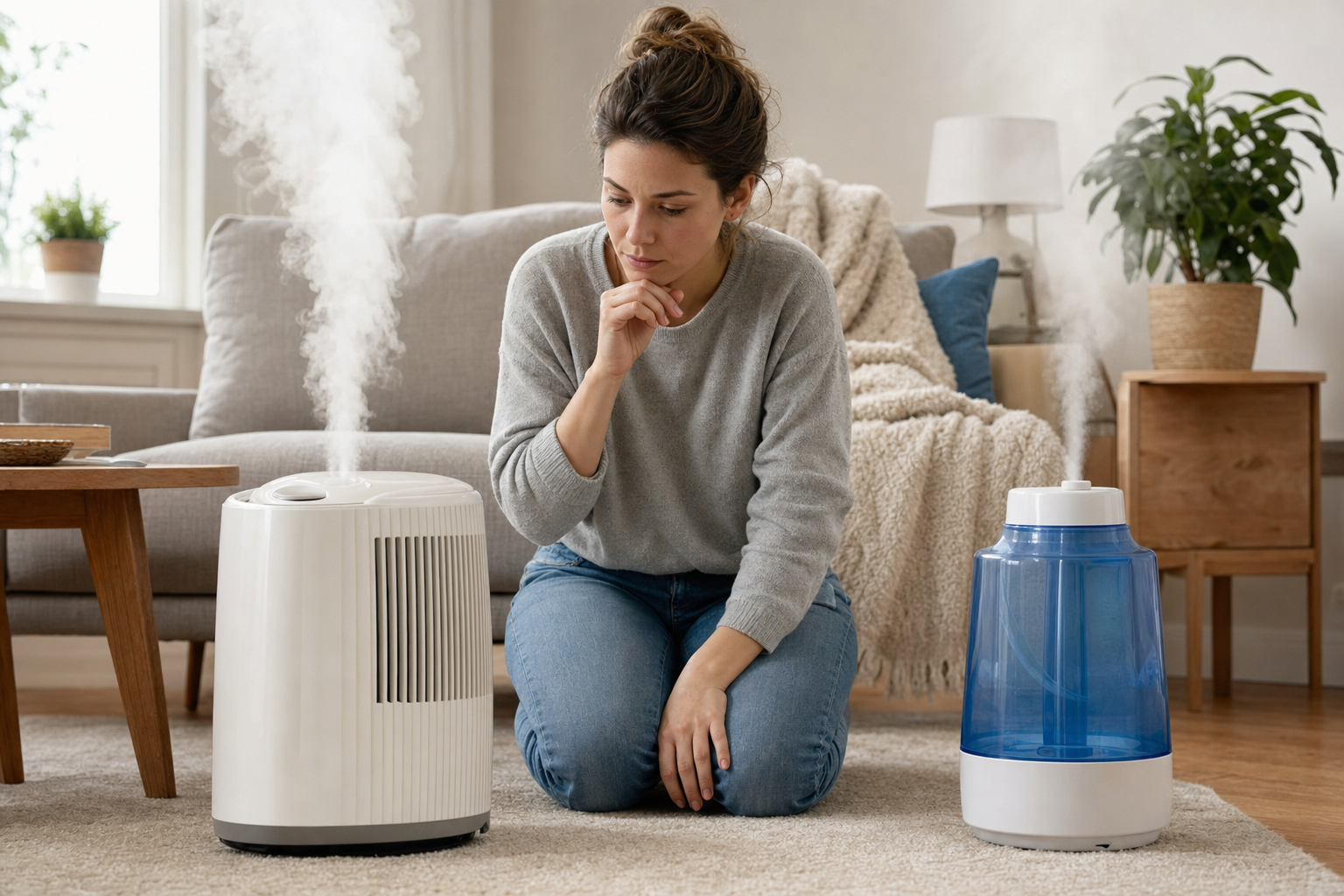
For most homes with hard tap water, an evaporative humidifier is the more practical choice because it is not expected to disperse substantial amounts of minerals into the air and can usually be filled with tap water. An ultrasonic humidifier is often the better choice for a quiet bedroom or office, but its filter-free design may replace wick purchases with the cost and effort of using distilled or other low-mineral water. In an evaporative vs ultrasonic humidifier comparison, the best option depends mainly on your water, tolerance for fan noise and willingness to manage recurring supplies.
How the two cool mist technologies differ
An evaporative humidifier draws water into a porous wick, filter or belt. A fan blows room air through the wet material, allowing water to evaporate into the room. The added moisture is normally invisible. Minerals largely remain in the reservoir and wick rather than being released with the moisture.
An ultrasonic humidifier uses high-frequency vibrations to create a fine cool mist from the water in its tank. The visible plume is not steam: the water is not boiled. Many ultrasonic models do not use a large fan, so they are usually quieter than fan-driven evaporative models.
Ultrasonic humidifiers can also disperse minerals and microorganisms from their tank water. With mineral-rich tap water, the droplets can dry into fine white dust on furniture, electronics and other surfaces. The U.S. Environmental Protection Agency says ultrasonic humidifiers efficiently disperse minerals in tap water, while evaporative humidifiers are not expected to disperse substantial amounts of minerals.
Both types hold standing water and need regular cleaning. A filter-free humidifier still needs cleaning, fresh water and careful drying between uses.
Quick decision table
| Buying factor | Evaporative | Ultrasonic |
|---|---|---|
| Hard tap water | Usually the easier fit | Use distilled or other low-mineral water where possible |
| White mineral dust | Much lower risk | Possible when water contains minerals |
| Bedroom noise | Fan noise is audible, especially on higher settings | Usually quieter |
| Recurring supplies | Replacement wick or filter | Distilled water or a compatible demineralization cartridge may be needed |
| Cleaning | Tank, base and wick need regular attention | Tank, base and mist-producing parts need regular attention |
| Room size | Available as small units and higher-output consoles | Available in small and higher-output models |
| Electricity use | Compare the listed wattage and fan settings | Often uses less power, but compare the listed wattage |
| Best reason to buy | Tap-water convenience and less mineral dust | Quiet operation and no standard wick |
Compare the ownership cost and cleaning work
Evaporative models have an obvious consumable: the wick. As water evaporates, minerals accumulate in it, eventually reducing airflow and moisture output. The replacement interval varies with water hardness, frequency of use and model design. Check the manual rather than assuming that one wick will last an entire heating season.
Before buying, identify the exact replacement-wick model and confirm that it is readily available. Estimate the seasonal cost from the price of replacement wicks and the manufacturer’s recommended change interval. Proprietary wicks can make an inexpensive humidifier less convenient to own if replacements are costly or difficult to find.
Ultrasonic machines are commonly sold as filter-free, but that does not guarantee zero supply costs. The Environmental Protection Agency recommends water with low mineral content for ultrasonic humidifiers to reduce scale and mineral dispersion. In a hard-water area, that may mean buying distilled water or using a demineralization cartridge specifically supplied or recommended for the model.
Spring, artesian and mineral water are not substitutes for distilled water because they have not been treated to remove mineral content. Reverse-osmosis or deionized water can also remove most minerals, although the Environmental Protection Agency notes that distillation is the most effective method. Watch for white dust even when using a cartridge, because their ability to remove minerals can vary.
Water from a typical salt-based home softener is not the same as distilled water. Cation-exchange softeners remove hardness minerals such as calcium and magnesium by exchanging them for sodium or potassium ions. Do not assume that a softened-water tap provides the low-mineral water an ultrasonic humidifier needs.
Cleaning effort depends as much on the individual design as on the technology. A wide tank opening, smooth interior surfaces and easy access to the reservoir make routine cleaning easier. An evaporative unit may require work around its wick holder and fan grille; an ultrasonic unit may have narrow areas around its misting components.
For portable humidifiers, the Environmental Protection Agency advises emptying the tank, wiping all surfaces dry and refilling it daily. It also advises cleaning portable units every third day. Unplug the appliance first, follow the manufacturer’s instructions, and rinse away cleaning products thoroughly. Replace a wick that is stained, hardened or musty according to the manufacturer’s directions.
Ultrasonic models often use less electricity because they do not rely on a large fan. However, actual consumption varies by model and output setting. An older ENERGY STAR market report found lower average energy use for ultrasonic portable humidifiers, but its product data are dated. Compare each model’s listed wattage and expected daily run time instead of choosing by technology alone.
Choose by room water and maintenance priorities
For a quiet bedroom
Choose an ultrasonic humidifier if fan noise disturbs your sleep and you are prepared to use suitable water. Ultrasonic units are generally quieter because they do not need a large fan. Look for enough runtime for the night, dimmable controls and a built-in humidistat.
If you prefer to use tap water or do not want to store distilled-water containers, consider a small evaporative model with a low or sleep fan setting. Check the stated sound level or independent testing where available, since a low fan hum can still be distracting to some sleepers.
For a hard-water home
An evaporative humidifier is normally the easier option. Minerals will still collect in the reservoir and wick, but far fewer should become airborne white dust. Hard water can shorten wick life, so include replacements in the budget.
An ultrasonic model can still be suitable if you consistently use distilled or otherwise low-mineral water. Before buying, estimate its daily water use and decide whether buying, carrying and storing that amount is realistic.
For a large room
Do not choose based only on an advertised square-foot rating. Compare tank capacity, maximum moisture output, runtime and independent performance testing where available. Large evaporative console models can provide high output with tap water, but their fans may be noticeable. High-output ultrasonic models can be quieter, although their demand for low-mineral water becomes more significant as daily water use rises.
An open floor plan, high ceiling, air leaks or frequently opened doors can reduce effective coverage. One portable unit may not humidify several separated rooms evenly, regardless of the coverage number on the box.
For the lowest practical maintenance
Low maintenance can mean different things. If you want to avoid buying and replacing wicks, choose an easy-to-disassemble ultrasonic model and plan for low-mineral water. If you want to avoid white dust, distilled-water purchases and close attention to tap-water minerals, choose an evaporative model with an inexpensive, widely available wick.
Whichever type you choose, prioritize a built-in humidistat or use a separate hygrometer. The Environmental Protection Agency advises keeping indoor relative humidity at or below 50%. Reduce output if nearby surfaces become damp, and respond promptly to condensation. If moisture is already appearing on glass, follow these steps for stopping condensation inside windows in cold weather before running the humidifier more.
The most useful final comparison is the cost of one heating season, not the purchase price alone. Add expected wick replacements for an evaporative model, then compare that total with the distilled water or cartridges likely required for an ultrasonic model. Choose the option whose noise level and care routine you can realistically maintain.