What should indoor humidity be in winter? The U.S. Environmental Protection Agency generally advises keeping indoor relative humidity between 30% and 50%, but winter conditions often require a lower setting. As outdoor temperatures fall, reduce humidity enough to prevent condensation on windows, walls or other cold surfaces. The practical target is the highest comfortable level that keeps those surfaces dry.
Use outdoor temperature to choose a winter humidity target
Relative humidity is the amount of water vapor in the air compared with the maximum the air can hold at its current temperature. Warm indoor air can hold more moisture than cold air. When that warm, moist air reaches a cold window, exterior wall or poorly insulated corner, it cools and can reach its dew point, producing condensation.
For this reason, one fixed setting, such as 45%, may be acceptable in mild weather but excessive during a severe cold spell. An EPA moisture-control page lists the following maximum indoor humidity levels for cold outdoor temperatures:
| Outdoor temperature | Recommended maximum indoor relative humidity |
|---|---|
| 20°F | 35% |
| 10°F | 30% |
| 0°F | 25% |
| -10°F | 20% |
| -20°F | 15% |
Treat these figures as upper limits, not as settings that will suit every home. Older or poorly insulated windows may require a lower humidity level, while better-insulated homes with higher-performing windows may tolerate more. Indoor temperature also matters because the relative-humidity reading changes as room temperature changes.
During ordinary winter weather, a setting around 30% to 35% may be workable if windows and other cold surfaces remain dry. Check the forecast, your hygrometer and the coldest windows in the home. Lower the setting before a significant temperature drop rather than waiting for frost or water to appear.
Measure humidity in a representative room
A small digital hygrometer is useful because a humidifier’s built-in control may not reflect conditions throughout the home. A whole-house humidistat may measure air in the heating and cooling system, while a portable humidifier may measure air very close to the appliance.
- Start in a regularly occupied room. A living room or bedroom is more useful than a bathroom, kitchen, laundry room or damp basement.
- Keep the meter away from direct heat and moisture. Do not place it beside a supply register, radiator, fireplace, exterior door, sunny window or the humidifier’s mist stream.
- Allow time for the reading to settle. Follow the manufacturer’s instructions after moving the meter between rooms.
- Check more than once. Look at readings at different times over several days, particularly early in the morning after a cold night. Cooking and showering can cause short-lived increases.
- Compare cold rooms. A bedroom over a garage, a room with older windows or a poorly insulated corner may need a lower humidity setting than the area near the thermostat.
If two hygrometers show different readings when placed side by side, check their stated accuracy. Use the readings as an approximate range rather than treating either number as exact. In a large or multilevel home, use a meter on each conditioned level or move one meter between rooms.
Let condensation and construction guide the setting
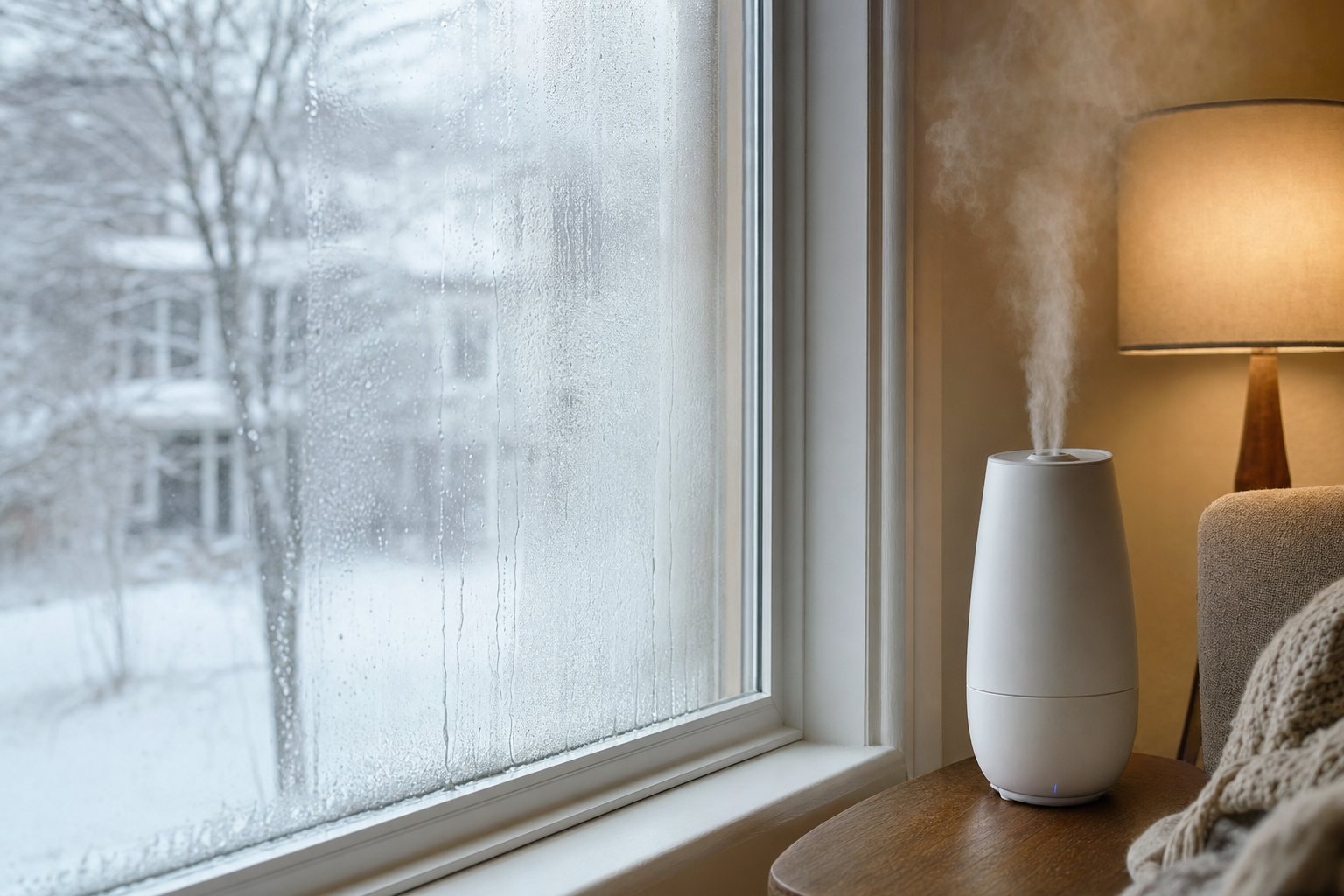
Condensation on the room-facing side of a window is a warning that the surface is too cold for the amount of moisture in the indoor air. Lower or turn off the humidifier if you see persistent fogging, water droplets, frost, wet frames or dampness on nearby walls. Wipe up water promptly so it does not soak into frames, trim or flooring.
Brief moisture along the bottom edge of a window in unusually cold weather may clear as conditions change. Repeated or widespread condensation needs attention. The guide to how to stop condensation inside windows in cold weather explains further steps involving ventilation, airflow and window surfaces.
Your home’s construction affects how much winter humidity it can safely support:
- Windows: Better-insulated, well-sealed windows and storm windows keep the room-facing glass warmer and reduce condensation risk.
- Insulation: Adequate insulation raises the temperature of interior wall and ceiling surfaces. Missing insulation can create cold areas even when windows appear dry.
- Air sealing and ventilation: A tighter home can retain moisture from people, cooking and bathing. It still needs effective exhaust ventilation to remove excess moisture.
- Air circulation: Closed blinds, heavy curtains, blocked registers and furniture tight against exterior walls can create colder, less ventilated pockets.
Dry windows do not prove that every concealed surface is dry. Musty odors, peeling paint, damp closets, recurring wet corners or visible mold can indicate a leak, seepage, inadequate insulation or another moisture problem. Renters should document the condition and notify the property owner or manager rather than attempting structural repairs.
What to do when winter humidity is too low
If readings are consistently below about 30% and there is no condensation, increase humidity gradually. Do not jump directly to 50%, particularly during cold weather.
- Confirm the reading with a second meter or by moving the meter to another suitable room.
- Check weatherstripping and obvious air leaks that may be allowing excessive cold, dry outdoor air indoors.
- Do not block required vents, combustion-air openings or other ventilation that fuel-burning equipment needs.
- Raise a whole-house humidistat in small increments, then check windows and colder rooms over the next day.
- Use a portable humidifier only where it is needed, and keep nearby floors, furniture, fabrics and walls dry.
Portable humidifiers need regular care. EPA guidance says to empty the tank, wipe surfaces dry and refill it daily; clean portable units every third day. Use water with low mineral content when practical, especially in ultrasonic or impeller humidifiers, to reduce scale and mineral dust. See can you use tap water in a humidifier for more on water choices, or compare an evaporative or ultrasonic humidifier before buying a unit.
What to do when winter humidity is too high
Turn down a portable or whole-house humidifier when measured humidity exceeds the temperature-appropriate maximum, condensation appears or nearby materials feel damp. Turn the unit off temporarily if reducing the setting does not stop moisture from accumulating.
- Lower a manual humidistat before a forecast cold spell.
- For an automatic whole-house control, follow the manufacturer’s instructions and confirm that any outdoor-temperature sensor is operating correctly.
- Use kitchen and bathroom exhaust fans during cooking, bathing and showering, and make sure they discharge outdoors rather than into an attic or other enclosed space.
- Confirm that the clothes dryer vents outdoors. Avoid drying large loads of laundry indoors where possible.
- Reduce other moisture sources, such as long showers, frequent boiling, indoor drying and excess houseplants.
- When outdoor air is cold and dry, brief ventilation can help remove indoor moisture without unnecessarily chilling the home.
- Investigate plumbing leaks, basement seepage or recurring dampness if humidity remains high while the humidifier is off.
During each major cold spell, compare the outdoor temperature, indoor humidity reading and condition of the coldest windows. This three-part check is more reliable than holding one humidity percentage throughout winter.
Sources
- U.S. Environmental Protection Agency guidance on controlling moisture in the home
- U.S. Environmental Protection Agency guidance on using and caring for home humidifiers
- University of Minnesota Extension guide to controlling moisture problems in a home
- ENERGY STAR information on window condensation resistance