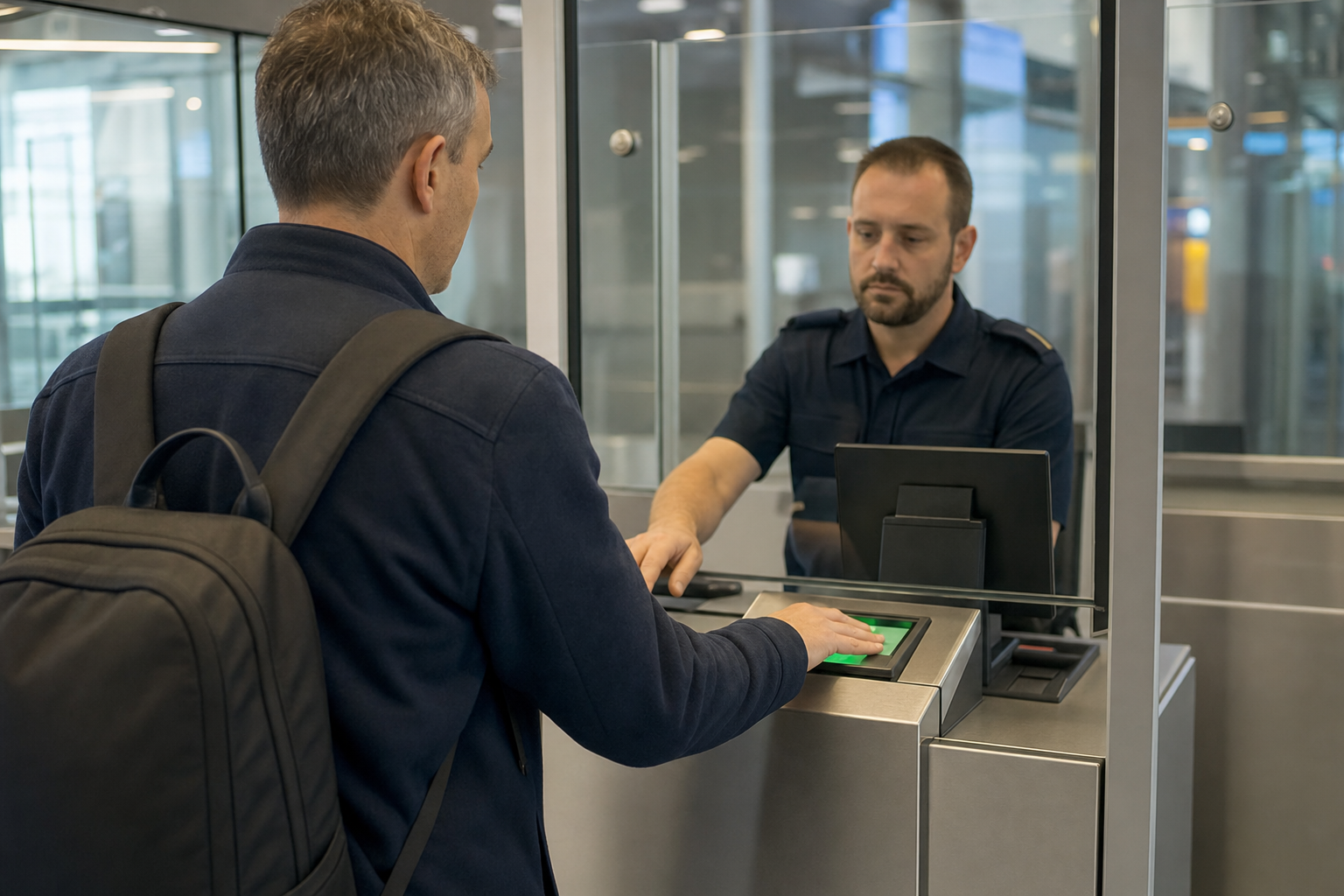
You may be asked to scan your fingerprints again each time you cross an external border covered by the Entry/Exit System (EES), but that does not usually mean a new biometric record is being created from scratch. For an adult U.S. citizen travelling without a visa for a short stay, EES keeps an individual file containing four fingerprints and a facial image. On later crossings, border authorities verify your identity against that file and record the new entry or exit. Depending on the border point and its equipment, verification can use a live facial image or fingerprints.
This guide concerns adult U.S. citizens making visa-free short visits. EES became fully operational at the external borders of the 29 European countries using the system on April 10, 2026. It applies to short stays of up to 90 days in any 180-day period. Rules for children and for travellers who need a short-stay visa differ and are outside this article’s scope.
Verification can require another fingerprint scan
At the first EES registration, authorities create an individual file from passport information, a facial image and, for visa-exempt travellers such as most U.S. visitors, fingerprints from four fingers where physically possible. The system also creates a separate record for the entry or exit.
On a later entry or exit, an existing file should be found and your identity verified. European Union rules allow the verification to compare either a live facial image with the facial image in the EES or the live fingerprints of a visa-exempt traveller with fingerprints stored in EES. In practice, the border authority decides which biometric identifier is the main one at that crossing point.
| What happens | First EES registration | Later external-border crossing |
|---|---|---|
| Passport and personal data | Used to create the individual file | Checked and updated if necessary |
| Facial image | Recorded in the individual file | May be captured live for identity verification |
| Fingerprints | Four fingerprints are stored for visa-exempt adults, where possible | May be scanned again for identity verification |
| Entry or exit | The crossing is recorded | Each covered entry and exit is recorded |
So the practical answer is not a simple yes or no. Do not assume that one set of fingerprints means you will never use a scanner again. Be ready to follow the border officer’s or machine’s instructions at every EES external-border crossing. A repeat scan normally serves to confirm your identity, rather than to create a wholly new file.
You do not have to buy an EES registration or complete an EES application before travel. Border authorities carry out the required registration and checks. Some countries also offer the optional Travel to Europe mobile app at selected border points. The app can pre-register passport data and a facial image, but it does not replace passport control or any biometric check required at the border.
Why a new scan or image may be needed
Repeated biometric checks help link the person presenting the passport to the correct EES file. A further scan does not by itself mean that there is a problem or that you have been selected for extra scrutiny.
- Routine verification: The border point may use a live facial image, fingerprints or both as part of its normal process.
- An unsuccessful match: If the first verification does not produce a reliable result, border staff can carry out further checks and may use EES data to identify a person who may already be registered under another identity or travel document.
- Data that need updating: A new passport or changed passport details can require the border authority to update the individual file and confirm that it belongs to you.
- Technical or capture difficulties: Staff may ask you to repeat a scan if the image or fingerprint capture is incomplete or cannot be used.
- Temporary inability to provide fingerprints: If fingerprints could not be captured earlier because of a temporary physical condition, they may be taken when capture becomes possible.
The file is not kept forever. For a traveller with a recorded exit, an individual EES file and linked records are generally stored for three years and one day after the last exit, provided there is no new entry within three years of that exit. A traveller who returns after the applicable retention period may therefore need a new individual file. If no exit is recorded, the usual retention period is five years from the end of the authorised stay.
Do not confuse a biometric verification with the crossing record itself. EES records the date and place of each covered entry and exit, even when a returning traveller is processed quickly. Those records help authorities calculate compliance with the 90-days-in-180-days short-stay limit.
The border equipment can change your experience
EES sets common legal requirements, but the traveller experience is not identical at every airport, ferry terminal or land border. Countries may use staffed desks, self-service systems, electronic gates or a combination of these options.
Self-service systems
A self-service system can read a biometric passport, capture a live facial image, check for a previous EES registration and carry out parts of the border check. It may also guide a first-time traveller through pre-registration. The system operates under border-guard supervision, and travellers can be referred to an officer if the check cannot be completed, information needs updating or there is doubt about identity.
Electronic gates
Electronic gates may be available to travellers who are already enrolled or pre-enrolled in EES and meet the conditions for automated processing. When a self-service system and gate are physically separate, the gate must verify that its user is the same person who used the earlier system, using at least one biometric identifier. A gate can still refer you to a border officer.
Staffed passport-control desks
At a staffed desk, the officer can check your travel document, capture a facial image, request fingerprints, search for an existing file and update data where necessary. This route may take longer, especially when a match fails or a first registration is required, but it is the normal fallback where automated processing is unavailable or unsuitable.
Use the lane, kiosk or desk indicated by signs and staff. Availability varies by crossing point and may change during operations. EES applies at the participating area’s external borders. For example, a flight from the United States to France or travel from the United Kingdom to Belgium involves an external-border crossing. Travel between France and Italy normally does not.
What to do if the scanner cannot verify you
A failed fingerprint or facial check does not automatically mean that entry will be refused. It means the automated verification has not settled your identity and further checks may be needed. Stay with the process rather than repeatedly restarting a kiosk or moving to another line without instruction.
- Follow the on-screen or officer instructions. Present the requested finger or face position and remain still until the scan has finished.
- Try again if asked. A border officer or system may request another capture or a different biometric method.
- Show your current passport and explain relevant facts. Tell the officer if you have a new passport, a hand injury or a physical limitation that affects fingerprint capture.
- Go to a staffed desk when referred. Staff can conduct the additional verification or identification checks allowed under EES rules.
- Complete the exit process. Before leaving border control, make sure staff have told you that the process is complete. EES relies on recorded exits as well as entries.
Refusing to provide biometric data required for EES can result in refusal of entry. If you cannot provide fingerprints for physical reasons, do not refuse or leave the queue; explain the situation so that border staff can apply the appropriate procedure. Allow additional time for an EES external-border crossing, particularly if you have a tight onward connection.