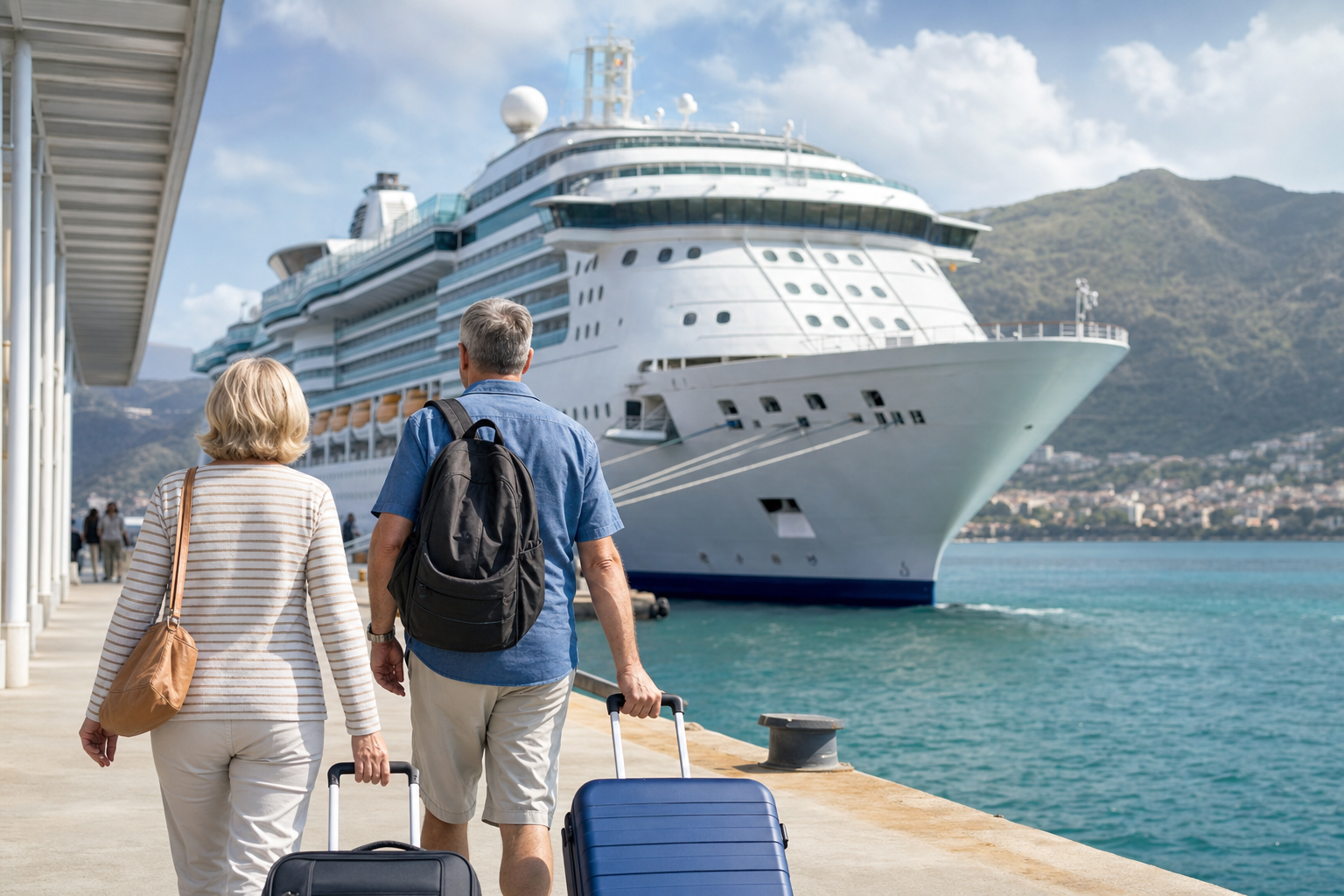
Does the Entry/Exit System apply to cruise passengers? Sometimes. A cruise that begins and ends outside the Schengen area will usually be exempt from Entry/Exit System, or EES, checks for itinerary day trips to Schengen ports. However, passengers who fly into Schengen to join a ship, board a mixed Schengen and non-Schengen itinerary, permanently disembark in Schengen or leave the cruise to travel independently may need an EES entry or exit record. The result depends on the complete route and on the arrangements made by the relevant border authorities.
This guide mainly applies to Americans and other non-European Union nationals visiting for a short stay. EES became fully operational at external border crossing points of the participating countries on April 10, 2026. It generally applies to eligible non-European Union travellers entering for stays of up to 90 days in any 180-day period. Citizens of European Union countries, Iceland, Liechtenstein, Norway and Switzerland are not registered in EES, and exemptions also cover several other groups, including many long-stay visa and residence-permit holders.
Use this itinerary decision tree
- Are you flying into a Schengen country before boarding? You will normally complete EES entry formalities at the first airport where you cross the Schengen external border. If you fly from the United States via Paris to Barcelona, for example, Paris is normally your first entry point.
- Does the cruise begin and end outside Schengen, with Schengen ports visited only as itinerary calls? Day trips ashore will usually be exempt from EES checks, but the port authorities can require checks in particular circumstances.
- Does the cruise include both Schengen and non-Schengen ports and begin in Schengen? Border authorities may arrange an EES exit check when you board and an entry check when you permanently leave the ship at the end of the cruise.
- Does the cruise end in a Schengen port? If you began outside Schengen and are leaving the ship there, authorities may carry out your formal EES entry check at final disembarkation rather than at an earlier port call.
- Will you leave the ship and continue independently? You may need a formal border check when leaving the ship, especially if you will travel to another port, stay ashore or miss the vessel.
Schengen and the European Union are not the same thing. Iceland, Liechtenstein, Norway and Switzerland are in Schengen but are not European Union members. Ireland and Cyprus are European Union members but do not use EES. The United Kingdom, Turkey, Morocco and Montenegro are also outside Schengen.
How EES works for common cruise itineraries
Round-trip cruises based outside Schengen
Consider a cruise sailing from Southampton, visiting France, Spain and Portugal, then returning to Southampton. Official United Kingdom guidance says sailings that start and finish outside Schengen will usually be exempt from EES checks for itinerary day trips into Schengen.
The European Commission’s Practical Handbook for Border Guards follows the same general approach. For a cruise calling at both Schengen and non-Schengen ports, it recommends that organised shore excursions and day trips at Schengen ports should not involve normal entry or exit checks. Passengers who remain on board during the call should not receive EES records either.
This is not an unconditional individual exemption. Border authorities assess security and irregular-migration risks and can carry out checks. A passport or identity check based on passenger lists is different from a full external-border check and does not itself create an EES entry or exit record.
Fly cruises beginning in Schengen
If you fly from the United States to Barcelona, Rome, Athens, Amsterdam or another Schengen embarkation city, you will normally complete EES entry formalities at the first Schengen airport where you arrive. Boarding a ship does not create a second entry record merely because the ship is in port.
A cruise that visits only Schengen ports normally does not involve external-border checks between those ports. The position changes if the itinerary includes a non-Schengen port, such as in Turkey or the United Kingdom. For mixed itineraries, the Commission handbook recommends, as a general rule, an exit check when passengers board at the beginning of the cruise and an entry check when they leave the ship at the end.
In practice, the cruise line may hold passports, provide terminal appointment times or direct passengers to an onboard or port inspection. Follow those instructions, because the precise procedure is set by the authorities for that route.
Americans do not complete a separate advance application for EES. EES registration happens at the border when it applies. See Do Americans Need to Register for EES Before Travel for the distinction between EES registration and a future travel authorisation requirement.
Cruises starting outside and ending inside Schengen
On a transatlantic cruise from the United States to Lisbon, or a sailing from Southampton ending in Barcelona, final disembarkation is especially important. The Commission handbook recommends an entry check when passengers leave the ship at the end of a mixed itinerary. This approach avoids creating incomplete EES records for passengers who make shore visits but remain with the cruise.
Processing may take place in the terminal, aboard the ship or through another arrangement organised by the border authorities. Do not assume that an EES entry must occur at the first geographical Schengen port. Earlier calls can be handled as itinerary day trips, while the formal entry check is completed at final disembarkation.
Leaving a ship and travelling independently
Suppose you leave a ship in Marseille, take a train independently and join another cruise in Barcelona. This is not the same as a temporary shore visit followed by a return to the vessel. You may need an EES check when leaving the first ship because you are continuing your journey independently.
The same issue can arise if you disembark early, miss the ship, stay overnight ashore or arrange your own transport to rejoin it. Tell guest services as early as possible. The operator may need to return a passport it holds and coordinate with border authorities.
Biometrics and the 90 day rule
When an EES entry or exit check is required, it may take place at an airport, cruise terminal, port facility or another inspection point arranged for the sailing. EES records passport data, the date and place of entry or exit, and biometric data such as a facial image and fingerprints. At later crossings, officials can verify stored biometric data, although they can collect data again where necessary.
If you hold a short-stay visa, your fingerprints should already be in the Visa Information System. They are not stored again in EES in the same way. An itinerary day trip that does not involve a formal entry or exit check should not create an EES record simply because you went ashore.
For most visa-free visitors, the short-stay allowance is 90 days in any rolling 180-day period. The day of entry counts as the first day of stay and the day of exit counts as the last. Moving between Schengen countries does not restart the allowance.
- If you entered Schengen by air before boarding, days normally continue to count until an exit is formally recorded.
- If authorities record an exit when you board a mixed itinerary, days after that exit do not count as part of that recorded Schengen stay unless and until you formally re-enter.
- Do not assume that no visible passport scan means a day is automatically outside your allowed stay. Cruise procedures are itinerary-specific.
Keep your itinerary, boarding records and any written directions from the cruise line if you are close to the limit. The official EES stay-checking tool can help, but, as of September 14, 2026, it does not reflect time spent on a stay that began before April 10, 2026. Consult How to Check How Many Schengen Days You Have Left With EES and ask a border officer or the relevant national authority if your calculation is unclear.
What to confirm before sailing
Check the final itinerary instead of relying only on the cruise’s marketing description. A substituted port can turn a Schengen-only sailing into a mixed itinerary, while an independent transfer or early departure can change the procedure that applies to you.
- Identify where you will first enter Schengen by air, land or sea.
- Ask the cruise line whether border authorities expect EES processing at embarkation, during the cruise or at final disembarkation.
- Tell the operator in advance if you will join late, leave early or transfer independently to another port.
- Carry your passport whenever the operator instructs you to do so, even if the ship normally holds it during the voyage.
- Allow extra time for biometric processing at airports, terminals or onboard inspection points.
The Commission handbook gives recommended cruise procedures rather than a personal guarantee that checks will or will not occur. Border authorities can make risk-based decisions, so instructions can differ between similar sailings. For your own trip, follow directions from the cruise line, port and border authorities.