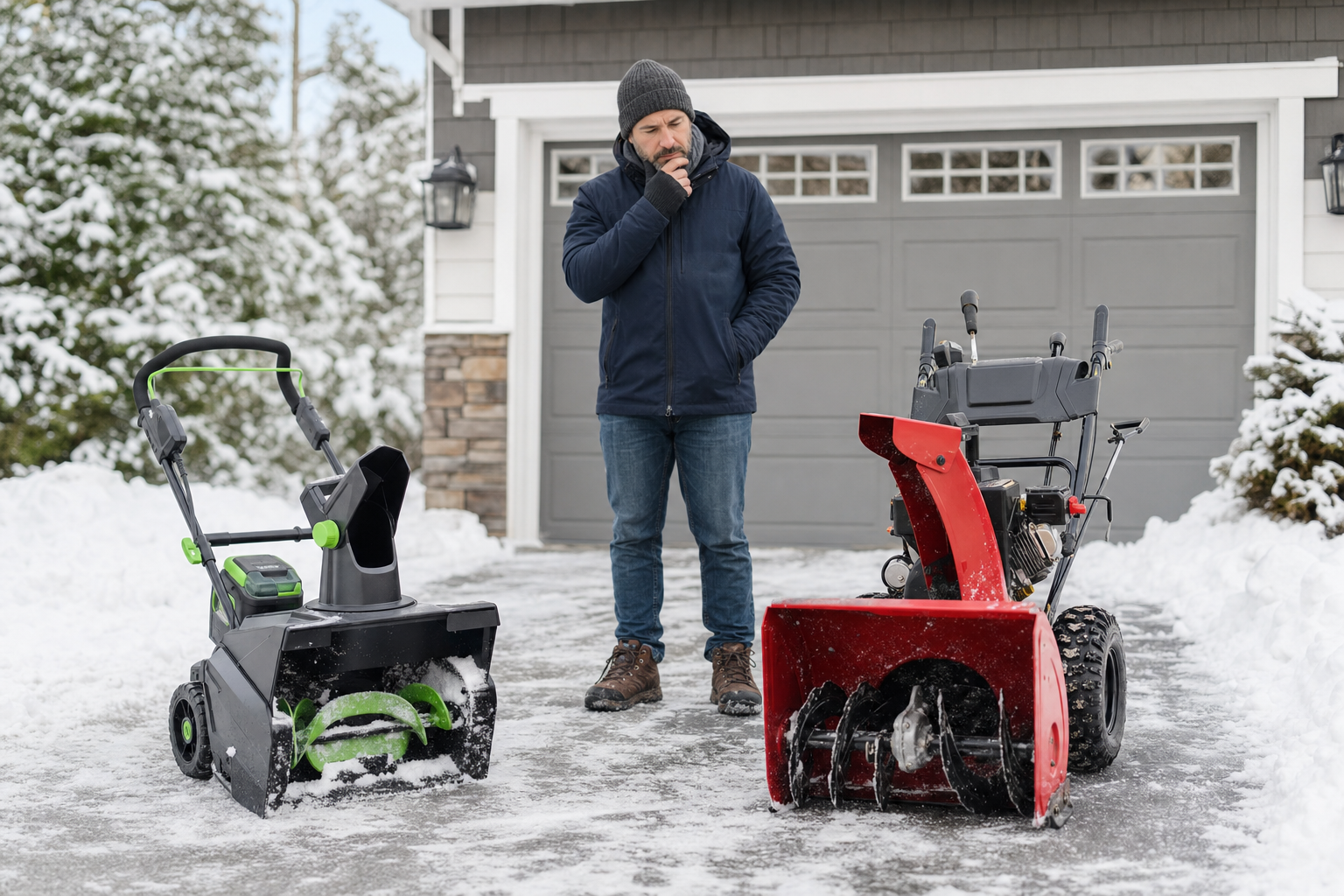
For most one- and two-car driveways, a battery snow blower is a practical choice when the surface is paved, snowfall is usually manageable and the included batteries can finish the full job in one session. Choose gas when the driveway is long or steep, heavy wet snow and plow piles are common, or you need to keep clearing for as long as fuel is available. Select the snow blower’s stage, traction and capacity for the toughest conditions you regularly face before deciding between battery and gas.
Choose the snow blower stage before the power source
Power source and snow blower stage are separate decisions. Battery and gas models are available in both single-stage and two-stage designs, although the range of heavy-duty gas machines remains broader.
A single-stage snow blower uses its auger or paddles to collect and discharge snow. These machines are generally compact, easier to turn and well suited to small paved driveways and walkways. Because the auger works close to the ground, a conventional single-stage machine is usually a poor choice for gravel or other loose surfaces.
A two-stage snow blower uses an auger to feed snow to a separate impeller, which sends it through the chute. Two-stage machines usually have a taller intake, larger wheels or tracks, and self-propelled drive. They are the better fit for deeper snow, slopes, larger areas and packed snow left by a road plow. Adjustable skid shoes can raise the housing above gravel, but they must be set according to the operator’s manual.
Compare like with like. A light battery single-stage model should be compared with a gas single-stage model of similar width and drive system, not with a large gas two-stage machine. Look at clearing width, intake height, self-propulsion, machine weight, battery package and local service support rather than relying on a single advertised snow-depth or driveway-size claim.
How battery and gas perform in driveway work
| Buying factor | Battery snow blower | Gas snow blower |
|---|---|---|
| Light snow on a small paved area | Often an excellent fit, with simple starting and no fuel handling | Effective, but may be more machine and maintenance than the job requires |
| Wet, deep or compacted snow | A capable two-stage model can work well, but difficult snow uses energy faster | Well suited to sustained work, especially in a heavy self-propelled two-stage model |
| Plow pile at the driveway entrance | Needs enough traction, machine capacity and battery reserve for the hardest part of the job | Usually provides the greatest margin for repeated attacks on dense snow |
| Continuing after a long session | Requires charged spare batteries or time to recharge | Can be refueled outdoors when the engine is off and cool |
| Starting and routine upkeep | Push-button starting; no engine oil, spark plug or carburetor | Requires fuel management and engine maintenance under the manufacturer’s schedule |
| Noise and storage | Usually quieter and has no gasoline fumes; batteries need correct storage and charging conditions | Typically louder; gasoline needs safe storage and seasonal preparation |
| Long-term costs | Low routine energy and maintenance costs, but replacement batteries can be expensive | Fuel, oil, stabilizer, wear parts and service add to ownership costs |
A February 2026 Popular Mechanics comparison is a useful example of why equivalent machines matter. It tested battery and gas versions of Toro’s 24-inch, self-propelled SnowMaster, which is a single-stage design. The tester found the battery model capable of moving snow at a similar level to the gas version, while the gas model retained the advantage of quick refuelling for longer jobs. The battery machine was quieter and avoids the fuel-storage and engine-maintenance work of a gas model.
Runtime claims need careful interpretation. Snow depth and moisture, air temperature, driveway slope, walking speed, chute setting, drifting and the plow pile all affect battery use. A claim based on a number of parked cars or a test area is useful for comparison, but it is not a guarantee that the blower will clear your complete driveway, sidewalks and berm in one charge.
Charging time also varies by battery and charger. For example, Toro lists a 215-minute recharge time for its 24-inch 60-volt SnowMaster package with a 10.0 amp-hour battery. A faster charger or spare battery can reduce interruption, but increases the initial cost. Do not add gasoline to a running or hot engine.
Use this checklist before buying
- Measure the whole clearing area. Record the driveway’s length and width, then add sidewalks, paths and the space where snow can be discharged.
- Identify the usual difficult conditions. Consider wet snow, drifting, freezing rain and the packed ridge created by a municipal plow, not only average snowfall.
- Check the slope and surface. A steep driveway favors self-propulsion, sound traction and manageable machine weight. Gravel generally calls for a two-stage model with correctly adjusted skid shoes.
- Decide whether one uninterrupted session is essential. If you must clear the driveway before leaving for work, allow margin for a plow pile and an unexpectedly heavy storm. That may mean spare batteries or gas.
- Compare battery systems correctly. Amp-hour ratings alone are not comparable across different voltages. Confirm the exact batteries supplied, their watt-hour capacity where stated, the number required for operation and the charger included.
- Check storage and service. Measure garage space, consider the effort of moving the machine without power, and check availability of batteries, scraper bars, belts, shear pins and repairs.
Cold-weather battery care matters. Follow the instructions for the specific battery platform rather than applying one temperature rule to every brand. For example, EGO’s manual for its 56-volt two-stage snow blower specifies an optimal charging range of 41°F to 104°F and instructs owners to remove batteries for storage. Keep batteries dry and protected from unsuitable temperatures, take them outside when needed, and allow a pack to return to its approved charging temperature before recharging it.
Total cost also depends on equipment you already own. A battery snow blower can be especially appealing if you already have compatible high-capacity batteries and a suitable charger. Starting a new platform with multiple large batteries can raise the purchase price. Gas equipment may cost less initially in some comparisons, but its long-term cost includes fuel, oil, storage treatment and potential engine service.
Use either type safely
Stop the machine before dealing with a clog. For a battery model, remove the batteries as directed in the manual. For a gas model, shut off the engine and wait for all moving parts to stop. Use the supplied clean-out tool or a long stick; never put a hand into the chute or auger housing. Keep bystanders away from the discharge path, clear debris from the driveway before snowfall, and operate gas machines outdoors only. Refuel outdoors with the engine off and cool.
Recommendations for common driveway workloads
Small paved driveway with mainly light snow: A quality battery single-stage blower is usually the most convenient option. It is easy to start, compact to store and avoids gasoline and routine engine maintenance. Confirm that the included battery set is intended for the area you need to clear.
Standard two-car driveway with mixed snow: Consider a battery two-stage model if it has self-propulsion, suitable traction and enough stored energy for the driveway, walkways and plow pile. Choose gas if heavy wet storms are frequent, you routinely clear more than one property, or waiting to recharge would be unacceptable.
Long or sloped driveway with deep snow and dense berms: A heavy self-propelled gas two-stage machine remains the lower-risk choice for extended clearing. A premium battery two-stage model can be appropriate, but buy for the hardest expected storm and include the cost of enough batteries and charging capacity to finish it.
The best answer is not battery or gas in isolation. First choose the stage, traction and clearing capacity your recurring worst conditions require. Then choose the power source that can complete that work on your schedule.