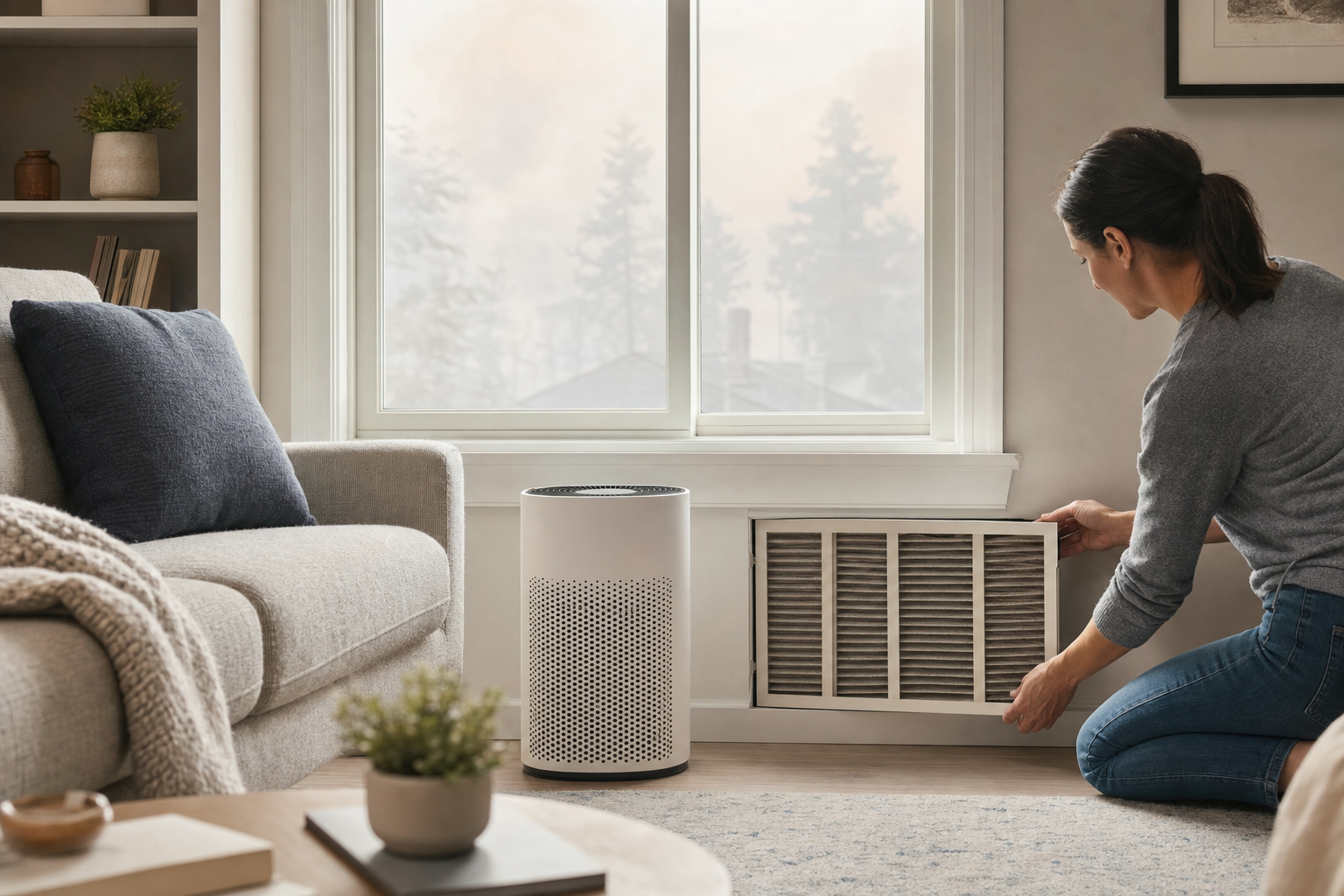
For most households, the best choice between an air purifier and an HVAC filter for wildfire smoke depends on the space you need to protect. Choose a correctly sized portable air purifier for one occupied room, such as a bedroom or home office. Use a MERV 13 or higher HVAC filter when you have a compatible forced-air system and can run its fan often during smoke events. For recurring or heavy smoke, using both is usually the most practical approach: central filtration for ducted areas and a portable unit for a cleaner-air room.
How portable purifiers and HVAC filters compare
| Buying factor | Portable air purifier | Higher-efficiency HVAC filter |
|---|---|---|
| Area served | One room or a connected open area | Areas served by the forced-air duct system |
| Main performance rating | Smoke clean air delivery rate, or CADR | Minimum Efficiency Reporting Value, or MERV |
| Recommended target | Smoke CADR of at least two-thirds of the room area in square feet | MERV 13 or higher, if the system can accommodate it |
| When it cleans | Whenever the unit is running | Only while air is moving through the HVAC system |
| Compatibility | Requires an electrical outlet, unobstructed airflow and enough floor or tabletop space | Requires a compatible forced-air system and a correctly sized filter |
| Noise | Fan noise is present in the room | Usually less noticeable in individual rooms, although the central blower may be audible |
| Ongoing costs | Electricity plus model-specific replacement filters | Replacement central filters plus electricity used when the blower runs |
A portable air cleaner is the flexible option for an apartment, a home without central forced air, or a household that wants to protect one bedroom. It can run independently of heating and cooling and can be selected using a measurable smoke CADR. A higher CADR means the unit delivers more filtered air and can clean particles from a room faster.
An HVAC filter can reach more of the home, but it works only when the system circulates air. During a smoke event, changing the thermostat fan setting from Auto to On can increase filtration time. It also increases blower electricity use. In cooling season, continuous fan operation can reduce how effectively some systems remove moisture, so consider comfort as well as filtration.
Neither option makes a leaky or multizone home perform like a sealed test room. Closed doors, poor airflow between rooms and smoke entering through gaps can all limit results. A portable purifier sized for one room should be used in that room with doors and windows closed as much as safely possible.
Use this decision tree before buying
- Do you have central forced-air heating or air conditioning? If not, start with a portable purifier. Radiators, ductless mini-splits and most window units do not provide a whole-home filter path. If you do have forced air, continue.
- Can the system use a MERV 13 or higher filter? Check the equipment manual and filter-cabinet specifications, or ask a qualified heating, ventilation and air-conditioning technician. If MERV 13 is unsuitable, use the highest compatible rating and add a portable purifier in the room used most.
- Are you cleaning one room or several rooms? For a bedroom, nursery, office or studio apartment, prioritize a portable purifier. For several connected rooms served by one duct system, a compatible HVAC filter can provide wider coverage.
- Will you run the equipment consistently? A purifier that is too loud to use, or an HVAC fan that remains off, will provide less protection than its rating suggests. Choose equipment that can operate at a tolerable noise level for the needed hours.
- How frequent are smoke events? For repeated or prolonged smoke, use both options if your budget permits and keep replacement filters available before fire season.
Renters will usually find a portable purifier simplest because the landlord may control the central filter. Homeowners should not assume that a thicker-looking or higher-rated filter is automatically better. Higher-efficiency filters can add airflow resistance, so the system fan, filter slot and ductwork must be able to handle the chosen filter.
How to size each filtration option
Portable purifier sizing
For wildfire particles, compare the smoke CADR, not only a large advertised room-size claim or the word “HEPA.” High-efficiency particulate air, or HEPA, describes filter performance, while CADR reflects both filtration and airflow. A unit can have an efficient filter but still clean a room slowly if it moves little air.
The Environmental Protection Agency recommends a smoke CADR of at least two-thirds of the room area in square feet, based on a typical eight-foot ceiling. For extra capacity during persistent smoke, the Association of Home Appliance Manufacturers suggests selecting a CADR approximately equal to the room area. This larger target can be useful if doors open often, the room has higher ceilings or you expect to use a quieter fan setting.
- Small bedroom: A 10-by-12-foot room is 120 square feet. Look for a smoke CADR of at least 80 cubic feet per minute. A model closer to 120 provides additional capacity.
- Living room: A 15-by-20-foot room is 300 square feet. Look for at least 200 smoke CADR, or closer to 300 for more capacity.
- High ceiling: A 12-by-12-foot room with a 10-foot ceiling has more air than the standard calculation assumes. Adjust its 144-square-foot area by 10 divided by eight, giving an equivalent area of 180 square feet. The minimum smoke CADR is therefore about 120.
For an open floor plan, calculate the connected area rather than only the space beside the purifier. If one available unit cannot meet the target, two well-placed units may be more effective. Keep each unit’s intake and outlet clear of curtains, furniture and walls, following the manufacturer’s placement instructions.
HVAC filter sizing and compatibility
Buy the exact physical dimensions required by the filter slot, and make sure the filter fits snugly so air cannot bypass its edges. For wildfire smoke, federal guidance recommends a filter marked MERV 13 or higher if the system can accommodate it. If it cannot, use the highest compatible MERV rating rather than forcing in an overly restrictive filter.
MERV 13 is not the same as HEPA filtration, and a residential system should not be fitted with a HEPA filter unless it was designed or modified for one. Consult the manufacturer or a qualified technician when airflow is already weak, the filter slot is narrow, or the system has a history of performance problems.
When using both is worth the cost
Combine a MERV 13 or higher HVAC filter with a portable purifier when wildfire smoke is frequent, the home is large, or someone needs the cleanest practical air in one room. The central filter treats recirculated air in the ducted part of the home, while the portable purifier provides more concentrated cleaning where a person sleeps, works or spends most of the day.
Run the portable unit continuously at the highest comfortable speed. Run the HVAC fan as often as practical during the smoke event. If your system has a controllable outdoor-air intake or recirculation setting, follow the manufacturer’s instructions for limiting unfiltered outdoor air during smoky conditions. Do not block vents or alter equipment that you do not understand.
Check both filters more often during smoke events. Replace them according to the manufacturer’s instructions, and replace an HVAC filter when it is dirty or begins to smell. Wildfire smoke can shorten the normal replacement interval.
Before buying, compare the full cost: purchase price, replacement filters and electricity. ENERGY STAR product information can help compare certified portable air cleaners by energy use and clean-air-delivery-rate efficiency. The Environmental Protection Agency notes that two or more well-placed portable units can be as effective as continuous central filtration and may cost less to operate in some homes.
Avoid ozone generators and do not rely on ionizers, plasma devices, ultraviolet-light devices or other electronic treatments as the main way to remove smoke particles. Mechanical filtration is the preferred approach. For a portable unit, check the California Air Resources Board certified-device list as well as its independently tested CADR. California certification addresses ozone emissions and electrical safety; it does not establish how effectively a device removes smoke particles.
If you can buy only one option, choose the one you can use reliably: a correctly sized portable purifier for one occupied room, or the highest compatible HVAC filter for a forced-air home whose fan can run often. Add the second option when you need both wider coverage and a more reliably filtered room.
Sources
- U.S. Environmental Protection Agency indoor air filtration guidance for wildfire smoke
- U.S. Environmental Protection Agency wildfires and indoor air quality guidance
- ENERGY STAR air cleaner buying guidance
- California Air Resources Board list of certified air cleaning devices
- National Institute of Standards and Technology research on air cleaner performance during wildfire smoke events