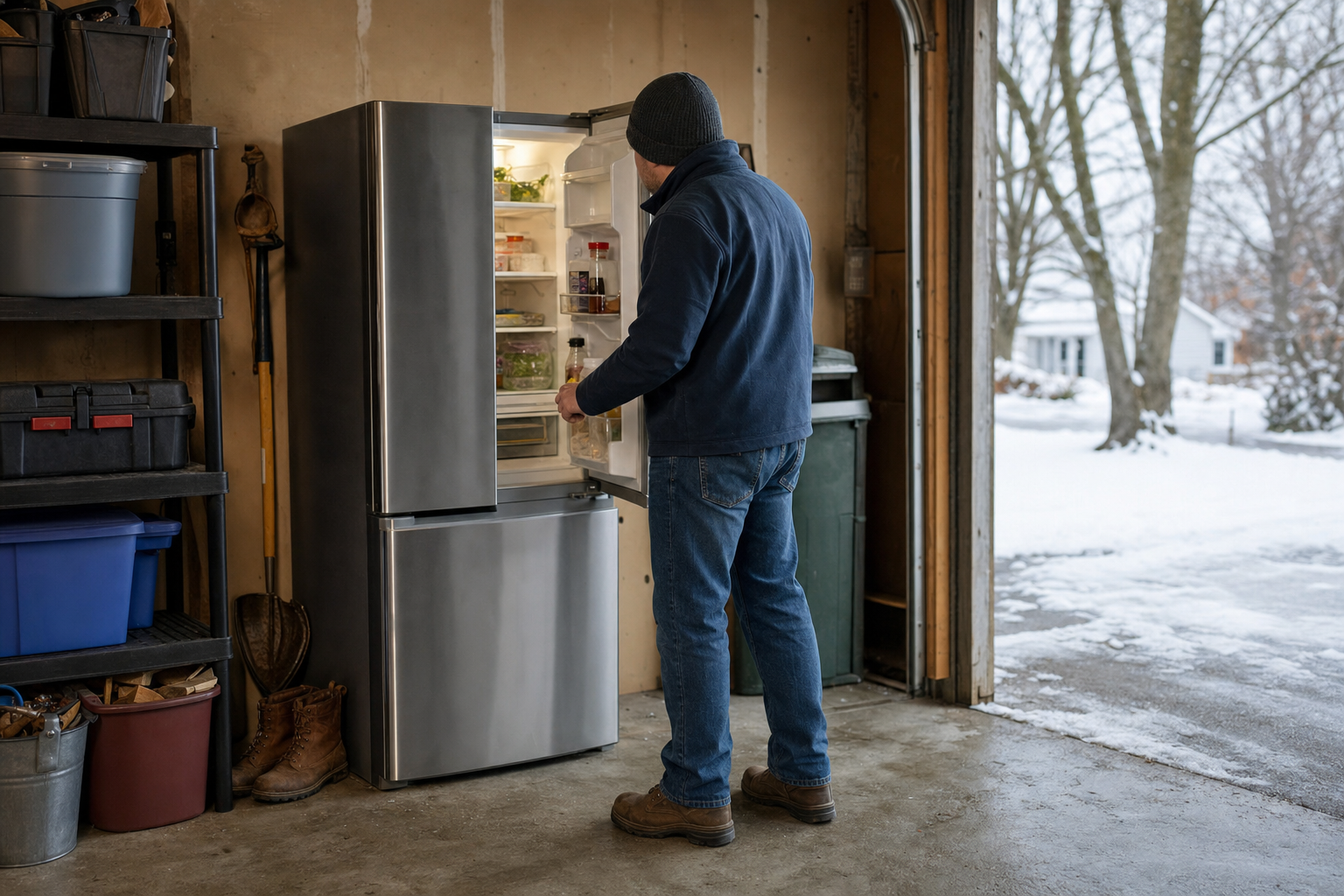
You can keep a refrigerator plugged in in an unheated garage during winter only when the exact model is approved for the temperatures the garage actually reaches. A standard refrigerator can cool improperly in cold surroundings: the fresh-food compartment may appear cold while the freezer gradually warms enough for frozen food to soften or thaw. Check the owner’s manual, measure the garage temperature and monitor the refrigerator and freezer separately before and during cold weather.
Why a cold garage can make the freezer warmer
Many refrigerator-freezer combinations use controls in or associated with the fresh-food compartment to determine when cooling is needed. In a cold garage, that compartment may remain near its target temperature with little help from the appliance. The compressor may then run less often or remain off for long periods.
That reduced operation can be a problem for the freezer. Even when a garage feels cold, it may be much warmer than a freezer’s recommended temperature of 0°F or below. If the compressor does not run often enough, the freezer can warm and frozen food can partially or completely thaw.
Cold conditions can also freeze foods and drinks in the refrigerator compartment. A refrigerator is designed to remove heat, not to keep its contents above freezing when the surrounding air is below freezing. Water lines and ice-maker components may also be at risk if the area freezes. Once the ambient temperature is outside the approved range, changing the temperature control may not solve the underlying problem.
There is no universal minimum temperature for every refrigerator. The limit is model-specific. Whirlpool documentation for many standard indoor models gives an operating range of 55°F to 110°F. GE Appliances says its garage-ready top-freezer models are designed for ambient temperatures from 38°F to 110°F, while it does not recommend installing most non-garage-ready refrigerators where temperatures fall below 60°F unless the owner’s manual says otherwise. These are examples, not specifications for every refrigerator sold by those manufacturers.
Check the exact model before winter arrives
- Find the complete model number. Look for the rating label inside the fresh-food compartment, near a crisper drawer, around the door frame or on a side wall. Do not rely on the brand name or the refrigerator’s appearance.
- Read the correct owner’s manual. Use the manufacturer’s support site and the full model number. Check the installation, location, ambient-temperature, garage-use and storage instructions. The documentation for the exact model controls.
- Identify the approved temperature range. Look for terms such as “ambient temperature,” “room temperature,” “installation location” and “garage ready.” Check the maximum as well as the minimum limit, since an unconditioned garage can also become too hot in summer.
- Measure the garage rather than estimating it. Put a minimum-maximum thermometer near the refrigerator, away from direct sunlight, exterior doors and heating equipment. Record overnight low temperatures for several days, including during a cold spell.
- Compare the readings with the manual. If the garage stays within the approved range, use the documented settings and monitor food temperatures. If it falls outside that range, relocate the refrigerator, control the room temperature in a suitable way or empty the appliance before sustained cold weather.
- Check for model-specific controls. If the manual describes garage mode, dual temperature control or a cold-weather setting, follow those instructions exactly. A similarly named control on another refrigerator may work differently.
If the manual is missing or unclear, contact the manufacturer with the model and serial numbers. Until suitability is confirmed, do not assume that a refrigerator is appropriate for winter garage use.
Garage-ready settings still have temperature limits
A garage-ready refrigerator is designed and tested for a wider range of surrounding temperatures than a typical indoor model. Depending on the model, it may use adjusted controls or separate refrigerator and freezer settings to keep the compressor operating often enough in cool conditions. However, garage-ready does not automatically mean that the appliance can operate below freezing.
For example, Whirlpool says that some models with a Garage Mode setting should use it when ambient temperatures are consistently from 38°F to 55°F; temperatures below 38°F may cause improper operation. GE says certain garage-ready top-freezer models are intended for 38°F to 110°F, with separate refrigerator and freezer adjustments for cold ambient conditions from 38°F to 54°F.
These settings are not heaters, and they do not override the model’s stated operating limits. Use only the setting and temperature range specified for the appliance you own.
| What you find | Recommended action |
|---|---|
| The garage stays inside the model’s approved range | Use the documented settings and monitor both compartments. |
| The model is garage-ready and requires a winter setting | Activate that setting only within the temperatures specified in the manual. |
| The garage occasionally falls below the approved minimum | Move temperature-sensitive food before the cold period, or relocate the appliance. |
| The garage regularly freezes | Do not rely on the refrigerator unless its manual explicitly approves those conditions. |
| No reliable operating range can be confirmed | Empty or relocate the unit before sustained cold weather. |
Do not bypass a thermostat or use an aftermarket garage or heater kit unless the refrigerator manufacturer specifically approves it for that exact model. GE Appliances advises against aftermarket garage or heater kits. Follow only the manufacturer’s installation and operating instructions.
Monitor refrigerator and freezer temperatures separately
Use one appliance thermometer in the refrigerator and another in the freezer. A built-in display may show a set temperature rather than the temperature around the food, and a safe reading in one compartment does not prove that the other is safe.
The United States Department of Agriculture recommends keeping the refrigerator at 40°F or below and the freezer at 0°F or below. To check the refrigerator, place a thermometer in a glass of water in the middle of the compartment and wait five to eight hours. To check the freezer, place the thermometer between frozen packages and wait the same amount of time.
Continue checking through the first sustained cold weather and after large temperature swings. Warning signs include soft ice cream, flexible frozen packages, melting ice cubes, frozen produce in the refrigerator compartment or food temperatures outside the safe range. Do not wait for visible spoilage before acting.
If freezer food has begun to thaw, assess it promptly. The Department of Agriculture says food that still contains ice crystals or is at 40°F or below can generally be refrozen, although quality can decline. Discard perishable food held above 40°F for more than two hours. Never taste food to decide whether it is safe.
When to move or shut down the refrigerator
When the garage is expected to fall below the appliance’s approved minimum, the practical options are to move the refrigerator to a suitable location, transfer food to reliable indoor refrigeration or empty the appliance before the cold period. An indoor location must still meet the manufacturer’s clearance, ventilation and electrical requirements.
If you shut the refrigerator down, follow the manual’s storage instructions. For a unit with an ice maker or water dispenser, turn off and disconnect the water supply as directed. Clean and dry the interior, then leave the doors positioned as the manufacturer instructs to reduce the risk of odors or mold.
The decision should be based on three checks: the exact model’s approved ambient-temperature range, the lowest temperature measured in the garage and thermometer readings from both food compartments.