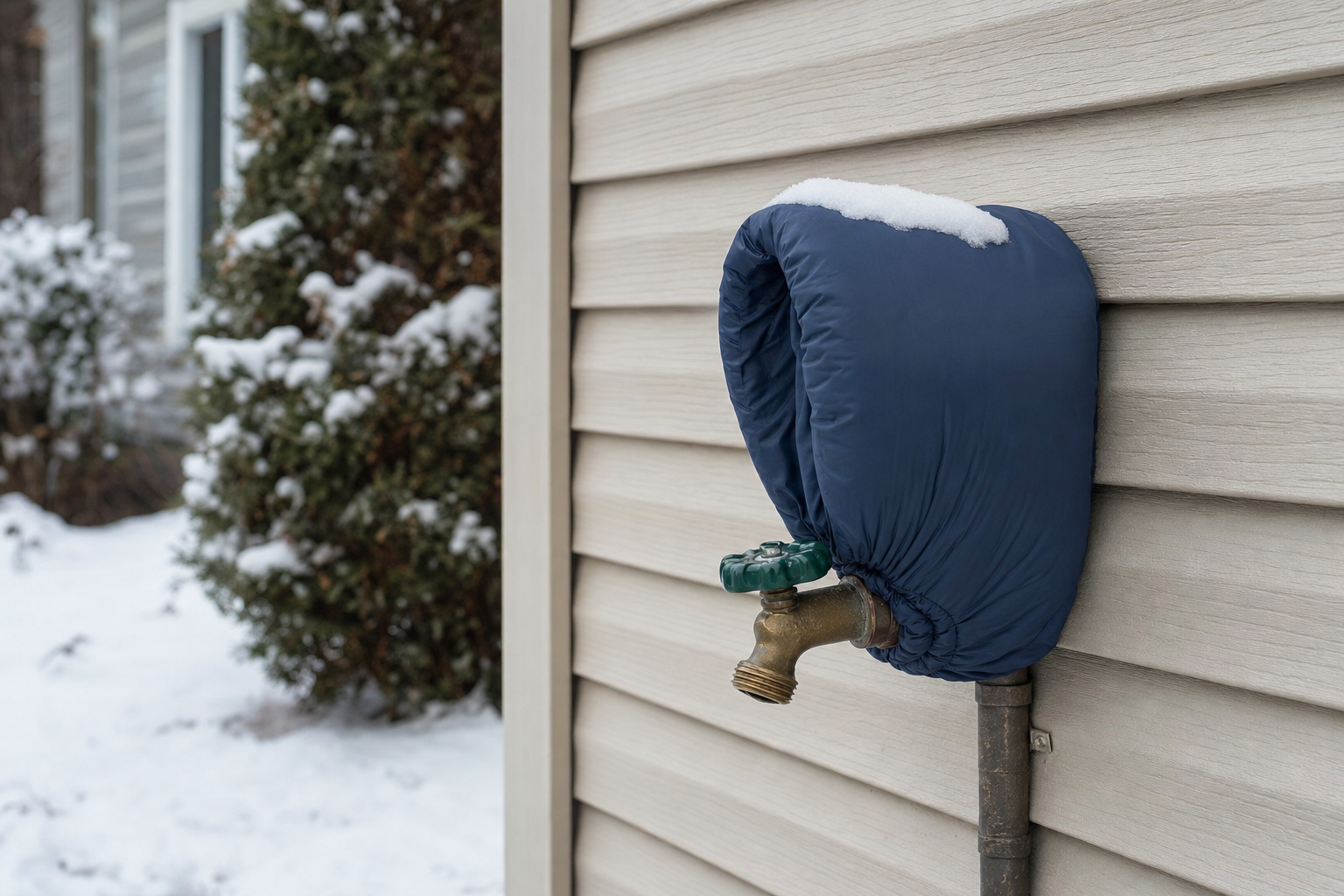
Yes, outdoor faucet covers can reduce the risk of freezing, but they are supplemental protection rather than a complete solution. A foam shell or insulated fabric cover slows heat loss around an outdoor faucet. It cannot drain trapped water, correct a poorly installed frost-free faucet or guarantee protection during a prolonged hard freeze. Disconnecting hoses and attachments, then shutting off and draining vulnerable lines where the plumbing allows, is more important than the cover itself.
Prepare outdoor faucets before temperatures are forecast to reach freezing. The right approach depends on whether the faucet is a standard hose bib or a frost-free model, whether its supply pipe passes through heated space and how long freezing conditions are expected to last.
How an outdoor faucet cover helps
A rigid foam cover or insulated fabric pouch creates a barrier between the faucet and cold outdoor air. A snug cover also limits wind exposure around the metal faucet and the wall penetration. Water utilities commonly recommend insulating covers as one part of cold-weather preparation.
A cover does not create heat or remove water from the faucet and pipe. Its effectiveness depends on the cover’s fit, wind, the duration and severity of the freeze, wall construction, pipe location and whether water remains trapped in the fixture. It is therefore sensible to treat a cover as extra protection, not as a substitute for draining a vulnerable line.
Be cautious about temperature claims on basic faucet covers. There is no single low-temperature rating that applies to every installation because the plumbing and exposure conditions vary considerably from one home to another.
Standard and frost-free faucets need different protection
| Faucet type | How it works | Winter protection |
|---|---|---|
| Standard hose bib | The shutoff mechanism is near the exterior handle, so water can remain close to the cold side of the wall. | Disconnect attachments, use a cover and, where possible, close the dedicated indoor shutoff and drain the outdoor line. |
| Frost-free faucet | A long stem places the valve seat farther inside the building. Its outer tube is designed to drain after the faucet is closed. | Remove every hose and attachment so it can drain. A cover can add protection, but it cannot compensate for poor pitch, a trapped hose or an unheated supply connection. |
A standard hose bib is more vulnerable because water may remain in both the faucet body and the pipe immediately behind it. A cover can help reduce exposure, but isolating and draining the line provides stronger protection when there is a dedicated shutoff valve.
A frost-free faucet, also called a frost-proof or freezeless faucet, is designed to drain the water from its outer barrel after the handle is closed. For this to work, the faucet must be installed with a slight downward pitch toward the outlet, its water-supply connection must be in heated space and the outlet must not be blocked. A hose, splitter, timer, nozzle or capped quick-connect fitting can trap water and defeat the design.
A correctly installed frost-free faucet will not always need its indoor supply closed for ordinary winter weather. Local plumbing requirements, the faucet manufacturer’s instructions and the home’s layout may call for an indoor shutoff and drain valve, however. See whether frost-free faucets need an indoor shutoff in winter for a closer look at that decision.
Prepare the faucet before fitting the cover
Use this sequence before freezing weather arrives:
- Remove every attachment. Disconnect the garden hose, splitter, timer, spray nozzle and any removable fitting that could retain water or obstruct drainage. Do this even with a frost-free faucet.
- Drain and store the hose. Raise or stretch the hose so water can run out. A fully drained hose can be stored outside, but repeated temperature changes can shorten its service life.
- Locate a dedicated indoor shutoff, if one exists. It may be in a basement, crawl space, utility room or cabinet near the outdoor faucet’s supply line. Do not confuse it with the main shutoff for the entire home.
- Close the dedicated valve. Use normal hand pressure. Do not force a corroded or stuck valve, which could break or begin leaking.
- Drain the isolated outdoor line. Open the outdoor faucet after closing its supply valve. Some stop-and-waste valves have a small drain or bleeder fitting; use it only according to the valve’s instructions, with a container ready to catch water. Follow the valve manufacturer’s guidance on whether the outdoor faucet should remain open or be closed after draining.
- Check the wall opening and nearby pipes. Seal suitable small gaps around the pipe with an exterior-grade material, without obstructing drainage or service access. Insulate accessible pipes in unheated basements, crawl spaces, garages and similar areas.
- Fit the cover tightly. Centre a foam cover over the faucet and pull its retaining loop snug so the gasket meets the wall. Close a fabric cover firmly around the faucet base. Replace cracked foam, torn fabric or flattened insulation.
If there is no separate shutoff, remove all attachments, close the faucet normally and fit a snug insulating cover. Keep the home heated during cold weather and make sure everyone in the household knows where the main water shutoff is. Do not turn off the entire home’s water supply solely to winterize one faucet unless you know how to drain the plumbing system correctly.
Match the precautions to the expected freeze
For a brief freeze near 32°F (0°C), removing attachments and fitting a well-sealed cover may lower the risk for an outdoor faucet at a heated home. A correctly installed frost-free faucet should drain after its attachments are removed, with a cover providing additional protection.
For a multi-day or severe freeze, do not rely on the cover alone. Shut off and drain standard outdoor-faucet lines where possible, protect plumbing in unheated spaces and follow guidance from your local water utility. Advice to drip water generally concerns vulnerable indoor supply pipes, not an outdoor spigot left running beneath a cover. If you are considering that step, review when to drip faucets in freezing weather and follow local instructions.
Common mistakes include:
- Putting a cover over a faucet while the hose is still attached.
- Leaving a splitter, timer or other fitting on a frost-free faucet.
- Assuming a frost-free label compensates for incorrect installation or an unheated supply connection.
- Closing an indoor valve without draining the isolated section.
- Using loose towels that can become wet, compressed or blow away.
- Forcing a frozen handle or using an open flame to thaw plumbing.
Call a plumber if an indoor shutoff will not move, the faucet or pipe is visibly split, water appears inside a wall or crawl space, or the faucet has little or no flow while other fixtures work normally. A frost-free faucet that leaks inside the house when it is turned on can indicate a split barrel within the wall and needs prompt repair.
Before the first forecast freeze, remove every connected device and confirm that a frost-free faucet can drain freely. If you cannot identify the faucet type or isolate a vulnerable standard line, arrange an inspection rather than relying on a cover as the only protection.