Usually, no. The Entry/Exit System (EES) does not register a non-European Union national who holds a valid residence permit or long-stay visa issued by a country operating EES. Take the document and your passport to border control. Two important exceptions are residence permits and long-stay visas issued by Cyprus or Ireland: their holders are generally registered in EES when entering an EES country for a short stay. Different rules can apply to qualifying family members of European Union, Icelandic, Liechtenstein, Norwegian or Swiss citizens.
EES has been fully operational at external Schengen border crossing points since April 10, 2026. It records the entry and exit of non-European Union nationals making short stays, including travel-document information and biometric data such as a facial image and fingerprints. It does not replace normal border checks or guarantee admission to a country.
Check the issuing country and the document
The answer depends on the document you hold, the country that issued it and whether it is valid when you cross the external border. For this purpose, an EES country is one of the 29 European countries using the system, including the Schengen countries and Iceland, Liechtenstein, Norway and Switzerland.
A non-European Union national with a valid residence permit or long-stay visa issued by an EES country is not registered in EES. The exemption applies to the document holder, not simply to someone who has applied for residence or has an immigration appointment. You still need to complete the usual border-control process and show the relevant document with your passport.
Cyprus and Ireland are the main exception. They do not operate EES. The European Commission states that holders of residence permits and long-stay visas issued by Cyprus or Ireland are registered in EES. For example, a United States citizen travelling from the United States to France with an Irish residence permit would normally be processed as a short-stay traveller for EES purposes, unless another exemption applies.
This does not make an Irish or Cypriot residence permit invalid. It means that the general EES exemption for permit holders is tied to documents issued by a country operating EES. Your departure airport, airline and transit route do not change which country issued the document.
Use this EES document checklist before travelling
- Do you have a valid residence permit or long-stay visa?
Check the document itself, including its expiry date. A residence permit must be a qualifying residence document under the border rules; an application receipt is not automatically a permit. - Which country issued it?
If it was issued by a country operating EES, a valid permit or long-stay visa normally means you are exempt from EES registration. If it was issued by Cyprus or Ireland, expect EES registration for a short stay unless you qualify under a separate exemption. - Are you relying on a residence card as a family member?
A qualifying non-European Union family member of a European Union, Icelandic, Liechtenstein, Norwegian or Swiss citizen is exempt if they hold the appropriate residence card or residence permit. The European Commission says this exemption applies whether or not the family member travels with the citizen. - Is the permit expired, being renewed or not yet collected?
Do not assume that an expired card, renewal receipt or approval email produces the standard EES exemption. National law may preserve residence or return rights in some situations, but border acceptance of temporary documents depends on the issuing country and the exact document. - Is it a first application?
Temporary documents issued while a first residence-permit application or asylum application is being examined are generally excluded from the Schengen Borders Code definition of a residence permit. A narrow exception may apply to certain documents issued to beneficiaries of the United Kingdom Withdrawal Agreement, so check the rules for that status if relevant.
If no exemption applies, EES registration does not give you a right to enter. You must still meet the normal conditions for a short stay, including having any required visa, a valid travel document and evidence supporting the purpose and conditions of your visit. Travellers preparing for their first registration can also read Do Americans Need to Register for EES Before Travel.
What to show at border control
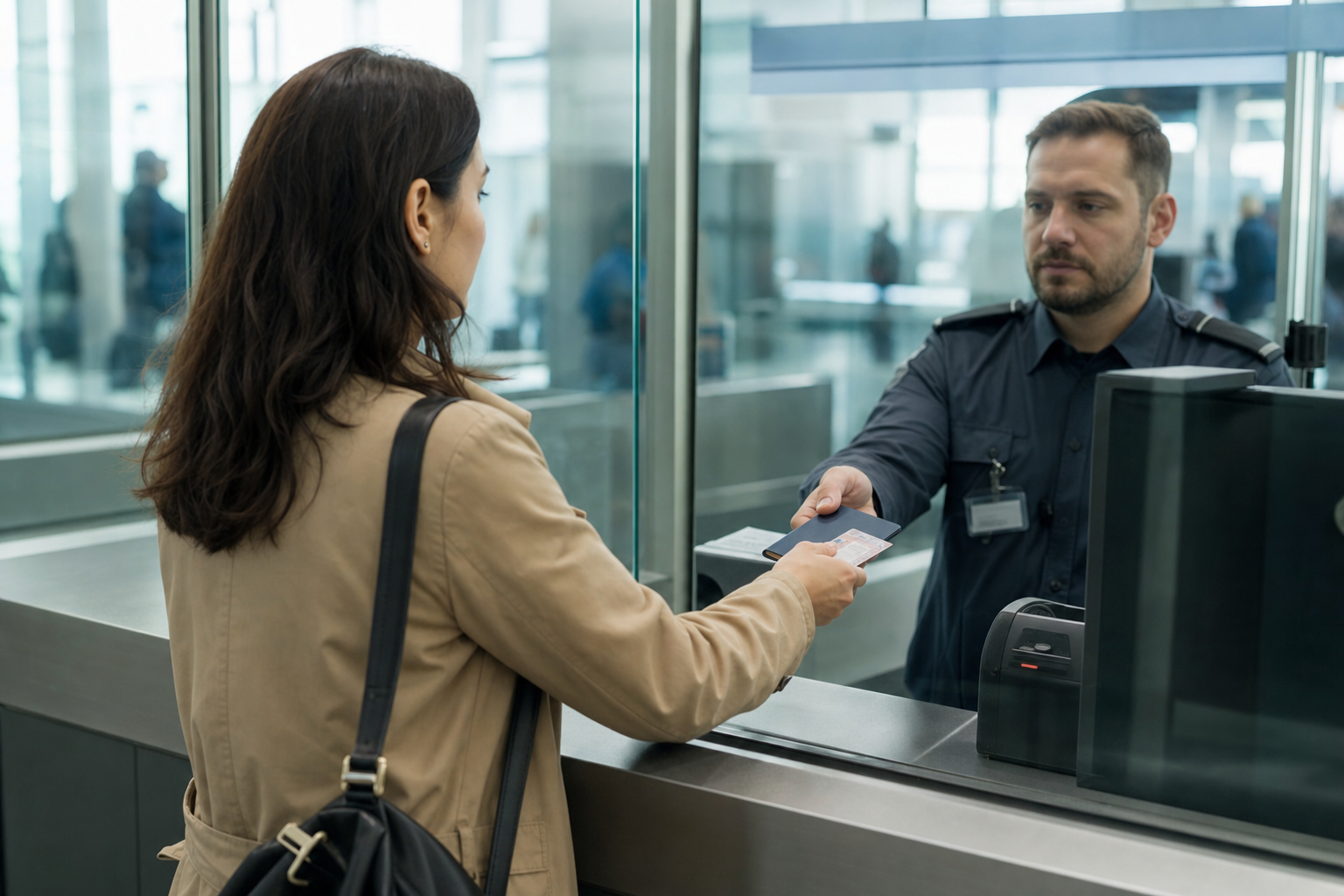
Carry the passport you are using for travel and the valid residence permit, residence card or long-stay visa on which you rely. Present both documents at border control. Austrian Interior Ministry guidance specifically warns that holders of residence permits, residence cards and long-stay visas must show the relevant document; otherwise, EES registration is required.
For an unusual immigration situation, carry supporting official paperwork as well. This may include an official renewal certificate, a document confirming an extension of validity or written instructions from the issuing immigration authority. Supporting papers can help explain your status, but they should not be assumed to have the same effect as a valid residence document.
- Your valid passport or other accepted travel document.
- Your valid residence permit, qualifying residence card or long-stay visa.
- Official evidence of an extension or renewal, where applicable.
- Family-status evidence if you rely on free-movement family rights.
- Written instructions from the relevant immigration authority for a non-standard case.
If you have been approved for a permit but have not collected it, treat that as a separate case. Austrian guidance gives the example of a visa-free traveller entering Austria to collect an approved residence permit: because the person does not yet possess the valid permit on entry, that entry is recorded in EES. Once the valid document has been received and is presented at the border, the person is no longer registered in EES on that basis.
If an automated gate, kiosk or staff member directs you towards EES registration but you believe you are exempt, show your residence document and ask for border-control assistance before providing biometric data. Border officers can check the document and determine the correct process.
Family cards and travel outside your country of residence
Family-member documents require particular care. The relevant exemption is for non-European Union family members of a European Union citizen, or of a citizen of Iceland, Liechtenstein, Norway or Switzerland, who hold the appropriate residence card or residence permit. A marriage certificate or other proof of a family relationship alone does not create this document-based EES exemption.
This rule can matter to holders of documents from Cyprus or Ireland. An ordinary Cypriot or Irish residence permit or long-stay visa does not provide the general permit-holder exemption. However, a qualifying residence card or permit that documents the holder’s free-movement family rights may fall within the separate family-member exemption. Check the legal basis and title of the document rather than relying on a card that merely includes the word “family.”
EES exemption also does not give a residence permit holder unrestricted rights to stay or work elsewhere. A residence permit or long-stay visa issued by a Schengen country normally allows short travel to other Schengen countries for up to 90 days in any 180-day period, subject to the entry conditions. Staying longer, working, studying or moving to a second country normally requires permission from that country.
Periods authorised by a residence permit or long-stay visa are not counted in the usual 90-days-in-180-days calculation. If you need to track separate short stays outside your country of residence, see How to Check How Many Schengen Days You Have Left With EES.
Before travelling with an expired document, a pending renewal, a first-application receipt or an unusual family-member document, obtain written, route-specific advice from the issuing immigration authority and the border authority of the first EES country you will enter.