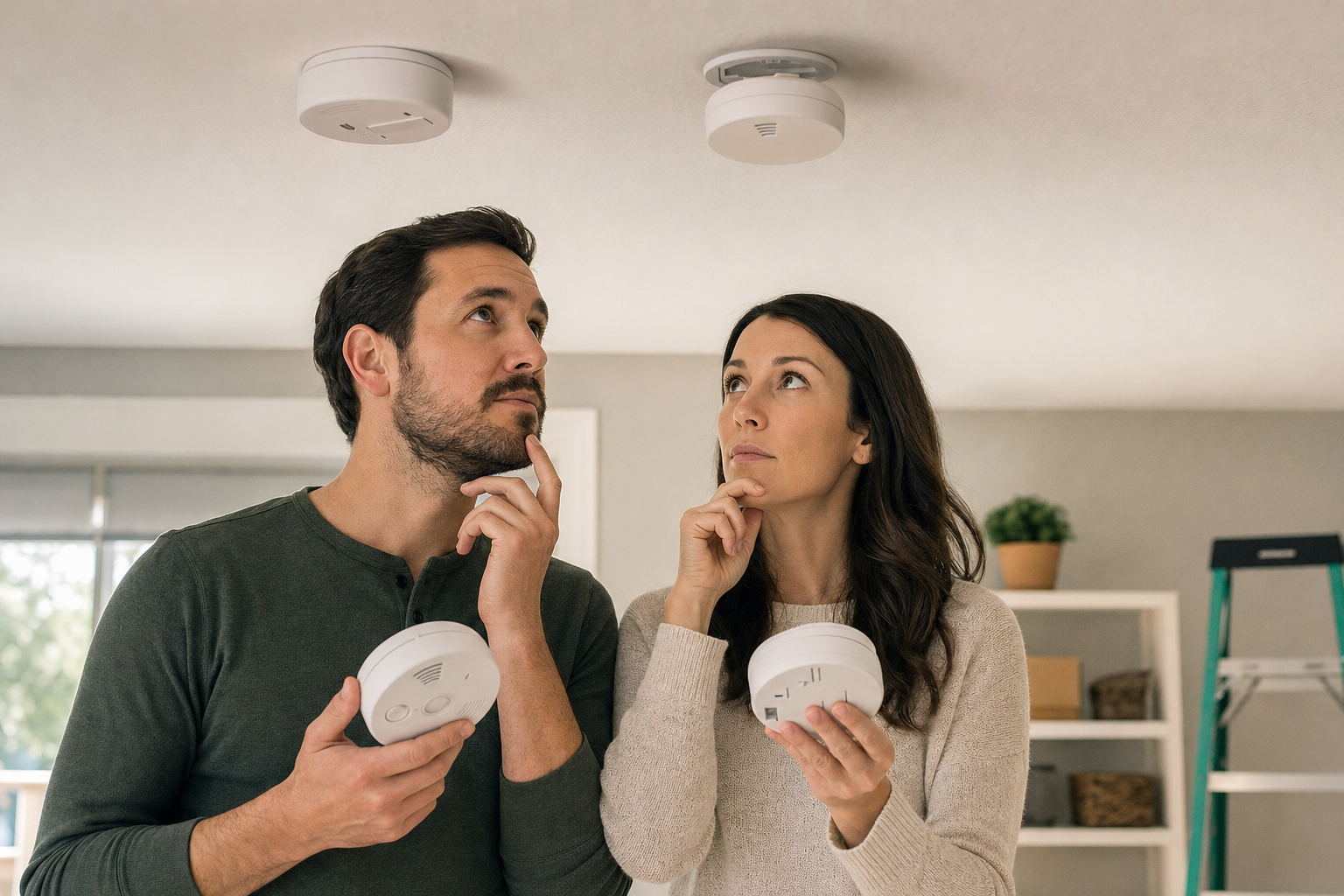
For most U.S. homeowners choosing between hardwired and battery smoke alarms, start with the home and its existing system. If the house already has hardwired, interconnected alarms, replace them with compatible hardwired models with backup power unless the local building or fire authority allows another approach. If there is no alarm wiring, sealed 10-year battery alarms can be a practical choice. In either case, prioritize interconnected alarms so that a fire detected in one area triggers an alarm throughout the home.
Hardwired alarms do not automatically detect smoke better than battery-powered alarms. Detection depends on the alarm’s sensing technology, condition, placement and installation. The practical differences are the power source, interconnection method, maintenance needs and installation work.
Use this decision tree before choosing an alarm
- Does the home already have hardwired, interconnected alarms? Replace them with compatible hardwired models that include backup power. Check the existing model numbers, the manufacturer’s compatibility information and local requirements before buying. Do not assume alarms will interconnect because their plugs fit or because they have the same brand name.
- Is there no alarm wiring at the location? Consider a sealed 10-year battery alarm. In a multilevel or larger home, choose listed battery-powered alarms that support wireless interconnection rather than unrelated standalone units.
- Are you adding a bedroom, converting an attic or finishing a basement? Ask the local building department or fire marshal whether the project requires alarms that meet current location, interconnection or power-source rules. Permitted work can trigger requirements that did not apply when the home was built.
- Are walls and ceilings already open for a major renovation? Discuss a hardwired, interconnected system with the contractor and permitting authority. New hardwired connections should be installed by a qualified electrician.
- Is this a rental? Contact the landlord or property manager rather than changing the installed power source or disconnecting an alarm. State and local rules, as well as the lease, can assign maintenance and replacement duties differently.
There is no single nationwide rule that lets a homeowner replace a required hardwired alarm with a battery-only model. Requirements vary by jurisdiction and by the scope of work. Check locally before changing an alarm’s power source, location or interconnection arrangement.
Hardwired and battery smoke alarms at a glance
| Feature | Hardwired alarm | Battery-powered alarm |
|---|---|---|
| Primary power | Household electrical system | Replaceable or sealed battery |
| During a power outage | Operates if its backup battery is working | Does not depend on household electricity |
| Interconnection | Usually through an interconnect wire; selected models also support wireless links | Standalone models do not communicate; selected models offer wireless interconnection |
| Maintenance | Monthly testing and backup-battery care as directed | Monthly testing; replace removable batteries as directed or replace a sealed unit at end of life |
| Installation | Straightforward only when a compatible connection already exists; new wiring needs an electrician | Usually easier where no wiring exists, but placement and setup instructions still apply |
| Cost pattern | Can cost more when electrical labor, repairs or permits are needed | Standalone units may cost less initially; wireless interconnected models cost more than basic units |
| Best fit | Existing wired systems, new construction and major renovations | Older unwired homes and approved locations where new wiring is impractical |
A power outage does not automatically make battery alarms more reliable. A battery-only alarm depends entirely on its battery. A hardwired alarm with a working backup battery has two available power sources, but a hardwired model without functioning backup power may not operate during an outage. Check the backup-battery design before buying a replacement.
Sealed 10-year battery alarms reduce routine battery changes and make it harder to remove a battery for another purpose. However, 10-year does not mean maintenance-free. Test the alarm monthly and replace it if it signals a fault, reaches its marked replacement date or fails a test. Hardwired alarms are also available with sealed long-life backup batteries.
Which type works best in common home situations?
An existing hardwired system
Keep the hardwired interconnection unless the local authority approves a different arrangement. Identify the make and exact model of every interconnected alarm, then use the manufacturer’s compatibility list to select replacements. Mixing unapproved models can result in nuisance alarms, failure to alarm throughout the system or other operating problems.
If alarms were installed at about the same time and are nearing the end of their service life, replacing the group together can simplify compatibility and future maintenance. U.S. Fire Administration guidance says to replace smoke alarms 10 years from their manufacture date, even if the test button still works. See why a working test button does not cancel the alarm’s expiration date.
An older home without alarm wiring
Sealed 10-year battery alarms avoid opening finished walls solely to run electrical cable. In a larger or multilevel home, wireless interconnected battery alarms are generally more useful than independent alarms because activation in a basement or distant bedroom can alert people elsewhere in the house.
Wireless interconnection does not necessarily require Wi-Fi. Many alarm systems communicate directly by radio signal, but setup procedures, range and compatible model lists vary. Buy alarms designed and listed to work together, and follow the manufacturer’s instructions for the number and placement of units.
A new bedroom, floor or finished basement
Determine whether the work needs a permit and whether current local rules require a particular power source or interconnection method. Where allowed, a compatible wireless alarm can extend whole-home interconnection without running new cable through finished areas. Some product systems can connect compatible wired and wireless alarms, but this is model-specific rather than universal.
A rental home
Tenants should not remove, cover or replace a hardwired alarm with an unrelated battery model. Report missing, expired, damaged or chirping alarms promptly to the landlord or property manager. A personal battery alarm may provide supplemental warning where permitted, but it is not a substitute for required installed equipment.
A chirp can indicate a low battery, end-of-life warning, fault or another model-specific issue. If a new battery does not solve it, consult the manual and use this guide to troubleshoot a smoke alarm that still chirps after a battery change.
A major renovation or new construction
When walls and ceilings are already open, hardwired interconnected alarms with backup power are often the practical long-term choice and may be required by the applicable code. Include alarm planning in the permit and electrical scope rather than adding it after finishes are installed. New hardwired alarm installation should be performed by a qualified electrician.
Check these details before buying replacements
- Interconnection: Confirm whether the alarm is standalone, wire-interconnected or wirelessly interconnected. Battery-powered does not automatically mean standalone.
- Compatibility: Use the exact model numbers in the product instructions. Connector shape, brand name or marketing language alone is not enough.
- Backup power: For hardwired models, determine whether backup power uses a replaceable or sealed battery and follow the manufacturer’s maintenance instructions.
- Alarm age: Check the manufacture date and any replacement date on every unit. Replace alarms according to the label and manufacturer’s instructions; U.S. guidance generally calls for replacement at 10 years.
- Coverage: Install alarms inside every bedroom, outside each separate sleeping area and on every level of the home, including the basement. Follow the product instructions and local rules for exact placement.
- Testing: Test alarms monthly and make sure every compatible interconnected unit sounds during a system test. Never disable an alarm because of cooking smoke or steam; use its hush feature and follow the manufacturer’s instructions instead.
Price should come after coverage, compatibility and code compliance. A low-cost standalone battery alarm may remove whole-home notification if it replaces one part of an interconnected system. Conversely, new electrical wiring may be unnecessary in an older unwired home when approved wireless interconnected alarms provide the required coverage. Test every alarm monthly, check its age and contact the local fire marshal or building department before changing an existing system.