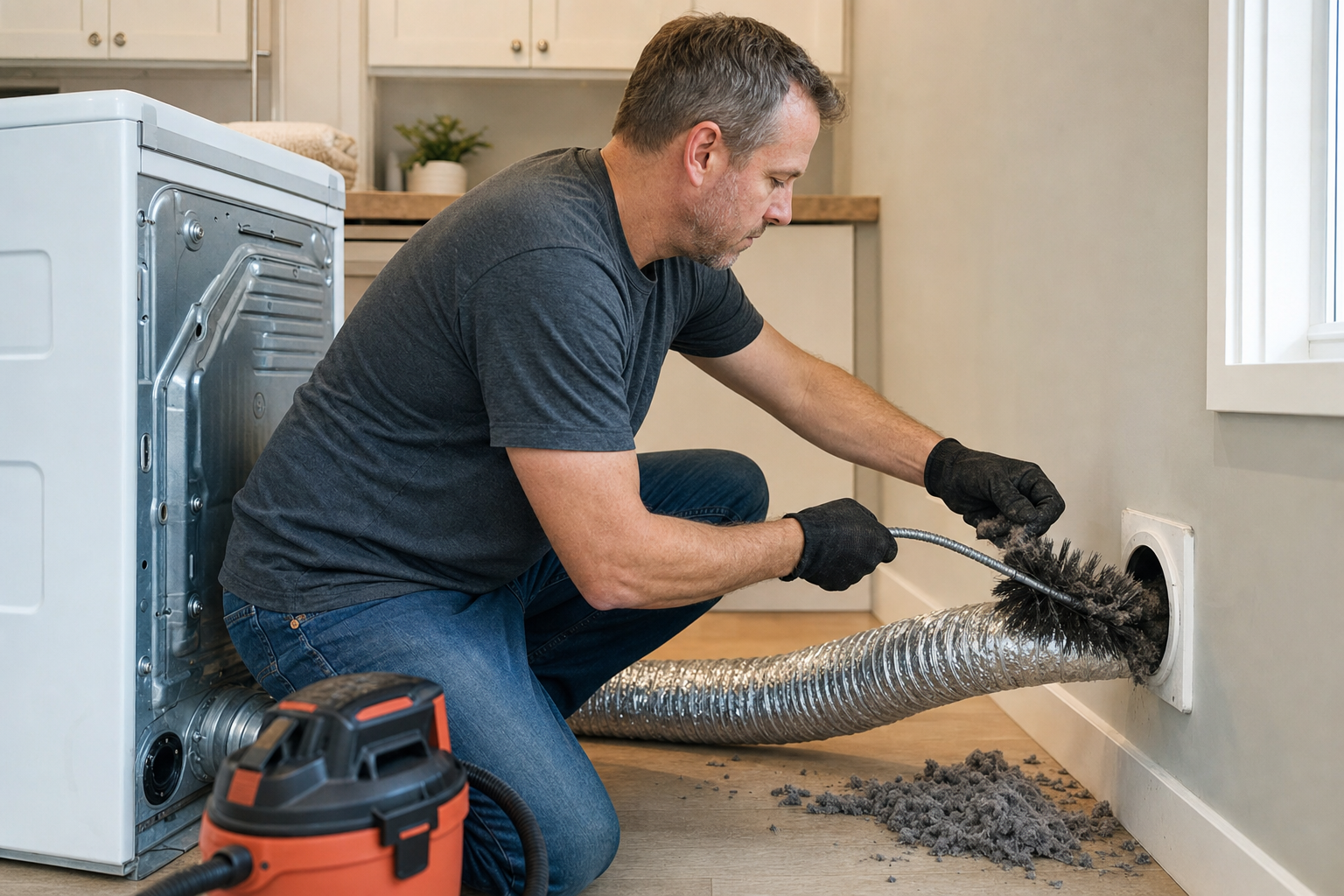
For a conventional vented clothes dryer, clean the complete exhaust duct about once a year as a practical starting point. Inspect it sooner when drying times increase, airflow at the outdoor outlet weakens, or the duct route is long or difficult to access. Clean the lint screen before or after every load. These are separate tasks: cleaning the screen does not remove lint that has collected in the connector, exhaust duct or dryer cabinet.
There is no single interval that suits every home. Dryer manufacturers may give a different maintenance schedule for a particular model, and heavy use or a restrictive duct route can require earlier attention. The key is to combine regular cleaning with prompt action when airflow or drying performance changes.
Cleaning matters for safety as well as performance. The U.S. Fire Administration reports that failure to clean was the leading factor contributing to ignition in 31 percent of home clothes-dryer fires reported from 2018 through 2020.
Set a dryer vent cleaning schedule that fits the installation
Use annual full-duct cleaning as a baseline, then inspect more often when conditions make lint buildup or restricted airflow more likely. A short, straight duct that exits through an exterior wall is generally easier to inspect and clean than a long concealed route with several bends or a roof termination.
| Household or vent condition | Practical approach |
|---|---|
| Typical household with a short, direct duct | Clean the full duct about once a year and check performance between cleanings. |
| Dryer used very frequently | Inspect the exterior outlet and drying performance more often; clean the duct earlier if airflow declines. |
| Pets, towels, bedding or other lint-heavy loads | Check for buildup more often because hair and lint can accumulate faster. |
| Long duct or several bends | Inspect more often than annually and arrange professional cleaning if the route cannot be fully accessed. |
| Roof outlet or concealed duct | Use a qualified professional when safe access or a complete inspection is not possible. |
| Drying takes longer than usual | Check the lint screen and exhaust path now instead of waiting for the next scheduled cleaning. |
Every bend adds resistance to airflow and provides a place for lint to settle. A crushed or kinked transition duct behind the appliance can cause a similar problem. The International Residential Code also limits the transition duct between the dryer and the fixed exhaust duct to a single listed and labeled length no longer than eight feet; local code requirements may differ.
A roof outlet deserves extra caution because it is harder to observe safely. Do not climb onto a roof merely to inspect a dryer outlet. If the duct route is inaccessible, arrange a professional inspection and cleaning rather than assuming the system is clear.
Clean the lint screen, exhaust duct and dryer interior separately
Clean the lint screen after every load
Remove lint from the screen before or after each drying cycle. ENERGY STAR says this improves air circulation and dryer efficiency and is an important safety measure. Do not run the dryer without its lint filter.
Dryer sheets can leave a film on the screen that reduces airflow even when little lint is visible. ENERGY STAR recommends regularly scrubbing the filter if you use dryer sheets. Follow your appliance manual for the correct washing method, and allow the screen to dry completely before putting it back.
Clean the complete exhaust duct, not just the area behind the dryer
The exhaust path runs from the dryer connection to the outdoor outlet. A proper cleaning covers the full route, including the transition duct behind the appliance and the exterior hood or vent cover. Check that the connector is not crushed, torn or kinked and that the outdoor damper opens while the dryer is running.
Leaves, lint, nesting material and other debris can obstruct the outside outlet. Do not add a screen over a dryer exhaust termination unless the dryer manufacturer and applicable local requirements specifically allow it. Model building codes generally prohibit screens at dryer-duct terminations because they can collect lint.
For a vented dryer, the permanent exhaust duct should be metal with a smooth interior. The Consumer Product Safety Commission advises replacing flexible plastic or foil accordion-style ducting, which can trap lint and is more easily kinked or crushed, with rigid or corrugated semi-rigid metal ducting. Follow the dryer manufacturer’s installation instructions when replacing any duct component.
Leave cabinet cleaning to a qualified service person
Lint can also accumulate inside the dryer cabinet, including around the blower, motor and heating components. This is different from cleaning the lint screen or household duct. The Consumer Product Safety Commission recommends periodic cleaning of the dryer cabinet interior by a qualified service person.
Do not remove appliance panels unless the owner’s manual specifically identifies the work as user maintenance and you have the necessary skills. Gas connections, electrical components and moving parts create hazards outside ordinary vent cleaning.
Ventless condenser and heat-pump dryers do not use a conventional exterior exhaust duct, so this annual duct-cleaning guideline does not apply to them. They still need regular maintenance of the lint filter and, depending on the model, a condenser, heat exchanger, secondary filter or water container. Check the manual for the model-specific schedule. Our guide to heat pump dryers versus vented electric dryers explains the broader differences.
Act promptly when airflow warning signs appear
Do not wait for an annual cleaning date if the dryer’s behavior changes. Restricted airflow often shows up as a performance problem before a complete blockage develops.
- Loads take longer to dry. Clothes that previously dried in one normal cycle remain damp or need a second cycle.
- Airflow at the exterior outlet is weak. With the dryer running, the outdoor damper should open and exhaust air should escape. Little or no airflow can indicate a blockage or damaged connector.
- The laundry room becomes unusually hot or humid. This can indicate restricted exhaust flow, an air leak or a disconnected duct.
- Clothes or the dryer seem unusually hot. Stop using the appliance until the lint screen and exhaust path have been checked.
- There is a burning or scorched smell. Stop using the dryer and arrange an inspection. If there is smoke or fire, leave the home and call 911 in the United States or your local emergency number.
- A check-vent or airflow warning appears. Some dryers can detect restricted airflow. Check the owner’s manual for the exact meaning of any light or code.
Clean the lint screen first, but do not assume that resolves a persistent airflow warning. The complete exhaust duct may need cleaning, or the appliance may need diagnosis by a service technician. Longer drying times can also result from an overloaded drum or an unsuitable cycle, so check those basics before deciding the dryer has failed.
Know when to do it yourself and when to call a professional
Do-it-yourself cleaning is most suitable for an accessible, short and uncomplicated duct route. Before moving an electric dryer or disconnecting a permitted duct connection, turn off the appliance and unplug it. Follow the owner’s manual, and make sure every duct connection is securely restored before operating the dryer.
Routine tasks you can usually handle without opening the appliance include:
- Cleaning the lint screen after every load.
- Keeping the floor and area around the dryer free of lint and clutter.
- Checking the exterior outlet from a safe ground-level position.
- Inspecting an accessible transition duct for crushing or visible damage.
- Cleaning a short, fully accessible duct with equipment intended for dryer vents, if the appliance instructions permit it.
Use a qualified dryer-vent cleaning provider when the duct is long, concealed, sharply bent, inaccessible or routed through the roof. Professional help is also appropriate if cleaning tools become stuck, the duct is damaged or airflow remains weak after cleaning. Do not move a gas dryer if doing so could strain or disturb its gas connection.
Contact an appliance service technician when a check-vent warning remains after the duct is confirmed clear, the dryer overheats, an electrical or mechanical fault is suspected, or the cabinet interior needs cleaning. A noticeable change in drying time is a reason to inspect the airflow path now, not a reason to wait for the next calendar reminder.
Sources
- U.S. Fire Administration appliance and electrical fire safety
- U.S. Fire Administration clothes dryer fire safety flyer
- Consumer Product Safety Commission overheated clothes dryers safety alert
- ENERGY STAR clothes dryers maintenance guidance
- 2024 International Residential Code dryer exhaust duct requirements