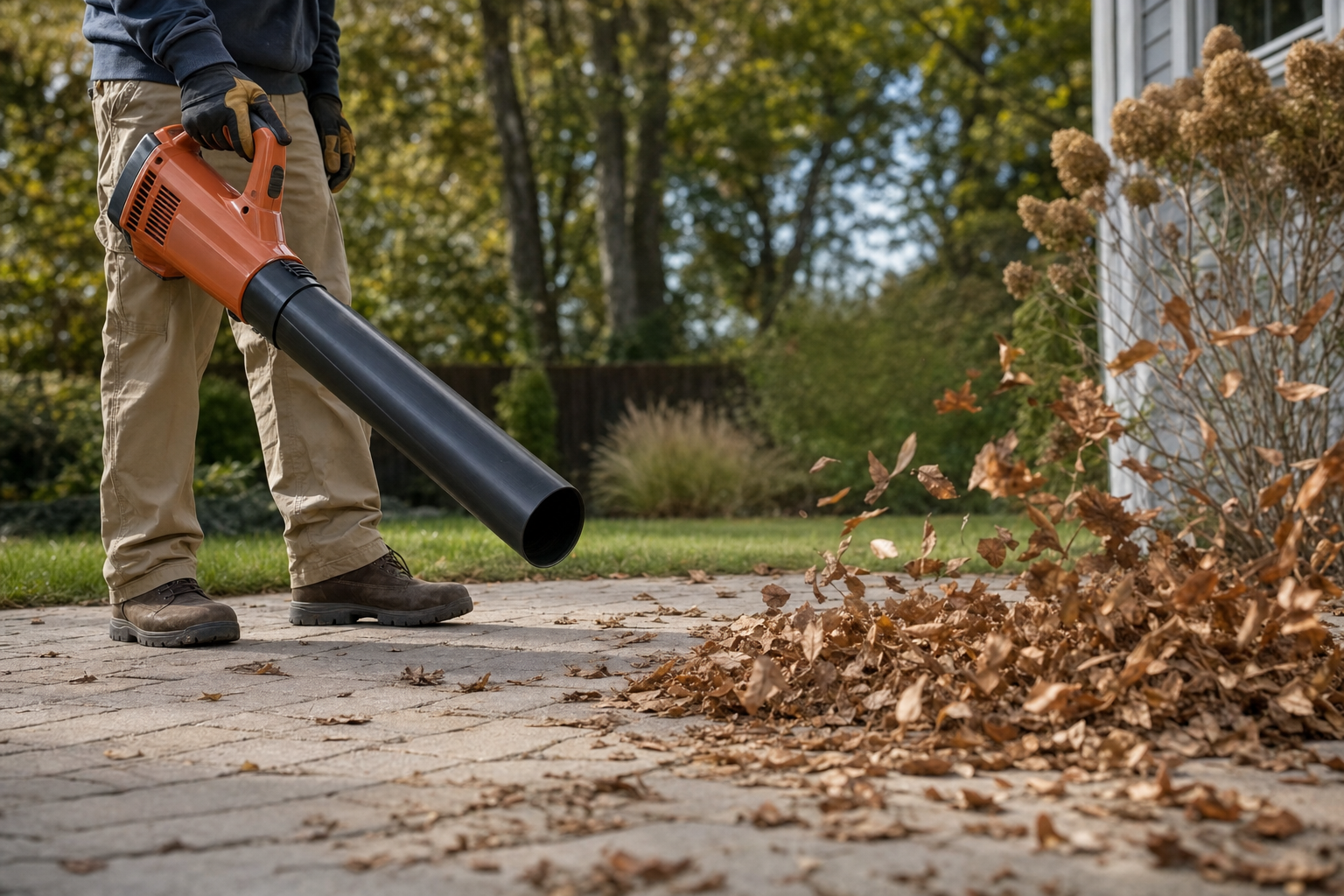
When comparing leaf blowers, do not choose a model solely because it has the largest cubic feet per minute or miles per hour figure. Cubic feet per minute, usually shown as CFM, measures air volume. Miles per hour, or MPH, measures air speed. Neither measurement describes the blower’s total performance by itself. Nozzle shape, outlet size, power mode, blowing force, runtime and control also affect how well the machine handles real yard debris.
What CFM and MPH actually measure
CFM measures the volume of air moving through a specified point each minute. As a practical rule of thumb, greater air volume can help a blower engage more loose material or cover a broader working area. That can be useful when sweeping dry leaves across an open lawn, moving grass clippings from a driveway or pushing an established pile.
However, a high CFM rating does not guarantee that a blower will easily free wet leaves pressed against pavement or embedded in turf. Its results also depend on air speed, nozzle design, the distance between the nozzle and the debris, and how the operator directs the airflow.
MPH measures how fast the air is moving at the stated measurement point. Higher speed can be useful for loosening stubborn material, particularly when a suitable nozzle directs the air where it is needed. MPH alone does not reveal how concentrated the airflow is or how much ground it covers. Concentration and coverage depend on factors such as nozzle geometry, outlet area, total airflow and operating configuration.
A small outlet can increase air speed while narrowing the stream, but that does not mean every blower with a high MPH rating automatically produces a narrow or concentrated stream. Likewise, two machines with the same rated speed may deliver different air volumes and behave differently in the yard.
- Use CFM as the air-volume measurement. It helps describe how much air the blower moves.
- Use MPH as the air-speed measurement. It tells you how fast the rated airflow is travelling.
- Use the nozzle specifications to understand coverage and direction. Do not infer those qualities from MPH alone.
Why nozzle and test conditions matter
Read specification labels and footnotes before comparing two blowers. A manufacturer may report airflow at the nozzle, inside the tube or at the blower housing. These locations can produce different figures because restrictions in the tube and nozzle affect the air before it reaches the work area. An at-nozzle rating can describe the configuration used at the outlet, but it should still be compared with another rating measured under similar conditions.
Nozzle choice can change both CFM and MPH. STIHL explains that its round blower nozzles generally provide greater air volume and a larger blowing area than its flat nozzles. Its flat nozzles provide higher air speed and are intended for heavier, wet or stuck material. These results come from the complete nozzle design, not from MPH independently determining concentration.
Published maximum figures may also represent different configurations. DEWALT, for example, lists the DCBL770B blower at 423 CFM and 129 MPH in its standard arrangement. The company says its flat concentrator nozzle can increase air speed to 175 MPH. A shopper should not assume that the blower simultaneously produces 423 CFM and 175 MPH unless the manufacturer specifically identifies those figures as one operating point.
Power mode matters too. A battery blower may achieve its largest numbers only in boost or turbo mode. That extra output can be useful for a brief section of wet leaves, but continuous operation at maximum power generally places greater demand on the battery. Look for runtime information that identifies the battery capacity, operating mode and test conditions.
Standardized testing is not universal across every product category. The Outdoor Power Equipment Institute lists ANSI/OPEI B175.2 as a safety and performance-testing standard for new internal-combustion-engine handheld and backpack blowers and blower-vacuums. Its stated scope covers gasoline-engine equipment, not electrically powered models. Published electric-blower ratings can still be informative, but buyers should not assume that every manufacturer tests every model under identical procedures.
Some companies also publish blowing force in newtons, shown as N. A newton is a unit of force, and a blower’s rating is intended to describe the pushing effect of its air stream under the tested configuration. Husqvarna, for example, lists the 590BTS with a round nozzle at 1,245 CFM, 216 MPH and 56 N of maximum blowing force.
A force rating provides useful additional context, but it is not automatically comparable across every brand. Nozzle choice, power mode and testing procedure can influence the reported result. Treat newtons as another specification to check, especially when comparing machines from the same manufacturer or products with clearly equivalent test configurations.
Match the specifications to your yard work
The following are practical starting points rather than universal performance rules. Debris moisture, leaf type, surface texture, nozzle technique and weather can all change what works best.
| Cleanup task | Useful emphasis | What to consider |
|---|---|---|
| Loose dry leaves | Air volume and coverage | A higher CFM rating and a nozzle that produces a broad working stream may help move more loose material at once. |
| Wet or matted leaves | Air speed, force and airflow | A nozzle designed for higher speed may help loosen debris, while adequate air volume helps move it after it breaks free. |
| Pine needles in grass | Speed and precise control | Focused airflow may help lift needles, but variable speed is valuable near mulch, gravel and delicate plants. |
| Grass clippings | Moderate output and control | A controllable stream can sweep clippings without producing unnecessary dust or scattering gravel. |
| Driveways and patios | Air speed and throttle control | Use enough output for material caught in joints, then reduce the speed around doors, vehicles and planting beds. |
| Large seasonal cleanups | Sustained output and capacity | Consider runtime, battery or fuel capacity, operating weight and whether a backpack format would reduce fatigue. |
There is no single CFM or MPH threshold that suits every property. A compact yard under several mature deciduous trees may produce more debris than a much larger open property. Frequent cleanup of dry leaves may require less peak performance than occasional removal of deep, rain-soaked piles.
A blower supplied with both round and flat nozzles may be more versatile than one with an exceptional headline figure but only one airflow pattern. You might use a higher-speed nozzle to loosen wet leaves beside a wall, then switch to a broader stream to gather them. Variable speed further improves control because maximum output is not desirable around mulch, loose stone, dust, windows or fragile plants.
What else to compare before buying
- Runtime: Check the battery capacity and power setting used for any advertised runtime. Confirm whether the product is a complete kit or a tool-only model that requires a separate battery and charger.
- Operating weight: Determine whether the listed weight includes the battery, fuel, blower tube and nozzle. Bare-tool or dry weight may understate what you will carry.
- Handheld or backpack design: Handheld machines are convenient for shorter jobs. Backpack blowers distribute weight across the shoulders and hips and may be more comfortable during extended cleanup, even though their total weight is often greater.
- Speed controls: A variable trigger, selectable power levels or cruise control can help limit dust, conserve battery power and reduce debris scatter.
- Noise information: Compare sound figures only when they use the same measurement, such as sound pressure at the operator’s ear. Battery equipment is not silent. The Centers for Disease Control and Prevention advises using appropriate hearing protection when loud noise cannot be avoided.
- Battery compatibility: If you already own cordless tools, verify that your batteries fit the blower and can deliver its full rated performance. A physically compatible battery may not always provide the recommended capacity.
- Included nozzles: Confirm which attachments come with the product and which were used for each CFM, MPH or force rating.
- Local restrictions: Check local rules covering blower types, noise limits and permitted operating hours before purchasing.
Start by identifying the hardest material you regularly need to move, the surfaces you clear and the length of a normal cleanup session. Then compare blowers in equivalent configurations. CFM and MPH are useful measurements, but the most suitable machine is the one that combines appropriate airflow, speed, force, control, runtime and comfort for your actual work.