For most short outages, a portable power station is the better choice for quiet, exhaust-free backup power for phones, lights, internet equipment and other modest essential loads. For multi-day blackouts or higher-demand equipment, a portable gas generator is usually more practical because it can keep running when safely refueled outdoors. Some homes benefit from both: a battery for overnight essentials and a generator for longer daytime use.
How portable power stations and gas generators differ
A portable power station stores electricity in a rechargeable battery and supplies it through alternating-current outlets and charging ports. It creates no combustion exhaust, needs relatively little routine maintenance and may be suitable for indoor use only when the manufacturer permits it.
A “solar generator” is generally a portable power station that is sold with, or can accept, solar panels. The panels do not provide unlimited power: recharge time depends on panel capacity, sun exposure, daylight, weather and the power station’s maximum solar input.
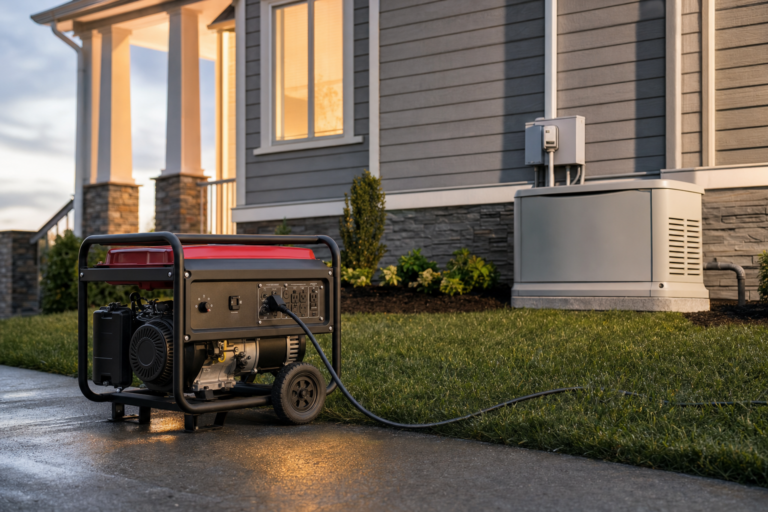
A portable gas generator makes electricity by burning gasoline, propane or another approved fuel. It can provide power for much longer than a battery if you have fuel and can refuel it safely, but it introduces carbon-monoxide, fire, noise and fuel-storage risks.
Do not compare units by their largest advertised wattage alone. Continuous output is the power a unit can supply steadily. Surge, sometimes called starting output, is the brief extra power available when a motor starts. A refrigerator, pump or furnace blower may have modest running demand but require much more power for a few seconds at startup.
Portable power station vs gas generator decision table
| Consideration | Portable power station | Portable gas generator |
|---|---|---|
| Best use | Selected essentials and short outages | Higher loads and extended outages |
| Runtime | Limited by stored watt-hours until recharged | Extended by safely adding fuel |
| Suitable loads | Router, phones, lights, television, refrigerator and compatible medical equipment | Refrigerator, freezer, sump pump, power tools and several essential loads together |
| Noise | Usually quiet, apart from cooling fans | Engine noise can affect occupants and neighbors |
| Indoor use | Only if the manufacturer allows it | Never |
| Maintenance | Periodic charging, inspection and software updates where provided | Oil, spark plug, air-filter, fuel-system and engine care |
| Storage | Dry, temperature-appropriate location | Safe equipment and fuel storage that follows local rules |
| Portability | Small units are easy to carry; large batteries can be very heavy | Many units have wheels, but the engine and fuel add weight |
| Ownership costs | No outage fuel expense, but battery capacity gradually declines with age and use | Fuel, oil, containers and maintenance add to the purchase cost |
| Apartments | Often the practical option, subject to building rules | Usually unsuitable because safe outdoor placement and fuel storage may be unavailable |
Purchase price can be misleading. A small power station may cost less overall if it covers occasional short outages without fuel or engine servicing. A generator can provide more sustained energy for the money, but you must budget for fuel storage, fuel rotation or stabilizer where appropriate, oil and maintenance.
How to estimate the output and capacity you need
Start with appliance labels, manuals and manufacturer specifications. Online wattage charts are useful for initial planning, but actual refrigerators, pumps and medical devices vary significantly.
- List essential loads. Separate needs from conveniences. A refrigerator, modem, lamp and phone chargers need far less power than electric heating, electric cooking or central air conditioning.
- Add running watts. Total the equipment that may operate at the same time. The result must stay below the unit’s continuous output rating.
- Allow for starting surge. Add the largest additional motor-starting demand to the simultaneous running load. For planning only, Honda lists an Energy Star refrigerator or freezer at approximately 132 to 192 running watts and 1,200 starting watts. Its example for a one-third-horsepower sump pump is 800 running watts and 1,300 starting watts. Use the specifications for your own equipment whenever available.
- Calculate energy. Multiply watts by expected operating hours to get watt-hours. A 50-watt load used for ten hours requires 500 watt-hours. For equipment that cycles on and off, estimate its average use over the period rather than assuming it runs continuously.
- Add a margin. For battery planning, allow roughly 20 to 30 percent for inverter losses, cold weather, battery ageing and estimation error.
For example, a refrigerator averaging 50 watts over 24 hours, a 15-watt modem and router running for 24 hours, 60 watt-hours of phone charging, 300 watt-hours of lighting and a 40-watt medical device used for eight hours would use about 2,240 watt-hours. With a 25 percent margin, plan for roughly 2,800 watt-hours of usable energy. The power station must also have enough continuous and surge output for the refrigerator and any other loads.
An average figure does not mean that a refrigerator draws 50 watts whenever its compressor runs. A plug-in electricity meter can give a more useful estimate of your own appliance’s energy use before an emergency.
Generator runtime is measured differently. Manufacturers often state hours per tank at a stated percentage of rated load. Actual runtime changes with the load, fuel type, temperature and maintenance condition. For a multi-day outage, calculate how much fuel you can safely store and use; do not assume that a single advertised tank runtime covers the event.
Choose for your household scenario and use it safely
Short apartment outage
For phones, a router, laptops, lamps and possibly a refrigerator, a power station is normally the practical choice. Check your lease and building rules, keep exits clear, and follow the product instructions for charging, ventilation, temperature and storage.
Overnight outage in a house
A medium or large power station can run selected essentials quietly without operating an engine overnight. Reserve energy for refrigeration, communications, a fan, selected lights and compatible medical equipment. Space heaters, electric water heaters and cooking appliances can drain a battery quickly.
Storm with a working sump pump
A sump pump combines a significant starting demand with unpredictable runtime. Either option can work if it handles the pump’s starting and running requirements, but a battery can be depleted quickly during continuous pumping. A gas generator may be more practical during a prolonged wet-weather event if a safe outdoor operating location is available.
Multi-day blackout
A gas generator usually has the advantage because refueling restores runtime quickly. Its practical limits are fuel availability, safe storage, noise and maintenance. Solar panels can extend battery operation, but panel output may be much lower during cloudy weather or short winter days.
Medical equipment
Do not size backup power for life-sustaining equipment from a generic appliance chart. Confirm electrical compatibility, required runtime and emergency procedures with the device manufacturer, equipment supplier and health care provider. The Food and Drug Administration advises users to check whether a device can operate safely from batteries or a generator and to plan for power loss.
Operate a portable generator outdoors only, at least 20 feet from homes and other buildings, with exhaust directed away from windows, doors and vents. Never run it in a house, garage, basement, crawlspace, shed, carport or other enclosed or partly enclosed area, even if doors or windows are open. Keep working carbon-monoxide alarms in the home, protect the generator from wet conditions as its manual directs, and shut it down and let it cool before refueling.
For a portable power station, look for a product that is listed or certified by a recognized testing laboratory for an applicable safety standard. UL 2743 is one standard that covers portable power packs intended for use when normal grid power is unavailable. A marketing statement that a product is merely “designed to meet” a standard is not the same as independent certification. Stop using a battery product that is damaged, swollen, unusually hot, smoking or producing an unusual odor, and follow the manufacturer’s instructions.
Never connect a portable generator directly to household wiring through improvised cords or outlets. This can backfeed utility lines and create an electrocution hazard. Supplying a home electrical panel requires properly installed transfer equipment and compliance with local electrical requirements. If safe generator placement is impossible, choose battery backup or seek advice on a professionally designed system instead.
Sources
- U.S. Consumer Product Safety Commission generator safety guidance
- Honda Power Equipment wattage estimation guide
- Food and Drug Administration guidance for medical devices during emergencies
- UL Solutions portable power pack testing and UL 2743 information
- Occupational Safety and Health Administration portable generator safety guidance