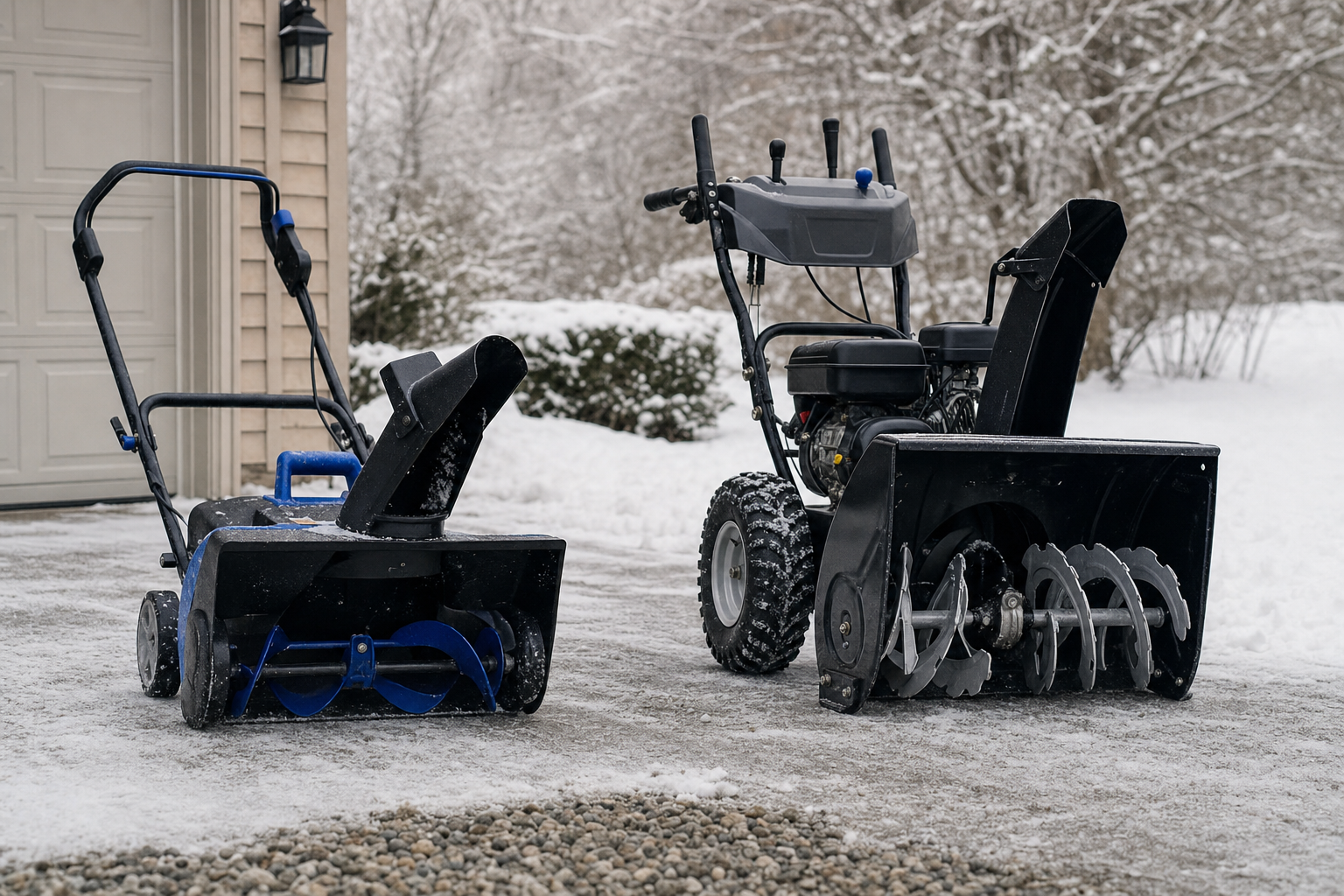
The practical answer is to match the snow blower to your driveway surface, snow conditions and storage space rather than simply buying the larger machine. A conventional single-stage snow blower is usually the better fit for a short, level, paved driveway and routine light snowfall. A two-stage model is usually the better fit for gravel, uneven ground, larger areas, frequent wet snow and dense piles left by a plow. High-capacity single-stage and compact two-stage models overlap, so compare the instructions and specifications for the individual machine before buying.
Snow depth alone is not a reliable buying rule. Six inches of wet, compacted snow or an end-of-driveway plow pile can demand more from a machine than a deeper layer of dry powder. The surface beneath the snow is just as important: a machine that clears pavement very closely may not be suitable for loose gravel.
How single-stage and two-stage snow blowers work
A typical single-stage snow blower uses a rotating auger or paddle system to collect snow and discharge it through the chute. Many conventional models have rubber-edged paddles that work very close to the pavement. This helps them scrape smooth asphalt or concrete cleanly and keeps the machine relatively light and easy to turn.
That close-to-ground design is useful on paved paths, narrow driveways and sidewalks, but it can be a disadvantage on loose surfaces. A conventional single-stage machine may collect stones, sticks or other debris along with the snow. Anything picked up can be thrown from the chute, so clear loose debris before use and follow the manufacturer’s surface instructions.
A two-stage snow blower uses an auger to bring snow into the housing and an impeller to move it through the discharge chute. Its auger is normally supported above the ground by skid shoes, while a scraper bar clears snow near the surface. The skid shoes can be adjusted to raise the housing over gravel, rough pavement and uneven areas.
Most two-stage machines are self-propelled and have a taller intake housing than typical single-stage models. These features can reduce the physical effort of clearing a long or wide driveway, particularly when snow is wet, deep or repeatedly packed down. They also make the machines heavier and require more storage space.
There are important exceptions. For example, Toro’s SnowMaster line is sold as single-stage equipment but includes self-propelled operation, a 24-inch clearing width and a high-capacity auger system. Conversely, compact two-stage machines can offer a 24-inch clearing width without the footprint of a full-size machine. The stage label is a useful starting point, not a complete description of capability.
Single-stage vs two-stage snow blower decision table
| Property condition | Usually the better fit | Why |
|---|---|---|
| Smooth, level, short paved driveway | Single-stage | It is generally lighter, easier to maneuver and can clear close to pavement. |
| Gravel or loose-stone driveway | Two-stage | Adjustable skid shoes can raise the housing to reduce the risk of picking up stones. |
| Long or wide driveway | Two-stage | Self-propelled drive and a larger housing can reduce effort and the number of passes. |
| Frequent wet snow or dense plow piles | Two-stage | The separate auger and impeller system is generally better suited to sustained, heavy clearing. |
| Limited shed or garage space | Single-stage or compact two-stage | Compare stored length, width, height and handle position, not clearing width alone. |
| Gentle paved slope | Depends | A self-propelled single-stage or two-stage model may work; traction and operator control matter most. |
| Steep, icy or uneven slope | Self-propelled two-stage | Its weight and driven wheels can offer more controlled forward movement, but conditions can still be hazardous. |
| Cleanest result on smooth pavement | Conventional single-stage | Ground-hugging paddles generally leave less snow behind. |
Match the machine to your driveway surface
Paved asphalt and concrete
For a smooth, level paved driveway, a conventional single-stage snow blower is often the most convenient choice. It is easier to pivot around vehicles, steps and narrow gates than a larger two-stage machine, and its paddles can clear close to the surface. That can limit the thin layer of snow that later refreezes.
A two-stage machine also works on pavement. Set its skid shoes and scraper bar according to the operator’s manual so the housing clears properly without catching cracks or raised joints. If your driveway has decorative concrete, pavers or a finished surface that marks easily, look for compatible non-abrasive skid shoes and accept that raising the housing may leave more snow behind.
Gravel, crushed rock and uneven ground
A two-stage model is normally the safer default for a gravel driveway because its skid shoes support the auger housing above the surface. For gravel or crushed rock, raise the skid shoes enough to prevent the machine from picking up stones. The correct setting depends on the surface and the model, so use the manual’s procedure rather than copying a measurement from another machine.
Leaving a thin base of packed snow is preferable to throwing gravel at windows, vehicles or people. Check the skid shoes and scraper bar before the season and periodically during use. Worn or uneven skid shoes can tilt the housing, reduce consistent clearing and make the machine more likely to catch on an uneven surface.
Do not assume that every single-stage model is unsuitable for gravel. Some models accept adjustable skid shoes designed for uneven or gravel surfaces. However, that does not make all single-stage designs equivalent to a two-stage machine. Check the manufacturer’s instructions for the exact model and use a cautious clearing height.
Consider snow type, driveway size and storage
Wet snow, refrozen slush and plow berms are harder to move than dry snow because they are dense and can clog a chute. If those conditions are routine where you live, a two-stage machine gives you more reserve capacity than a basic single-stage model. If they occur only occasionally on a short paved driveway, it may be more practical to clear in stages during a storm rather than buy a much larger machine.
Driveway size changes the calculation. A lightweight single-stage machine is easy to bring out for a quick pass, but manually guiding it becomes tiring over a long clearing route. A self-propelled two-stage machine can make a multi-car driveway more manageable, although it takes more strength to turn, transport and store when the engine is off.
Measure the route from storage to the driveway before purchasing. Check the clear width of doors and gates, the available depth in the garage or shed, thresholds, steps and whether the handle folds. A compact two-stage model may be only 24 inches wide at the housing, yet its overall stored dimensions and weight can still be substantially greater than those of a small single-stage machine.
Stage count is separate from power source. Battery and gasoline snow blowers are available in both single-stage and two-stage designs. Choose the mechanism and size that suit the property first, then compare battery runtime, charging, starting procedure, maintenance requirements and fuel storage in the battery or gas snow blower guide.
Recommendations for common buying situations
- Short urban driveway with light snow: Choose a conventional single-stage model when the surface is smooth and paved and storage is tight. Its close clearing and easy handling are usually more valuable than maximum capacity.
- Medium paved driveway with changeable winters: Compare a high-capacity single-stage machine with a compact two-stage model. Focus on intake height, drive system, weight, clearing width and the manufacturer’s approved surfaces.
- Gravel driveway with modest snowfall: Start with a two-stage machine with adjustable skid shoes. Set the housing high enough to avoid stones before the first storm.
- Large driveway with wet snow and plow piles: Choose a self-propelled two-stage model with an intake housing and chute controls that suit the amount of snow you normally handle. Do not choose width alone if the machine will be difficult to turn or store.
- Sloped paved driveway: Favor a self-propelled machine and assess traction carefully. A two-stage model is often the more practical choice for a substantial slope, but never use any walk-behind snow blower where footing or control is unsafe.
- Decorative pavement and close cleanup: A conventional rubber-paddle single-stage machine usually provides the closest finish. If you need two-stage capacity, set the skid shoes appropriately and expect some snow to remain where clearance is needed to protect the surface.
Snow blower safety: Never put your hands into a clogged chute or auger housing. Shut off the machine, remove the key or disconnect power as directed in the operator’s manual, wait for all movement to stop, and use the supplied cleanout tool or a suitable stick to remove the blockage.
Before buying, identify the feature that makes your driveway hardest to clear: loose gravel, a steep section, wet plow debris, recurring deep snow or limited storage. Let that condition determine the type of machine, then compare individual models for their approved surfaces, dimensions, weight and controls.