Drip faucets that serve vulnerable indoor pipes when a hard freeze is expected, especially if temperatures will fall below about 20°F or remain below 32°F for many hours. There is no single temperature that is safe for every home. A well-insulated pipe inside a heated wall may be fine during a brief dip into the teens, while a pipe in an exterior wall, crawl space, attic, garage or unheated basement can freeze during a longer period at or below 32°F.
Why 20°F is a guide rather than a universal rule
Some water utilities use 20°F as a practical threshold. Chesterfield County, Virginia, for example, advises residents to leave faucets dripping slowly when temperatures are expected to fall below 20°F. That is a useful prompt to act, not a guarantee that pipes are safe above 20°F or will freeze below it.
What matters is the temperature around the pipe, not only the temperature reported in the forecast. Pipes are at greater risk when cold air can reach them or when cold weather lasts long enough for walls, floors and unheated spaces to cool down.
Start precautions earlier, including during a sustained freeze near or below 32°F, if your home has any of these risk factors:
- Exposed plumbing: Pipes in crawl spaces, attics, unfinished basements, garages or exterior walls are more vulnerable.
- A long freeze: Several hours below freezing, repeated freezing nights or daytime temperatures that stay below freezing give pipes and surrounding materials more time to cool.
- Past freezing problems: A pipe that has frozen before should be treated as high risk until the underlying insulation, air-leak or routing problem is fixed.
- Cold drafts: Gaps around pipe penetrations, open garage doors, damaged windows and other openings can expose plumbing to freezing air.
- Loss of heat: A heating-system failure or power outage can quickly put normally protected pipes at risk.
- Lightly insulated construction: Plumbing beneath a mobile home or close to an exterior surface may cool faster than plumbing in a conventional insulated wall.
Follow instructions from your local water utility if it gives a different threshold or asks residents to conserve water. Construction methods, pipe locations and local water-system conditions vary widely.
Which faucets to drip and how much water to use
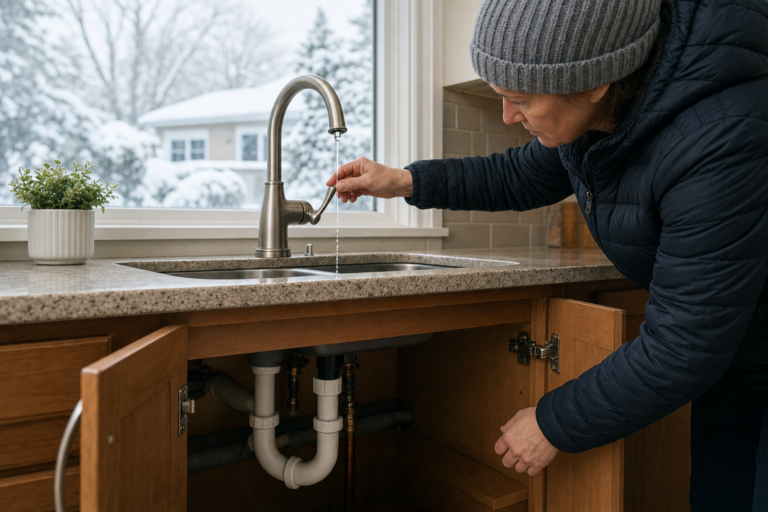
Do not automatically run every faucet. Drip the indoor fixture served by the pipe most likely to freeze. This may be a kitchen or bathroom sink on an exterior wall, a faucet above a crawl space or unheated basement, or a fixture whose pipes pass through a garage.
If you do not know where the pipes run, start with sinks on exterior walls and fixtures that have frozen before. Open cabinet doors beneath those sinks so warm room air can circulate around the plumbing. Move cleaners, medicines and other hazardous products out of the reach of children and pets before leaving cabinets open.
The American Red Cross advises letting cold water drip from the faucet served by exposed pipes. If both the hot- and cold-water lines are exposed, protect both lines. Oklahoma City advises opening both supplies, then reducing the flow to a small, steady stream. On a single-handle faucet, set the handle near the middle only when both supply lines need protection.
- Separate hot and cold handles: Open each vulnerable supply slightly.
- One vulnerable line: Run only that supply rather than sending water through a protected line unnecessarily.
- Single-handle faucet: Use a centered setting when the hot- and cold-water pipes share the same vulnerable area.
A small, continuous stream is usually appropriate: about as narrow as pencil lead or a strand of spaghetti. It does not need to be a normal hand-washing flow. Keep the drain clear and do not leave a stopper, dishes or other items in the sink that could cause an overflow.
A trickle can help prevent water from freezing in a vulnerable line. Leaving the faucet open also gives expanding water a path to escape if ice forms, which can reduce pressure in the pipe. It is not a substitute for insulation, air sealing or reliable heat, and severely exposed plumbing can still freeze.
When to start and stop dripping faucets
Begin before the coldest part of the weather, not after a faucet has slowed or stopped. Check the hourly forecast as well as the overnight low. A brief dip to 25°F is different from a full day below freezing followed by a night near 15°F.
Keep the heating system operating at a steady temperature during a freeze. If you will be away, the American Red Cross recommends leaving the heat on and setting it no lower than 55°F. For related guidance, see what temperature to leave your house in winter when away.
Stop dripping when freezing conditions have ended and vulnerable spaces have had time to warm. Do not stop simply because the sun is out if another freeze is expected that night. During a widespread cold event, check for guidance from your water provider; utilities may issue specific instructions based on local conditions and system demand.
Dripping alone may not protect pipes during a prolonged power or heating outage. If the building cannot be kept above freezing, contact a qualified plumber for advice on shutting off and draining the plumbing. Homes with wells, water heaters, fire-sprinkler systems or other specialized equipment may need a different procedure.
Prepare outdoor faucets instead of relying on a drip. Disconnect, drain and store garden hoses. If your home has a dedicated indoor shutoff for outdoor faucets, close it, open the outdoor faucet to drain the line and leave the faucet open as directed by the manufacturer. An insulated faucet cover can provide additional protection. Even frost-free faucets need hoses removed so the faucet can drain properly. See whether frost-free faucets need an indoor shutoff in winter.
How to recognize and safely thaw a frozen pipe
A frozen pipe is likely when a faucet that normally works produces only a trickle or no water during freezing weather. Check other fixtures to see whether the problem is limited to one branch line or affects more of the home. Accessible pipes may also show frost, feel unusually cold or have a visible bulge.
- Check for leaks first. If you see water, hear spraying inside a wall or find a cracked pipe, shut off the main water supply if it is safe to do so and call a licensed plumber.
- Leave the affected faucet open. Water can begin flowing as the ice melts, and an open faucet helps relieve pressure.
- Apply gentle heat to an accessible pipe. Use an electric hair dryer, an electric heating pad or towels soaked in hot water. Warm the pipe gradually, beginning near the faucet and working toward the frozen section.
- Never use an open flame. Do not use a blowtorch, propane or kerosene heater, charcoal stove or similar device to thaw plumbing.
- Inspect after thawing. Once normal water pressure returns, check accessible pipes, fittings and nearby areas for leaks.
Call a licensed plumber if you cannot locate the frozen section, the pipe is inaccessible, normal flow does not return or you find a crack or bulge. Repeated freezing in the same place calls for a permanent repair, such as insulation, air sealing, approved heat cable or rerouting the pipe, rather than depending on a dripping faucet every winter. Homes with plumbing beneath the floor may also benefit from reviewing whether crawl-space vents should be closed in winter.