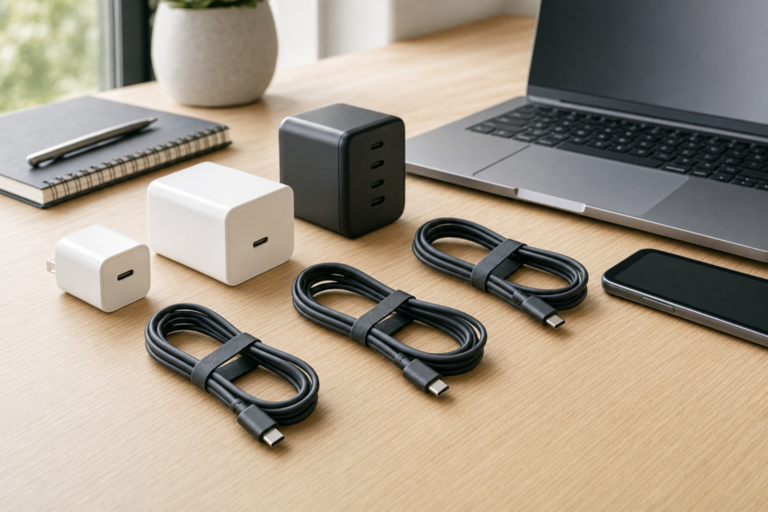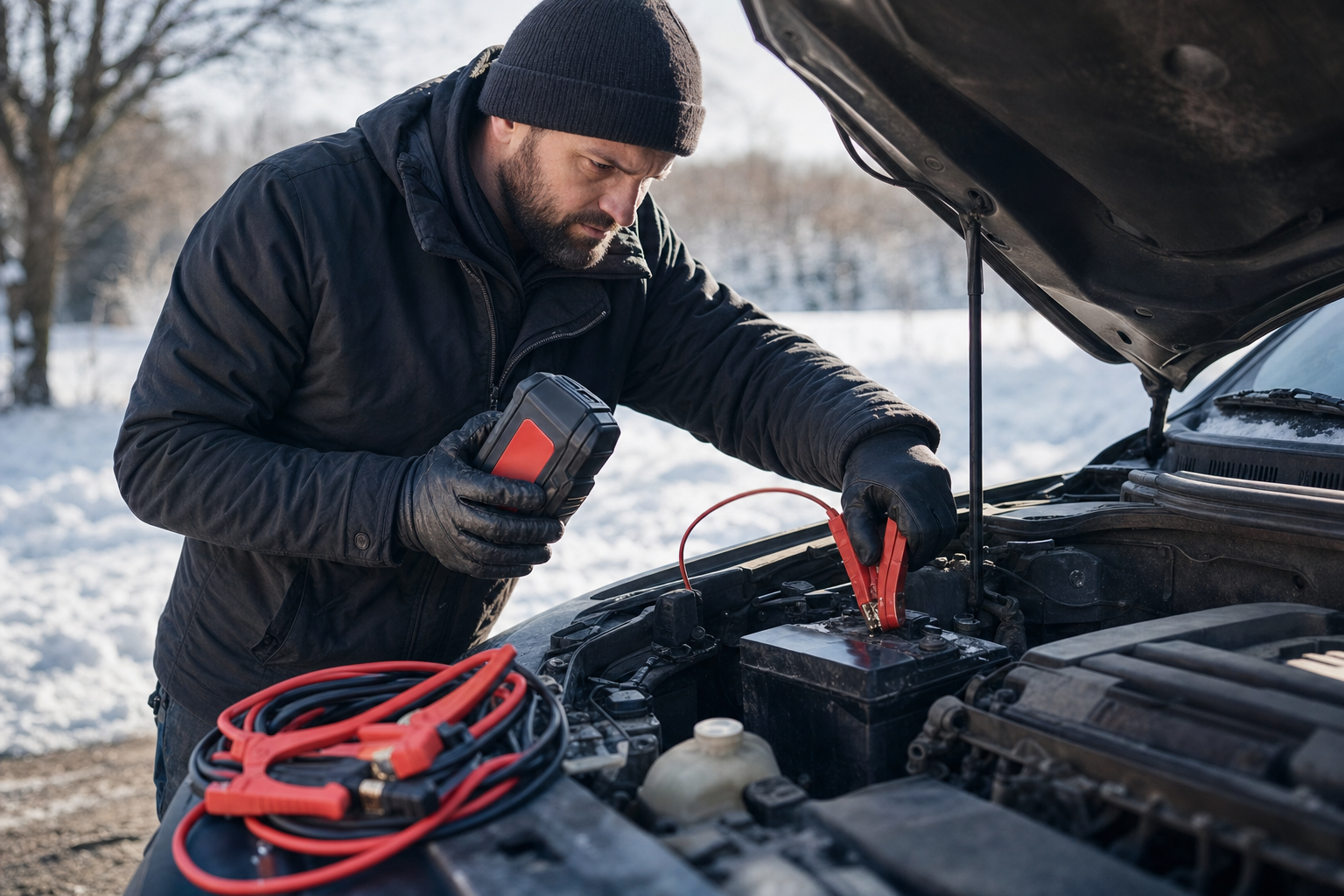
In a portable jump starter versus jumper cables comparison, a maintained jump starter is usually the better primary choice for drivers who may be alone because it can start a compatible vehicle without another car. Jumper cables cost less and do not need charging, but they need a suitable external 12-volt power source. For remote travel, harsh winters or maximum backup, carrying both is the most practical option.
Which option fits your driving situation?
| Consideration | Portable jump starter | Jumper cables |
|---|---|---|
| External power source needed | No | Yes, usually another compatible vehicle |
| Routine maintenance | Check the charge and recharge as the manual directs | Inspect clamps, insulation and wire |
| Long-term storage | Gradually loses charge | Stays electrically ready if kept dry and undamaged |
| Cold-weather performance | Available output can fall in severe cold | Depends on cable quality and the donor power source |
| Typical cost | Higher | Lower |
| Main advantage | Independent starting power | Simple, inexpensive backup |
Choose a portable jump starter if you commute at unusual hours, regularly drive alone, park where another vehicle may not be able to approach or travel through lightly populated areas. It can reduce the need to ask a stranger for help. Many units also include a flashlight, device-charging ports or an air compressor, although starting capability, safe operation and compatibility should come first.
Choose jumper cables if price and low maintenance matter most and you usually drive in populated areas. Cables are also a sensible choice for someone unlikely to follow a charging schedule. Their main limitation is important: even excellent cables cannot help without an appropriate source of power.
Carry both if a no-start situation would create a serious problem, you drive in very cold weather, own a truck or diesel vehicle, take long road trips or sometimes help other motorists. The jump pack provides independence, while the cables remain available if the pack has discharged, is outside its operating-temperature range or does not have enough capacity for the vehicle.
How to select the right jump starter or cables
Start with your vehicle owner’s manual. Confirm the electrical-system voltage, approved jump points and any warnings about jump-starting or using the vehicle to assist another one. Most passenger vehicles use a 12-volt starting or auxiliary system, but commercial trucks, recreational vehicles and specialty equipment may differ. Never connect a 12-volt product to a 24-volt system unless the product manufacturer explicitly approves that use.
For a portable jump starter, use the jump-starter manufacturer’s stated vehicle and engine limits. Makers commonly list maximum gasoline and diesel engine sizes. Diesel engines generally require more starting power, so a unit that is rated for a large gasoline engine may be suitable for a smaller diesel engine. Leave a useful capacity margin for cold weather rather than choosing the smallest unit that nominally fits your engine.
Do not compare products by peak-amp claims alone. Brands may measure or present that marketing figure differently. A stated gasoline and diesel engine rating, an accessible manual, clear operating-temperature limits and a reputable manufacturer are more useful buying checks.
For traditional cables, gauge describes wire thickness: a lower gauge number means thicker wire. For most passenger cars, four-gauge or six-gauge cables measuring 10 to 20 feet are practical. Longer cables make it easier to connect vehicles when batteries are on opposite sides, but length also adds electrical resistance. Choose thicker wire for longer cables, larger engines and colder conditions.
Look for clamps that open widely, grip securely and have clean metal contact surfaces. Flexible insulation is valuable in winter, when stiff cable jackets can be difficult to position. Thin eight-gauge or 10-gauge cables are a poor choice for demanding cold-weather use, larger vehicles or diesel engines.
Cold weather, charging and storage
Cold conditions challenge both the vehicle battery and emergency equipment. AAA reports that a conventional car battery can lose about 35 percent of its strength at 32°F and about 60 percent at 0°F. A cold engine can also require more current to start. A marginal vehicle battery, undersized jump starter or thin cable set is therefore more likely to disappoint during a hard freeze.
Jumper cables can remain useful after long storage, provided they stay dry and intact. Coil them loosely in a protective bag and inspect them at least seasonally for corrosion, loose clamps, exposed wire or brittle insulation. Replace damaged cables rather than covering serious defects with tape.
A lithium-ion jump starter gradually self-discharges. Charge it fully when new, after use and at the interval stated in its manual. Check the charge indicator before winter and before a long trip rather than relying on a pack that has sat untouched for a year.
Follow the pack’s published storage and charging-temperature limits. A freezing trunk can reduce available output, while a closed vehicle in direct summer sun can exceed a product’s safe storage range. Keep the pack secured in its protective case, dry and away from loose metal objects. If local temperatures regularly exceed the manufacturer’s limits, store it indoors and remember to return it before driving.
While preparing for winter, also review whether all-weather or winter tires fit your conditions and whether you need snow chains, cables or snow socks.
Safety features and buyer checklist
Look for a jump starter with clear instructions and protections against reverse polarity, short circuits, overcurrent and overheating. If a manufacturer says a model is certified to UL 2743, the safety standard for portable power packs that can include vehicle-booster functions, verify the certification for the exact product rather than relying only on a marketplace logo or a claim about tested cells. A claim that individual cells are tested is not the same as certification of the complete jump starter.
Check for recalls and safety warnings before buying and periodically afterward. On September 17, 2026, the U.S. Consumer Product Safety Commission warned consumers to stop using Hererod jump starters and power banks, models PW40 and EW40. The commission said it was aware of 16 fire reports, including seven reports of property damage. The warning is a reminder to check the exact make and model, not just a product category.
Do not attempt to jump-start a battery that is frozen, cracked, leaking or visibly swollen. Do not improvise if the voltage, battery type or correct connection points are uncertain. Take a jump pack out of service if it becomes swollen, unusually hot, damaged or gives off an unusual odor. Follow local hazardous-waste instructions for defective or recalled lithium-ion products; do not put them in household trash, curbside recycling or ordinary battery-recycling boxes.
Electric vehicle and hybrid owners need extra care. The high-voltage traction battery cannot be jump-started. In most cases, only the conventional 12-volt battery can be jumped, and its location, jump points and restrictions vary by model. Follow the owner’s manual exactly. Some electrified vehicles should not be used as donor vehicles for another car.
Before buying, confirm these essentials:
- Compatibility: Correct voltage, approved battery connections, fuel type and stated engine-size rating.
- Cold performance: Adequate capacity margin and a suitable operating-temperature range.
- Cable quality: Thick conductors, useful length, flexible insulation and secure clamps.
- Protection: Reverse-polarity, short-circuit, overcurrent and overtemperature safeguards on a jump pack.
- Certification: Any claimed independent finished-product certification can be verified for the exact model.
- Recall status: No active recall or safety warning for the exact model.
- Upkeep: A charging and inspection schedule you will actually follow.
If you will reliably recharge it, a correctly sized portable jump starter gives you the most independence. If you want inexpensive equipment that cannot quietly lose its charge, choose substantial jumper cables. When storage space and budget permit, keep both and inspect them as part of seasonal vehicle preparation.
Sources
- AAA Club Alliance guide to jumper cables and portable jump starters
- National Highway Traffic Safety Administration electric and hybrid vehicle battery safety guidance
- UL Solutions portable power pack testing and UL 2743 information
- U.S. Consumer Product Safety Commission warning for Hererod jump starters and power banks