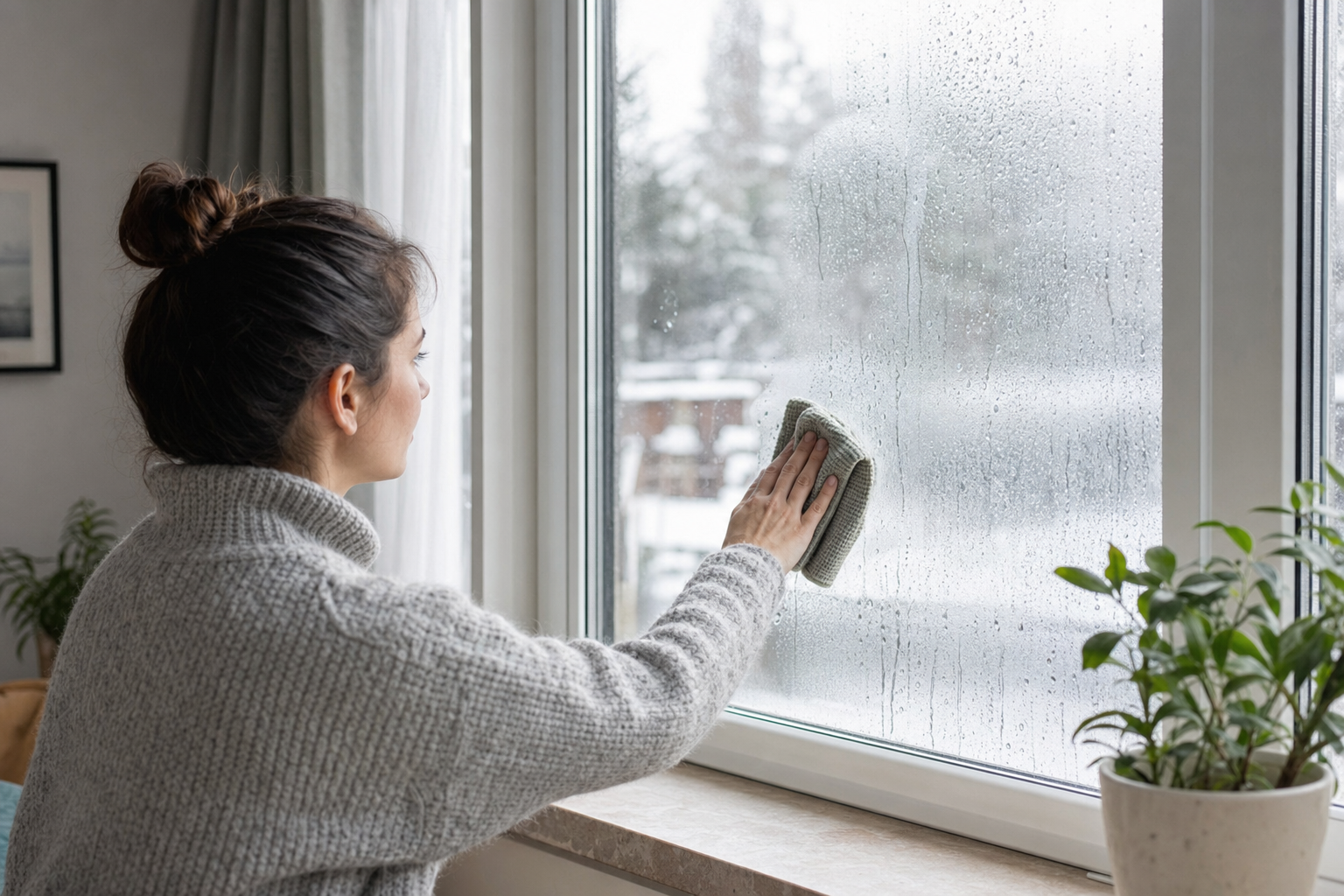
To stop condensation on windows in winter without replacing them, reduce indoor moisture, use kitchen and bathroom exhaust ventilation, improve airflow across the glass and address drafts. First, confirm where the moisture is located: water on the room-facing glass is usually indoor condensation, while moisture between panes or water entering around the frame needs a different repair.
Identify where the window moisture is located
Do not assume that every wet or foggy window needs replacement. Inspect the window closely before changing humidity settings or arranging repairs.
| Location | Likely cause | First response |
|---|---|---|
| Room-facing glass | Humid indoor air reaching cold glass | Reduce moisture and improve airflow over the glass |
| Between double- or triple-pane glass | A problem with the insulated-glass seal | Ask a window or glass professional whether the glass unit or sash can be replaced |
| Outside glass surface | Outdoor air reaching its dew point on cool glass | Usually no action is needed |
| Frame, sill or nearby wall | Possible rain, snowmelt, plumbing or flashing leak | Find the water entry point and arrange repairs |
Interior condensation can be touched and wiped from inside the room. It often collects at the bottom edge of the glass or around the frame, where the surface may be coldest. It can become noticeably worse after showers, cooking or a rapid drop in outdoor temperature.
Moisture between panes cannot be wiped away from either side. Persistent cloudiness, droplets or haze inside a sealed insulated-glass unit usually means the unit needs assessment. Lowering household humidity may reduce condensation elsewhere, but it will not remove moisture already trapped between the panes.
Exterior condensation wipes from the outdoor face. It occurs when humid outdoor air meets glass cooled below its dew point. In winter, exterior moisture may also be frost rather than liquid water. It normally clears as weather and glass temperature change.
A leak is more likely when dampness follows wind-driven rain or melting snow, or when it appears at joints, trim, drywall or the sill rather than evenly across the glass. Stains, peeling paint, swollen trim, soft wood and recurring damp patches need prompt investigation.
Check indoor humidity and moisture sources
Condensation forms when humid air contacts a surface colder than its dew point. A small digital hygrometer, which measures relative humidity, can help show whether indoor moisture is contributing to the problem. Use its reading as a useful guide rather than an exact diagnosis, since inexpensive meters vary in accuracy.
- Put the hygrometer in the affected room. Keep it away from the window, a heating register, direct sun, the kitchen range and a humidifier’s mist stream.
- Check it at different times. Look in the morning after a cold night and again later in the day. Note the room temperature as well as relative humidity.
- Record moisture-producing activities. Showers, cooking, dishwashing, indoor clothes drying, houseplants and normal occupancy all add water vapor. A humidifier that was appropriate in mild weather may be too high during a cold spell.
- Compare rooms. Condensation limited to a bathroom or bedroom may indicate a local ventilation, heating or airflow problem. Wet windows throughout the home suggest a larger moisture load.
For general indoor-air-quality control, the U.S. Environmental Protection Agency recommends keeping relative humidity ideally between 30% and 50%. In cold weather, however, many homes need a lower setting to keep windows dry. The right winter level depends on outdoor temperature, indoor temperature, window construction, frame material, air leakage and whether blinds or curtains trap cold air against the glass.
Rather than relying on one fixed percentage, lower humidity gradually until persistent window moisture stops. Turn down or temporarily switch off the humidifier first, then reduce other moisture sources and use exhaust ventilation. During a severe cold snap, a further reduction may be needed. For temperature-based guidance, see what indoor humidity should be in winter.
Reduce moisture and improve airflow
Remove moisture at its source
Use ventilation where moisture is produced instead of trying to correct the whole-house humidity level afterward.
- Run the bathroom exhaust fan during showers, keep the bathroom door closed while it operates and leave the fan on afterward. A practical starting point is at least 20 minutes; a persistently damp bathroom may need a longer cycle or a fan and ductwork check. See how long to run a bathroom fan after a shower.
- Use a range hood that vents outdoors when boiling, steaming or simmering. Use lids when practical.
- Make sure the clothes dryer vents outdoors. Avoid routinely drying wet laundry indoors during cold weather.
- Lower the humidifier setting or turn it off temporarily if windows are wet. Follow the manufacturer’s cleaning instructions; see whether you can use tap water in a humidifier for water-selection guidance.
Bathroom fans, range hoods and dryers should discharge outdoors, not into an attic, garage, crawlspace or another enclosed area. A sheet of tissue held near an operating bathroom exhaust grille should be drawn toward it, but that quick check cannot confirm that the fan is moving its rated airflow or that the duct is clear. If it is safe to do so, inspect the exterior vent while the fan or dryer runs and remove accessible lint, debris, ice or snow that blocks the outlet.
Keep warm room air moving across the glass
Closed curtains and tightly lowered blinds can isolate the glass from warm room air, making condensation behind the covering worse. Open window coverings during the day. If moisture develops overnight, leave a gap at the top or bottom so air can circulate.
Keep heating registers clear, move furniture away from windows and exterior corners, and leave interior doors open when practical. If one room is consistently colder than the rest of the home, correct the heating or insulation problem where possible. A cold bedroom with heavy curtains can have wet windows even when the humidity reading near the central thermostat seems reasonable.
Make the window surface warmer without replacement
Weatherstripping an operable sash and sealing appropriate gaps around the window can reduce drafts that chill the interior glass and frame. Do not block drainage or weep holes designed to let water escape. If you find gaps between the window unit and wall opening, or loose trim, consider an energy assessment or a qualified contractor rather than applying sealant blindly, because correct air sealing and water management must work together.
Storm windows, well-fitted interior storm panels and carefully installed shrink-film window kits can add an insulating air layer. Window film can reduce drafts and condensation, especially on older windows, but it must be installed according to the product instructions and should not interfere with safe operation or emergency egress. Interior storm panels should fit tightly; exterior storm windows need their designed drainage and ventilation paths left open.
These measures work best alongside moisture control. Even high-performing windows can collect condensation during very cold weather if indoor humidity is high enough. Conversely, a poorly insulated or leaky window may continue to get wet even after household moisture is reduced.
Dry wet areas promptly and know when to get help
Do not leave water standing on the sill. Wipe it up, remove damp curtains or belongings and clean a hard sill with water and mild detergent. Dry the area thoroughly as soon as possible. Do not paint, caulk or stain over wet or visibly moldy material.
Repeated wetting can damage finishes, swell trim, rot wood and wet the surrounding wall. The Environmental Protection Agency advises prompt drying of wet materials, ideally within 24 to 48 hours. For visible mold, a small area of less than about 10 square feet can often be cleaned by the homeowner; more extensive mold growth, substantial water damage or contamination from sewage or other dirty water warrants professional help.
Arrange an assessment if frost or pooled water returns after moisture, ventilation and airflow improvements; if frames are soft, distorted or decayed; or if water spreads into drywall. A cold or drafty window may need repair, air sealing or insulation around the rough opening rather than complete replacement.
Call a window or glass professional for fogging trapped between panes. Depending on the window design and the condition of the frame, it may be possible to replace the insulated-glass unit or sash rather than the whole window. Water that appears during storms or returns after surface caulking should be evaluated for flashing, siding, roofing, drainage or another exterior water-management defect.
Sources
- U.S. Environmental Protection Agency guidance on controlling moisture in the home
- ENERGY STAR guidance on residential window condensation
- ENERGY STAR guide to applying plastic window film
- University of Minnesota Extension guide to household moisture problems
- U.S. Environmental Protection Agency mold cleanup guidance