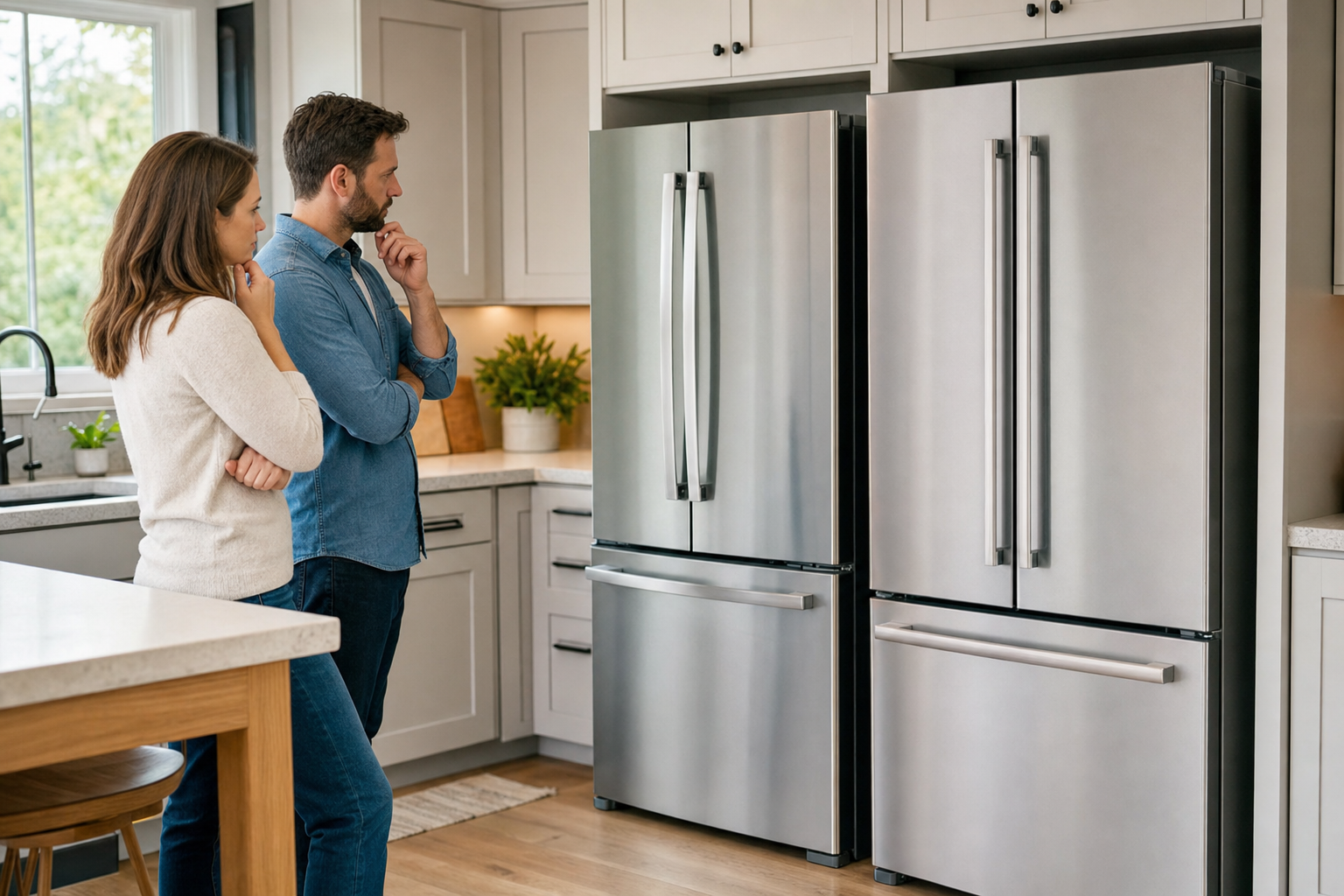
Choose a counter-depth refrigerator when kitchen clearance, easier access and a streamlined fit matter more than maximum storage. Choose standard depth when capacity is the priority. In a counter-depth versus standard-depth refrigerator comparison, however, the label matters less than the model’s complete measurements: cabinet, doors, handles, required clearances and open-door space.
Understand what refrigerator depth really measures
“Counter-depth” does not usually mean the entire refrigerator sits flush with the countertop. Kitchen counters are commonly about 24 to 25 inches deep, measured from the wall rather than the backsplash. A counter-depth refrigerator cabinet may align closely with the counter, but its doors normally extend beyond the counter so they can open. Handles add further projection.
Manufacturers may list several different depth measurements:
- Case or cabinet depth without doors: The metal refrigerator body, often the measurement that creates the counter-depth appearance.
- Depth without handles: The case plus closed doors, excluding projecting handles.
- Overall depth with handles: The full closed depth and the most useful number for calculating remaining aisle space.
- Depth with a door open 90 degrees: The distance from the back of the unit to the outer edge of an open door.
- Depth with drawers extended: Important for bottom-freezer models, convertible drawers and narrow galley kitchens.
Published dimensions can vary substantially by model. For example, LG lists its LFCC22426S counter-depth refrigerator at 24 3/4 inches deep without doors, 28 3/4 inches without handles and 31 1/4 inches with handles. Its total depth with a door open is 43 1/2 inches. That example shows why shopping from the “counter-depth” description alone can lead to an unpleasant surprise.
Required ventilation space must be added to the appliance dimensions. Rear, top and side allowances vary by model and condenser design. Hinge clearance is a separate issue: a refrigerator may physically fit into an opening but still be unable to open wide enough beside a wall, tall pantry or deep cabinet. Restricted doors can also make shelves, crispers or ice bins difficult to remove.
Use the shortlisted model’s specification sheet and installation instructions. Do not apply one brand’s clearance requirements to another refrigerator, or even to every model from the same brand.
Compare kitchen space with usable storage
| Factor | Counter-depth refrigerator | Standard-depth refrigerator |
|---|---|---|
| Closed projection | Usually closer to the counter edge | Often extends several inches farther |
| Storage capacity | Usually lower at a similar width | Usually higher |
| Back-of-shelf access | Shallower shelves can make food easier to see and reach | Deep shelves may require more reaching |
| Price comparison | Compare like-for-like models and features | Often provides more volume at the same width |
| Best fit | Narrow aisles, islands and visual alignment | Large households and bulk storage |
Start with the distance between the refrigerator wall and the nearest island, table or opposite cabinets. Subtract the refrigerator’s overall closed depth to find the remaining passage. Then check the manufacturer’s dimensions for a door opened to 90 degrees and for fully extended drawers.
A French-door model may intrude less with one door open than a single wide door, but handles and freezer drawers can still block the aisle. Check whether another person can pass behind someone using the refrigerator and whether open doors or drawers will strike an island or table. Kitchen layouts differ, so there is no universal clearance measurement that works for every room.
Capacity labels also need context. Advertised cubic feet measure total compartment volume, not how conveniently a household can organize food. Ice makers, air ducts, water filters, sloped walls, fixed bins and shelf spacing all affect the space available for everyday items.
Compare refrigerator and freezer capacity separately, then inspect the interior layout. A shallower, wider shelf may be more useful than a deep shelf where small containers disappear at the back. Counter-depth models can therefore feel easier to use even when their listed capacity is lower. Standard-depth models are often better suited to large pizza boxes, party trays, bulk packages and several days of leftovers.
Compare prices only among models with similar configuration, width and features. A basic standard-depth top-freezer model is not a useful comparison with a counter-depth French-door refrigerator with an external dispenser. Include delivery, installation, water-line parts, door removal, haul-away and any cabinet work when comparing the final cost.
Depth alone does not determine energy use. ENERGY STAR advises that larger refrigerators generally use more energy, while configuration and features also matter. Compare the yellow EnergyGuide labels, especially annual electricity use in kilowatt-hours, among models with similar capacity and features. The operating-cost figure is an estimate based on national assumptions; it is not a prediction of your local electricity bill.
Print this pre-purchase measurement checklist
- □ Measure opening width at the top, middle and bottom.
- □ Measure height at the left, centre and right, including hinges and overhead trim.
- □ Measure from the rear wall, not the backsplash, to the counter edge.
- □ Note baseboards, outlets, water valves and moulding behind the refrigerator.
- □ Record the model’s case depth, depth without handles and overall depth.
- □ Add the specified rear, top and side ventilation clearances.
- □ Check door-edge or hinge clearance beside walls and cabinets.
- □ Confirm the depth and width with every door open 90 degrees.
- □ Confirm clearance with freezer and refrigerator drawers fully extended.
- □ Measure the remaining aisle to an island, table or opposite counter.
- □ Measure every delivery doorway, hallway, stair landing and tight turn.
- □ Check exterior steps, elevator doors, railings and low ceilings.
- □ Compare packaged dimensions with unboxed dimensions.
- □ Ask whether appliance doors can be removed for delivery and who will reinstall them.
- □ Confirm that the electrical outlet, water connection and shutoff valve meet the installation instructions.
Measure the opening rather than copying the old refrigerator’s dimensions. Floors, walls and cabinets may not be square, so use the smallest measurement in each direction. For delivery, measure the whole route and allow for turning space. A refrigerator that fits through a doorway may still fail at a hallway corner.
Who should buy each refrigerator depth
Small kitchens: Counter depth is usually the better choice when a standard-depth refrigerator would pinch the aisle, interfere with an island or project into a nearby doorway. Prioritize overall depth and door swing over advertised capacity.
Bulk-shopping households: Standard depth generally provides more practical capacity for warehouse-store packages, large families and less frequent grocery trips. Verify that deeper doors and drawers will not obstruct circulation.
Kitchen remodels: Counter depth can create cleaner cabinet alignment without the price and installation demands of a true built-in refrigerator. Give the designer the exact specification drawing before cabinetry is ordered; “36-inch counter-depth refrigerator” is not a complete installation specification.
Homes with secondary freezer storage: Counter depth becomes easier to justify when a separate freezer holds meat, frozen meals and bulk purchases. If you are considering that arrangement, compare the practical differences in chest and upright freezers for garage use.
Verdict: Buy counter depth for fit, visibility and easier access to food. Buy standard depth for maximum capacity. Before placing the order, download the exact model’s specification and installation sheets and check every opening, clearance and delivery-path measurement against them.