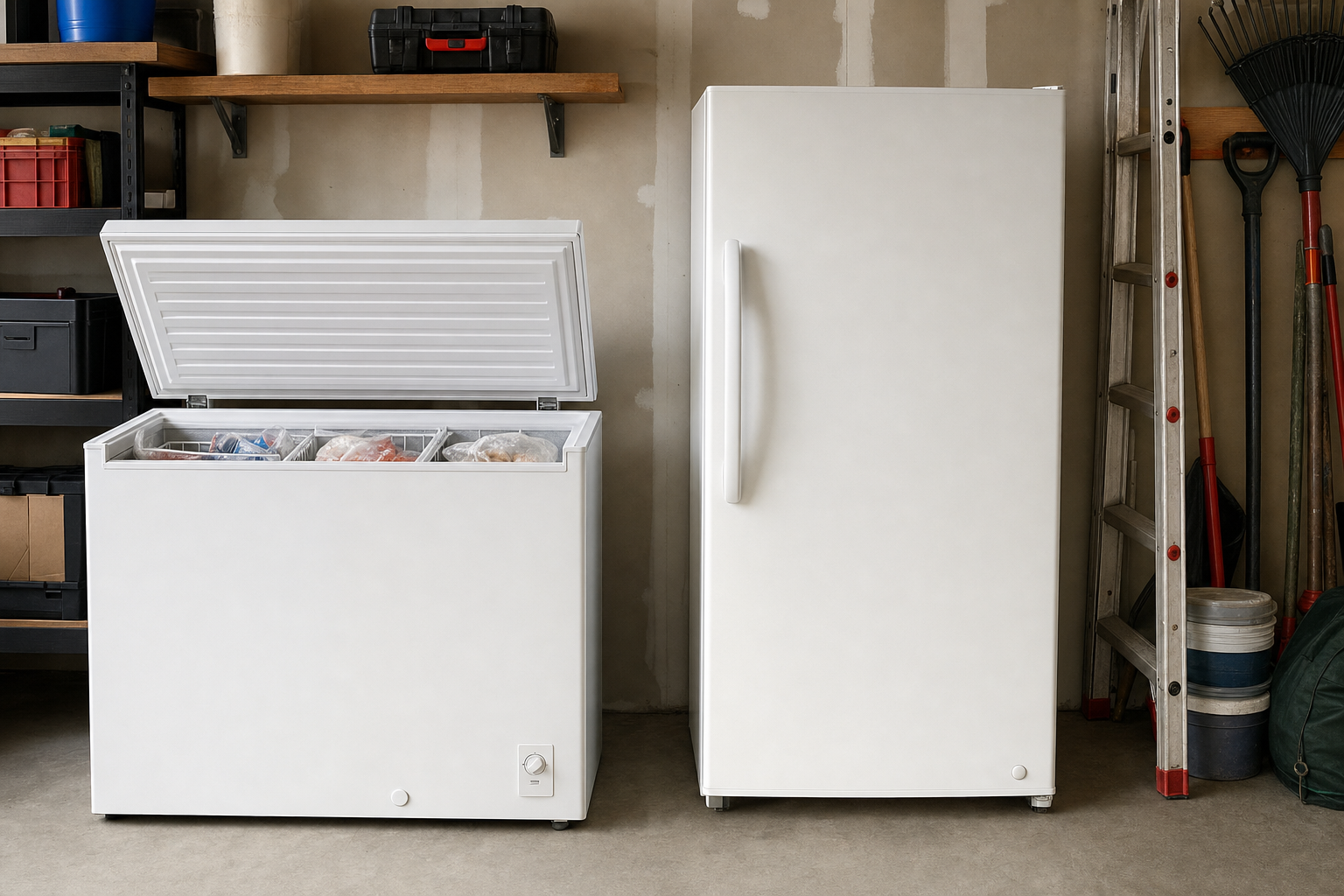
For most garages, choose a chest freezer if low energy use, bulk storage and better cold retention are your priorities. Choose an upright freezer if you need quick access, easier organization and a smaller floor footprint. First, however, confirm that the exact model is approved for the temperatures in your garage. A chest or upright freezer can work well there, but its shape alone does not make it garage-ready.
How chest and upright freezers compare in a garage
Chest freezers have a top-opening lid and a mostly open interior, usually with sliding baskets or dividers. This layout gives flexible storage for bulky packages, including large cuts of meat, whole poultry and bulk purchases. There are fewer fixed shelves taking up interior room, but food at the bottom can be difficult to find without a basket system or inventory list.
Upright freezers resemble refrigerators, with a front-opening door, shelves, drawers and door bins. Their vertical layout makes it easier to separate vegetables, prepared meals, meat and desserts. You can usually see more of the contents without moving other packages, making an upright convenient for a freezer used every day.
The floor-space trade-off matters in a garage. A chest freezer is generally wider and needs clear space above the lid. Do not use its lid as storage for boxes or tools that must be moved whenever you open it. An upright usually uses less floor area for a similar capacity, but it needs clear space in front for its door and for loading food.
Accessibility may decide the choice. Reaching the bottom of a deep chest freezer requires bending over its rim, which can be difficult for people with limited back, shoulder or arm mobility. An upright places much of its food between waist and eye level, although its lowest drawers still require bending.
Chest freezer vs upright freezer decision table
| Buying factor | Chest freezer | Upright freezer |
|---|---|---|
| Storage layout | Open cavity suits large, irregular packages and bulk quantities | Shelves and bins simplify sorting but divide the space |
| Organization | Needs baskets, dividers and a rotation system | Usually easier to label, categorize and inventory |
| Garage floor space | Usually wider and needs overhead lid clearance | Usually uses less floor area but needs front-door clearance |
| Accessibility | Requires reaching down into the cabinet | Most food is accessible from the front |
| Defrost system | Commonly manual defrost | Often automatic defrost, also called frost-free |
| Energy use | Usually lower for comparable use | Usually higher, especially with automatic defrost |
| Cold-air loss when opened | Lower because cold air tends to remain in the cabinet | Higher because cold air can spill from the front opening |
| Best access pattern | Occasional retrieval and long-term bulk storage | Frequent access to many different foods |
| Garage suitability | Only if the model’s approved ambient range fits the garage | Only if the model’s approved ambient range fits the garage |
Advertised cubic-foot capacity does not tell the whole story. Shelves, baskets, compressor housings and door bins affect how much food actually fits. Compare interior dimensions and shelf adjustability, then consider the shapes of the packages you normally freeze. A chest freezer may hold bulky meat efficiently, while an upright can keep smaller meal-prep containers visible and separated.
Garage ready status is a separate buying decision
Do not assume that all chest freezers tolerate garages better than uprights. Freezer style affects access and storage behavior; garage-ready status is a model-specific manufacturer claim about operating in a stated range of surrounding, or ambient, temperatures. Both chest and upright garage-ready freezers are available.
Check the owner’s manual, installation guide or manufacturer support page for the complete model number rather than relying only on a retailer filter or shelf label. Look for the permitted ambient-temperature range and installation instructions. If the manufacturer does not document that the model is suitable for the temperatures your garage reaches, do not assume that it is.
For example, GE Appliances states that its 2018 and newer garage-ready chest and upright freezers are tested to perform from 0°F to 110°F. That is an example of one manufacturer’s stated range, not a universal garage-ready standard. Other makes and models can have different limits.
Before buying, measure how hot the garage becomes on summer afternoons and how cold it gets overnight in winter. Measure near the intended location, since temperatures near a sun-heated garage door, exterior wall or heating equipment can differ from the rest of the space. If the garage can exceed the model’s approved limits, choose another location or control the room temperature appropriately.
Follow the exact model’s requirements for ventilation clearance, electrical supply and placement. Keep the appliance dry, leave access to the outlet and avoid obstructing air circulation. A power-on light, high-temperature alarm or remote temperature alert can be particularly useful in a detached garage, where an open door or power loss may otherwise go unnoticed.
Garage requirements for refrigerator-freezer combinations can differ from those for standalone freezers. See whether you can keep a refrigerator in an unheated garage during winter before applying standalone-freezer advice to a refrigerator-freezer.
Energy use, defrosting and power outages
Chest freezers normally have the efficiency advantage. The U.S. Department of Energy explains that they generally have more insulation and lose less cold air when opened. ENERGY STAR says a certified chest freezer uses about 215 kilowatt-hours of electricity per year, compared with about 395 kilowatt-hours for a certified upright freezer. These are broad comparisons, not predictions for a particular size or model. Compare the yellow EnergyGuide labels for similarly sized finalists, especially if the freezer will sit in a hot garage.
Defrost type is a major part of the difference. ENERGY STAR says manual-defrost freezers use about half the energy of automatic-defrost models, but they must be defrosted periodically to achieve that saving. It advises defrosting before frost exceeds one-quarter inch. Manual defrost is common in chest freezers, while automatic-defrost uprights offer more convenience but generally use more energy.
During a power outage, keep either type closed. The U.S. Department of Agriculture says a full, unopened standalone freezer will hold a safe temperature for about 48 hours; a half-full freezer will do so for about 24 hours. Those estimates depend on the freezer remaining closed and are not a guarantee for every model or garage condition. Group packages together if the freezer is not full, and use an appliance thermometer to monitor its normal operating temperature of 0°F.
A chest freezer can lose less cold air when opened, but opening either freezer during an outage shortens its hold time. If frozen food has thawed, follow USDA food-safety guidance rather than judging it by smell or taste.
Which freezer should you buy for your garage
- For bulk meat storage: Choose a garage-ready chest freezer. Its open interior accommodates large packages efficiently, while baskets can keep smaller cuts near the top. Maintain a written or digital inventory so older food does not remain buried.
- For meal-prep households: Choose a garage-ready upright if you store many labelled containers and retrieve different meals throughout the week. Shelves and drawers make first-in, first-out rotation easier.
- For a small garage: An upright is usually the better fit because it uses vertical space. Measure the cabinet, handle depth, door swing and required ventilation clearances before ordering.
- For outage-prone areas: A chest freezer is a sensible choice because it loses less cold air when opened. Keep it reasonably full and remember that the USDA’s 48-hour estimate applies to a full freezer that remains unopened.
- For easy organization and accessibility: Buy an upright with adjustable shelves, sturdy drawers, lighting and a temperature alarm if available. It will generally be easier to use than a deep chest freezer.
- For lower likely operating cost: Start with a right-sized, ENERGY STAR certified manual-defrost chest freezer, then compare its EnergyGuide estimate with similarly sized alternatives.
Make the purchase in two stages: choose the format that fits your access, storage and space needs, then confirm in the manufacturer’s documentation that the exact model can operate across your garage’s measured winter and summer temperatures.