For unattended winter storage, an automatic battery maintainer is usually the better choice. A maintainer monitors the battery and moves into a regulated float or maintenance stage after charging. A traditional trickle charger supplies a low current continuously and generally needs supervision and timely disconnection. Product labels are not always precise, so choose based on the charging functions and battery types stated in the manual, not simply on whether the box says “trickle charger.”
This comparison applies to 6- and 12-volt starter and accessory batteries in cars, motorcycles, lawn tractors and similar equipment. It does not apply to an electric vehicle’s high-voltage traction battery.
How a battery maintainer differs from a trickle charger
Both devices normally deliver far less current than a high-output shop charger. The practical difference is what they do after the battery reaches a full charge.
A basic trickle charger continues providing a small charging current until it is disconnected. Even at a low rate, prolonged charging can overcharge a lead-acid battery, causing excessive gassing, heat, electrolyte loss or reduced service life.
An automatic maintainer changes its output as the battery charges. Depending on the model, it may progress through initialization, bulk charging and absorption before entering float or maintenance mode. In that final stage, it holds the battery at an appropriate voltage or monitors it and charges only when needed to counter self-discharge and small vehicle loads.
| Feature | Automatic maintainer | Traditional trickle charger |
|---|---|---|
| Output after full charge | Uses a regulated float or maintenance stage | Usually continues supplying low current |
| Long-term connection | Appropriate only when the manual permits it for the battery type | Requires monitoring and disconnection when charging is complete |
| Partly discharged battery | Many models recharge it through a bulk-charging stage | May recharge it slowly, depending on output and battery condition |
| Best use | Seasonal storage and infrequently used equipment | Short, supervised charging sessions |
Manufacturers and retailers sometimes call any low-amperage charger a “trickle charger,” including smart maintainers. Look for wording such as automatic maintenance mode, float mode, multistage charging or ongoing maintenance until disconnected. Automatic shutoff alone is not necessarily maintenance: some chargers stop when full but do not restart if battery voltage later falls.
Choose a charger that matches the battery
Start with the vehicle and battery manuals. Modern vehicles may specify remote charging points, a particular grounding point, or procedures intended to protect a battery-monitoring sensor and vehicle electronics. Do not assume that connecting clamps directly to both battery posts is always the correct method.
Battery voltage and chemistry
Confirm both the voltage and chemistry on the battery label. Common types include flooded lead-acid, absorbed glass mat, usually shortened to AGM, gel and lithium. A charger must support the battery’s exact voltage and chemistry.
- Flooded lead-acid: Use a charger intended for conventional lead-acid batteries and follow its instructions for long-term maintenance.
- AGM and gel: Use a charger that the manufacturer states is compatible with the battery. Many smart chargers have a dedicated AGM setting, and the correct charge profile matters for valve-regulated lead-acid batteries.
- Lithium: Use only a charger specifically approved for that battery chemistry. Lithium iron phosphate, also called LiFePO4, is common in powersports batteries, but it is not compatible with every lead-acid charger. Some lithium charging modes are intended only for batteries with an internal battery-management system. Follow the battery maker’s storage and temperature limits.
Maintenance output and recharge time
An output of about 0.75 to 2 amps is often enough to maintain a healthy motorcycle, lawn-tractor or passenger-car battery. It can also recharge a mildly discharged battery, but slowly. In simple terms, replacing a 20 amp-hour deficit at 1 amp takes at least 20 hours; real charging takes longer because charging current tapers near full charge.
If a battery is partly discharged before storage, a smart charger-maintainer with a 3- to 5-amp charging stage may be more practical, provided its manual approves that battery type and capacity. Larger automotive batteries, dual-battery systems and batteries that repeatedly go flat may need a more capable charger and a proper battery and charging-system test. Small smart chargers can also refuse to start when voltage is below their detection threshold.
A maintainer is not a substitute for a jump starter or a repair. If immediate starting power is the priority, see the comparison of a portable jump starter and jumper cables. Repeated discharge can indicate an aging battery, excessive parasitic draw or a charging-system fault.
Check the location and charger features
For garage storage, check the lead length, connection options and the manual’s ventilation requirements. Ring-terminal leads can be useful for motorcycles and seasonal equipment because they stay attached to the battery and reduce repeated handling of clamps.
For a carport or outdoor parking space, use a charger explicitly rated for the expected environment. Do not expose an indoor-only charger, plug or extension connection to rain, melting snow or standing water. Check the charger’s stated weather or ingress-protection rating, use a suitably protected outlet, and follow the manufacturer’s restrictions on extension cords.
Choose equipment that bears a certification mark from an independent testing laboratory recognized for the applicable product category, such as UL or ETL. Useful features include reverse-polarity protection, short-circuit protection, temperature protection and a clear fault indicator. These features reduce risk, but they do not replace correct connections, compatible settings and periodic inspection.
Which device suits common winter situations
- Seasonal or collector car: Choose an automatic maintainer that supports the installed battery chemistry and whose manual permits long-term maintenance. If the battery is not already charged, choose a charger-maintainer with a real bulk-charging stage rather than a maintenance-only device.
- Motorcycle, scooter or all-terrain vehicle: A lower-amperage maintainer is often suitable because these batteries have relatively low capacity. Confirm the voltage and chemistry, especially if the original lead-acid battery has been replaced with lithium.
- Lawn tractor: Use a compatible low-output maintainer, or follow the equipment maker’s instructions for removing and storing the battery. Battery care is only one part of seasonal preparation; also decide whether to drain lawn mower gas before winter.
- Car used mainly for short trips: A maintainer can restore charge that short journeys may not replace. Frequent weak starts still warrant a battery and charging-system test rather than permanent reliance on a charger.
- Vehicle parked without an outlet: A solar maintainer may help offset self-discharge, but a small panel is generally for maintenance, not recovery of a weak battery. Use a system with an appropriate charge controller and reverse-current protection, and follow the vehicle maker’s approved connection method.
A conventional trickle charger can remain useful when you already own one, know it is compatible and can supervise it. It is a poor choice for a vehicle left unattended for weeks or months.
Connect and use the charger safely
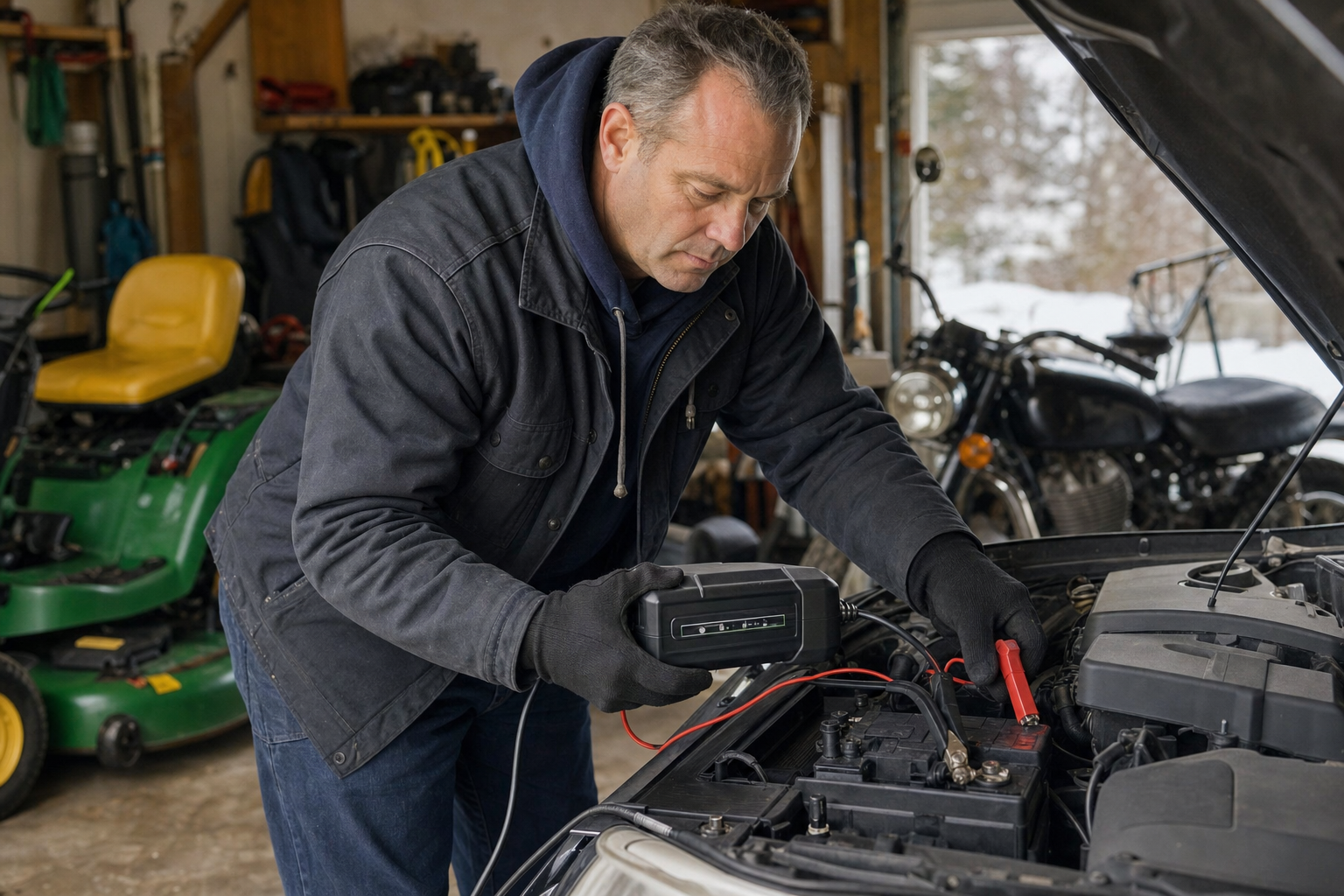
Read both manuals before connecting anything. Turn off the vehicle and accessories, identify the approved charging points, select the correct voltage and battery mode, and follow the charger’s specified connection and disconnection sequence. Keep leads away from belts, fans, hinges and hot components. Make the plugged-in cable obvious so that nobody attempts to drive away while the charger is connected.
Charge in a dry, well-ventilated location. Inspect the charger, power cord, plug, leads and connectors periodically, even when the device is intended for long-term use. An automatic maintainer reduces the need for daily attention; it does not make a damaged cable, poor connection or unsuitable location safe.
Never charge a battery that is visibly damaged or frozen. Cracks, bulging sides, leaks, frost, ice or a strong sulfur-like odor are reasons to stop and seek qualified help. A damaged or frozen battery can rupture and create an explosion, electrical or acid hazard. Do not try to solve the problem by selecting a higher charging rate.
When comparing products, the important statement in the manual is that the charger automatically enters a suitable maintenance mode and supports your exact battery type. If the instructions do not clearly allow ongoing maintenance, treat it as a supervised charger rather than a winter-long maintainer.