Do not leave untreated old gasoline in a lawn mower over winter, but do not automatically drain every mower. The right method depends on the mower and engine manual. Some manufacturers advise storing the mower with fresh fuel treated with a stabilizer; others direct owners to empty the tank and fuel system. Follow the procedure for your exact model, especially if it differs from general advice.
Choose the fuel storage method in your manual
Manufacturer instructions differ because fuel systems and storage procedures vary. Briggs & Stratton advises using fresh treated fuel and filling the tank before storage, while its guidance also says to remove fuel and run the engine until it stops if stabilizer is not used or the engine uses alcohol-blended gasoline. Husqvarna’s U.S. guidance for gasoline lawn mowers says to add stabilizer to the final tank of the season and empty the tank before storage.
Honda uses a more specific approach. For storage of 30 to 90 days, Honda says to add stabilizer to fresh fuel, run the engine outdoors for 10 minutes to circulate treated fuel, turn off the fuel valve, then let the engine run until it stops. For more than 90 days of inactivity, Honda says to empty the entire fuel system, including the tank.
Use this decision order:
- Find the exact manual. Locate the model and serial numbers on the mower identification plate. Check both the mower manual and the separate engine manual, if there is one. If their instructions conflict, contact the mower manufacturer or an authorized dealer before storing it.
- Check the fuel’s condition. Fuel stabilizer slows deterioration; it does not restore stale gasoline. Do not rely on gasoline with an unknown age or fuel that already appears contaminated or has been stored too long.
- Consider the storage period. Follow the manual’s storage limits and the stabilizer label. A winter lay-up can exceed 90 days in many areas.
- Use the specified fuel. Check the manual for the required octane rating and ethanol limit. Many current small engines allow gasoline with up to 10 percent ethanol, often labelled E10, but higher-ethanol fuel is not automatically suitable.
- Assess the storage area. Do not store a mower or gasoline where fuel vapors could reach a furnace, water heater, pilot light, open flame, spark or other ignition source.
If you cannot identify the mower or find reliable instructions, ask an authorized service dealer. Do not guess about fuel-system procedures on a riding mower or any model with a fuel pump, fuel injection or an unfamiliar tank arrangement.
How to empty the fuel system safely
Use this method when the manual calls for an empty tank, the mower will be stored beyond the permitted time for treated fuel, or the fuel is unsuitable for storage.
- Work outdoors, away from flames, sparks and smoking materials. Let the engine cool before handling or transferring gasoline.
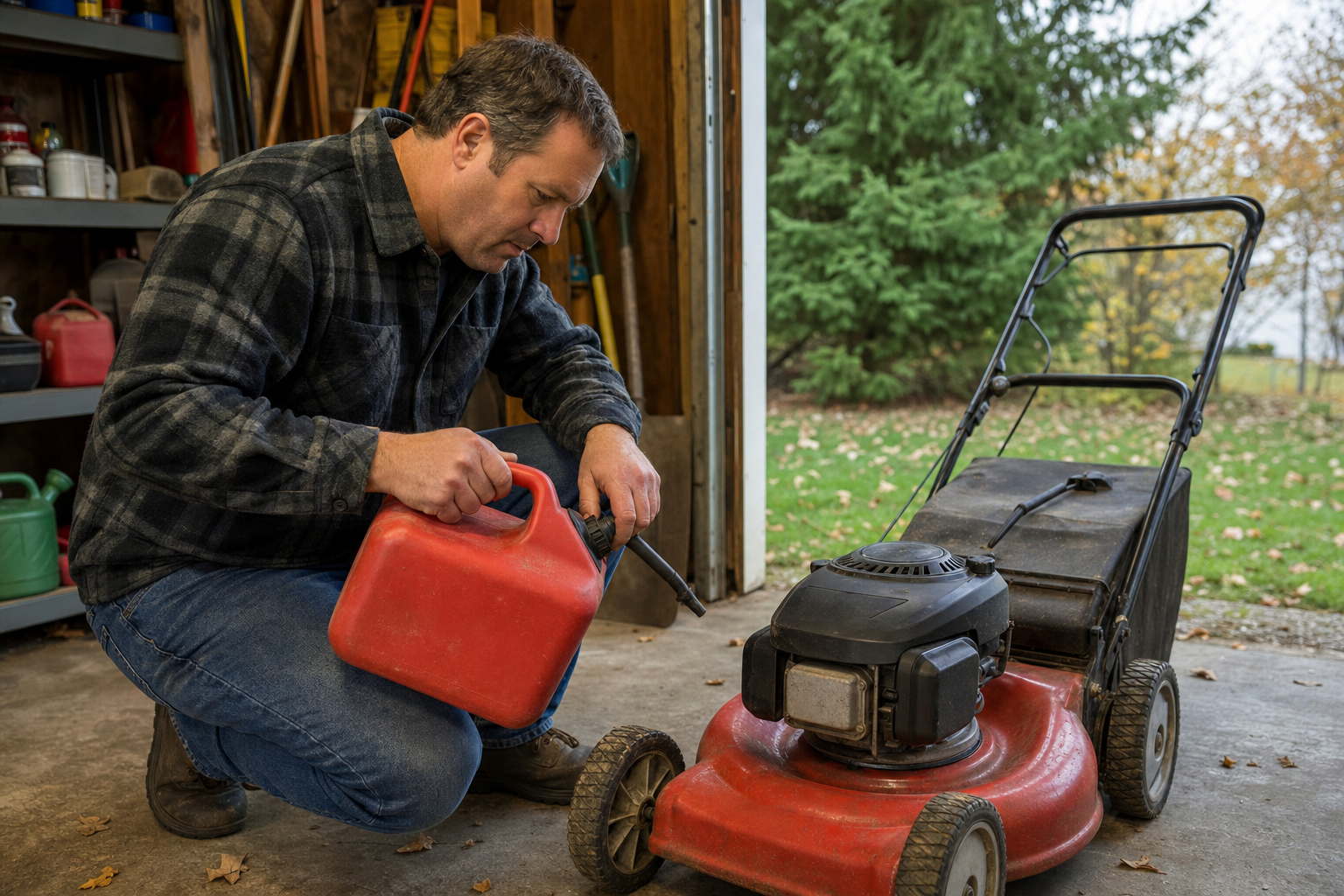
- If the manual provides a tank-draining procedure, transfer the fuel into a suitable portable gasoline container using the specified drain, valve or hand pump.
- Run the mower outdoors until it stops from lack of fuel if the manual instructs you to do so. Some manuals direct you to try starting it again to clear the remaining fuel from the carburetor.
- Set any fuel shutoff valve to the position specified in the manual.
Never siphon gasoline by mouth. Do not tip a mower to pour fuel from the filler neck, disconnect fuel lines casually or handle gasoline in a house, basement or enclosed garage. If the procedure requires work you are not comfortable doing, arrange service instead.
How to store a mower with stabilized fuel
Use this method only when the mower or engine manufacturer permits it. Start with fresh gasoline that meets the mower’s stated fuel requirements.
- Add the correct amount of fuel stabilizer, following the product label. More stabilizer does not provide better protection.
- Fill the tank to the level specified in the manual. Do not fill into the filler neck; gasoline needs room to expand.
- Run the engine outdoors for the period stated in the manual so treated fuel reaches the carburetor and fuel lines. Honda, for example, specifies 10 minutes when stabilizer is first added to the mower’s fuel.
- Shut down the mower, allow it to cool and position the fuel valve as instructed. Some manuals then require running the carburetor dry with the fuel valve off.
Do not add stabilizer to old gasoline and assume it is ready for winter. Replace unsuitable fuel with fresh fuel if the manufacturer permits stabilized-fuel storage.
Keep any leftover gasoline in a closed portable container intended for gasoline and keep it out of children’s reach. Store the container in a cool, well-ventilated location away from the home and ignition sources. Never use drink bottles, open pails or improvised containers. For gasoline you cannot use safely, contact your local household hazardous-waste program or solid-waste authority for disposal options. Never pour it onto the ground, into a drain or into a storm sewer.
Winterizing walk behind and riding mowers
Before maintenance, stop the engine, allow it to cool, remove the ignition key if fitted and disconnect the spark-plug lead. Keep the lead away from the spark plug to reduce the risk of accidental starting.
For a walk-behind mower:
- Follow its specified empty-tank or stabilized-fuel procedure. A small tank does not prevent fuel from deteriorating.
- Change the engine oil while it is warm if required by the maintenance schedule, using the oil grade and quantity in the manual. A two-stroke mower that uses an oil-and-gas mixture does not have crankcase oil to change.
- Remove grass from the deck with a brush, wooden scraper or the manufacturer-approved washing method. Keep hands clear of the blade even after disconnecting the spark-plug lead.
- Inspect the blade, air filter, starter cord, wheels and fasteners. Replace a bent, cracked or badly damaged blade rather than attempting to straighten it.
- Fold the handle only as the manual shows, so control cables are not damaged.
For a riding mower or lawn tractor:
- Use the model-specific storage procedure. Riding mowers may have larger tanks, filters, pumps and shutoff valves.
- Change the oil and oil filter when the maintenance schedule requires it, and inspect belts, pulleys, tires, blades and lubrication points.
- Follow the manual’s battery-storage instructions. Depending on the mower, this may mean disconnecting the negative cable, removing the battery or using an appropriate battery maintainer.
- Remove the key and store it away from children. Use the parking brake during storage only if the manufacturer recommends it.
Remove packed grass and debris from the deck and engine area, then let washed parts dry completely. Store the mower level in a clean, dry, ventilated and locked location. Cover it only after it is dry.
If leaves are still covering the yard before the mower is stored, Should You Rake Leaves or Mulch Them Into Your Lawn explains how to choose a final cleanup method.
Spring restart checklist
- Remove the cover and check for fuel or oil leaks, corrosion, nests and chewed wiring.
- Reconnect the spark-plug lead and, for riding mowers, the battery as directed.
- Check the oil level, air filter, blade, belts, tires and fasteners.
- Open the fuel valve if the mower has one.
- If the system was emptied, add fresh gasoline of the specified grade.
- If treated fuel remained in the tank, check the manufacturer’s permitted storage time before starting.
- Move the mower outdoors before starting it. Listen for unusual noises and check for fuel or oil leaks.
The key winter rule is not simply to drain the mower or fill it. Remove untreated or unsuitable gasoline, identify the exact model and follow its complete storage procedure.
Sources
- Briggs & Stratton equipment storage checklist
- Husqvarna gasoline lawn mower winter storage guidance
- Honda lawn mower fuel recommendations and storage guidance
- U.S. Consumer Product Safety Commission fuel container and gasoline safety guidance
- U.S. Environmental Protection Agency household hazardous waste guidance