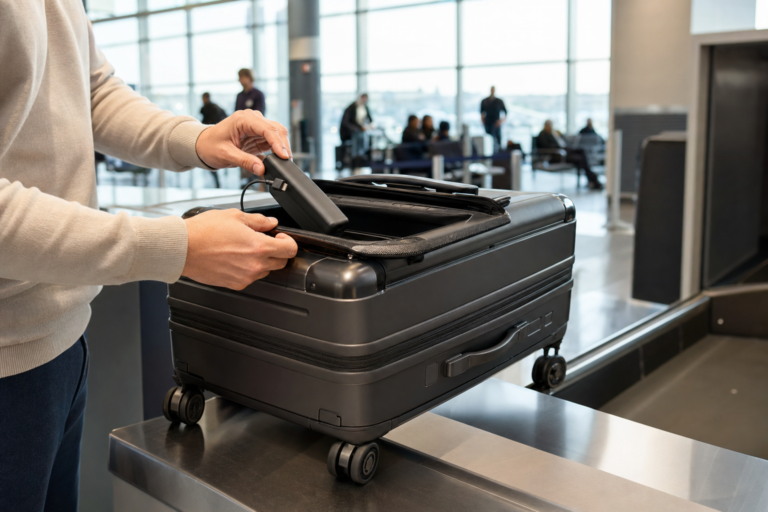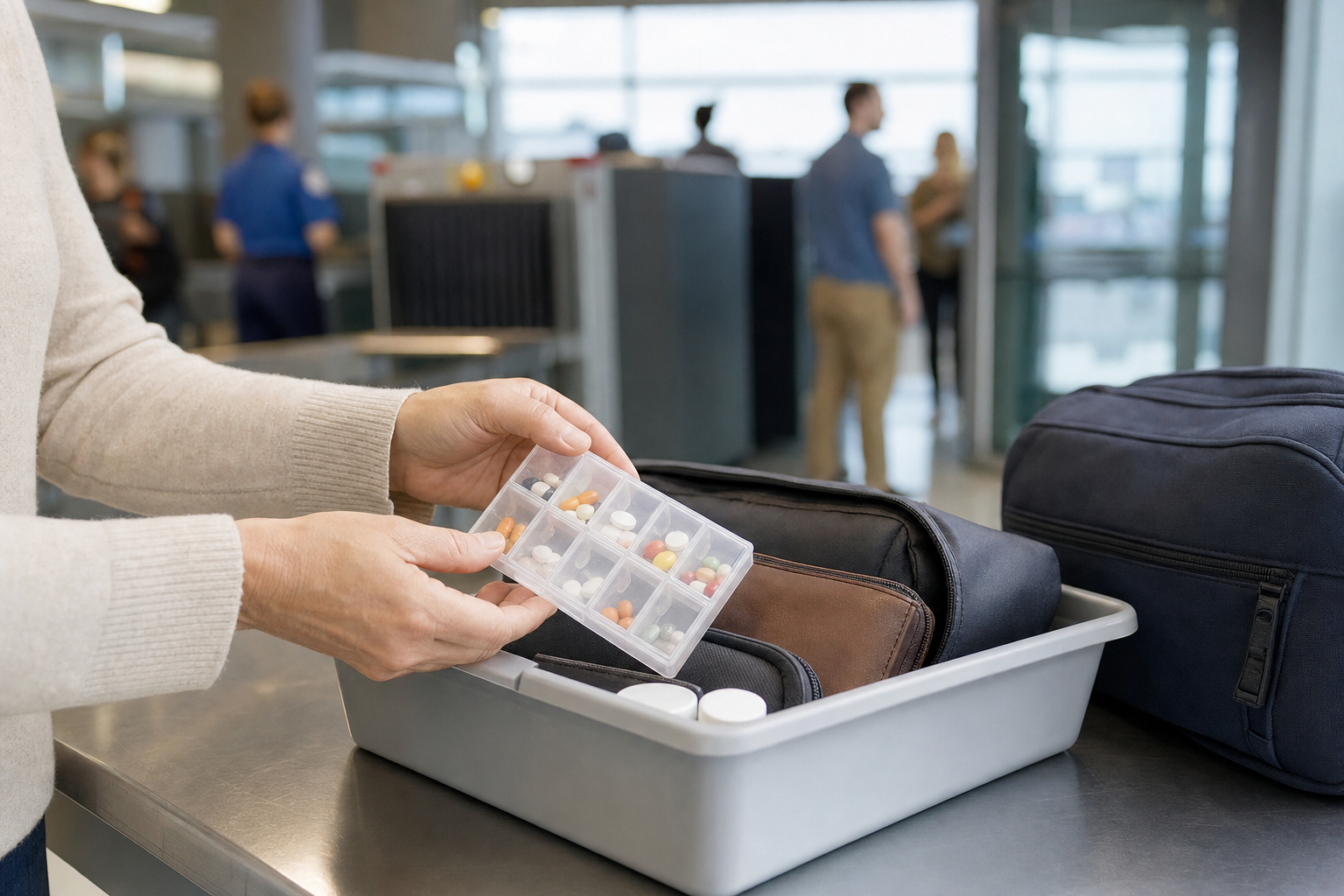
Yes. You can generally bring prescription and over-the-counter pills through Transportation Security Administration screening in a pill organizer on a domestic United States flight. The Transportation Security Administration, usually called TSA, allows pills in both carry-on and checked baggage and does not require them to remain in their original pharmacy bottles. All medication must still undergo security screening.
Although a pill organizer is acceptable to TSA, it is not always the best choice. Original labeled containers can make medication easier to identify and may help you comply with state laws, controlled-substance rules or international customs requirements. Essential medication should normally travel in your carry-on bag rather than checked luggage.
TSA rules for pills and pill organizers
TSA permits solid medication in carry-on and checked baggage. Its guidance does not set a quantity limit for pills, tablets or other solid medication, provided the items are screened. This covers prescription medication, common over-the-counter medicine and vitamins.
TSA recommends labeling medication to make the screening process easier, but it does not require prescription medication to be in a pharmacy bottle. You can therefore use a weekly organizer, a small container or another secure package when taking a domestic flight.
Keep in mind that TSA officers focus on transportation security. Passing through a checkpoint does not establish that you are complying with every law governing possession of a particular medicine. TSA notes that individual states may have their own prescription-labeling requirements. This can be especially relevant when carrying a controlled substance.
Pills are usually screened by X-ray with the rest of your belongings. You generally do not need to declare ordinary solid medication. However, you may tell an officer about it if you need special handling, are carrying an unusually large supply or want the medication screened separately.
If you do not want medication to pass through the X-ray machine, ask for a visual inspection. Make the request before the medication or the bag containing it enters the X-ray tunnel. Alternative screening can take longer and may require additional inspection of the medication or your other property.
A divided organizer with securely closing compartments is preferable to a bag containing loose, mixed tablets. It reduces the chance of pills spilling or becoming confused. Even so, unidentified medication may be difficult to replace or explain if an airline, police officer, pharmacist or medical professional needs to identify it.
How to pack medication and supporting information
Keep essential medicine in your carry-on
Medication that you may need during the journey should be in your carry-on bag or personal item. Checked luggage can be delayed, lost, damaged or inaccessible during a flight. Keeping medicine with you also allows you to answer questions if it needs additional screening.
Pack enough for the planned trip and consider a modest extra supply in case of an unexpected delay. Do not place your entire supply in checked baggage. If you divide it between bags, keep enough in your carry-on to manage a significant delay or lost suitcase.
Protect medication from heat, moisture and direct sunlight. Do not leave it in a parked vehicle or another location that can become extremely hot or cold. Ask a pharmacist how to store any medicine that has temperature-sensitive instructions.
Separate TSA requirements from practical precautions
TSA does not routinely require a prescription, clinician’s letter, pharmacy record or photograph of a label for ordinary pills at a domestic checkpoint. The following items are practical backups rather than standard TSA requirements:
- The original pharmacy-labeled container, particularly for a controlled substance
- A copy of the prescription or a current pharmacy record
- A medication list showing generic and brand names, strengths and dosing instructions
- Contact details for the prescribing clinician and dispensing pharmacy
- A clinician’s letter if medication, syringes or medical equipment may require explanation
A photograph of the pharmacy label can be a convenient secondary record, but it is not guaranteed to replace an original container or formal documentation. The original label is more useful if the medicine must be identified, replaced or presented to an authority.
If you are unsure whether a prescription is a controlled substance or whether state labeling rules apply, ask the dispensing pharmacist before departure. A pharmacist can also print an updated medication list or provide an additional labeled container when appropriate.
Liquid medication and medically necessary cooling packs
Medically necessary liquids, gels, aerosols and creams may exceed the standard carry-on limit of 3.4 ounces or 100 milliliters. TSA allows them in reasonable quantities for the trip, and they do not have to fit inside the usual quart-size liquids bag.
Tell a TSA officer about oversized medically necessary liquids at the checkpoint and place them separately for inspection. Additional screening may include testing the outside of a container or asking you to open it. Pack liquids in tightly closed containers and consider placing them in a separate leak-resistant pouch, even though TSA does not require a zip-top bag.
Medically necessary gel ice packs are allowed in reasonable quantities whether they are frozen solid, partly melted, slushy or fully melted. Notify the TSA officer that the packs are medically necessary and present them for inspection. This exception can cover cooling supplies used for temperature-sensitive medication.
The rule is different for ordinary gel packs or ice used only to keep food and other non-medical items cold. Those frozen-liquid items generally must be completely solid at screening. If they are partly melted, slushy or contain liquid, they must comply with the normal carry-on liquids limits. Clearly separating medically necessary cooling supplies from food-cooling packs can prevent confusion.
Needles and syringes required for medication can also receive additional attention. Keep them with the medicine they are used to administer and, where practical, retain identifying information from the pharmacy or prescriber. Travelers using an insulin pump, glucose monitor or another medical device should tell the officer before screening begins and follow the device manufacturer’s safety instructions.
Controlled substances and international travel
A medicine can be permitted through TSA screening while remaining subject to separate possession, customs or importation laws. For domestic travel with a controlled substance, the cautious approach is to use the original pharmacy-labeled container and carry supporting prescription information. This is a risk-reduction measure, not a general TSA requirement for all pills.
Take only an amount reasonably connected to your trip and keep the medication under your control. Do not combine different controlled prescriptions in one compartment, and do not carry medication prescribed to another person.
For international travel, do not assume that TSA acceptance makes a pill organizer acceptable at your destination. Customs authorities and national drug laws determine what can enter a country. A medicine that is commonly prescribed in the United States may be restricted or prohibited elsewhere. Limits may also apply in a transit country if you pass through customs during a layover.
The Centers for Disease Control and Prevention advises international travelers to keep medication in its original labeled packaging and avoid transferring it to a pill organizer before arrival. Check official destination and transit-country guidance using the medicine’s generic name as well as its brand name, since brands vary internationally.
A destination may limit quantities, require advance permission or demand a medical certificate with specific wording. A general clinician’s letter may not be sufficient. Begin checking the rules well before departure, especially for narcotic pain medicine, stimulants, sedatives, injectable drugs and other controlled substances.
Travelers entering the United States must also follow United States importation rules. Drug Enforcement Administration guidance says controlled substances brought into the country for personal medical use must meet labeling and original-container conditions. It also states that foreign visitors may bring up to 50 dosage units of a controlled substance for personal use, subject to the applicable requirements.
Medication purchased legally abroad is not automatically eligible to enter the United States. The Food and Drug Administration explains that personal importation may be considered in limited circumstances, but this does not create an automatic right to import an unapproved drug. Review current Food and Drug Administration, Drug Enforcement Administration and United States Customs and Border Protection requirements before returning with medicine obtained overseas.
Sources
- Transportation Security Administration What Can I Bring complete list
- Transportation Security Administration guidance on traveling with medication
- Centers for Disease Control and Prevention guidance on restricted medications
- Drug Enforcement Administration guidance for entering the United States with medication
- Food and Drug Administration personal importation guidance