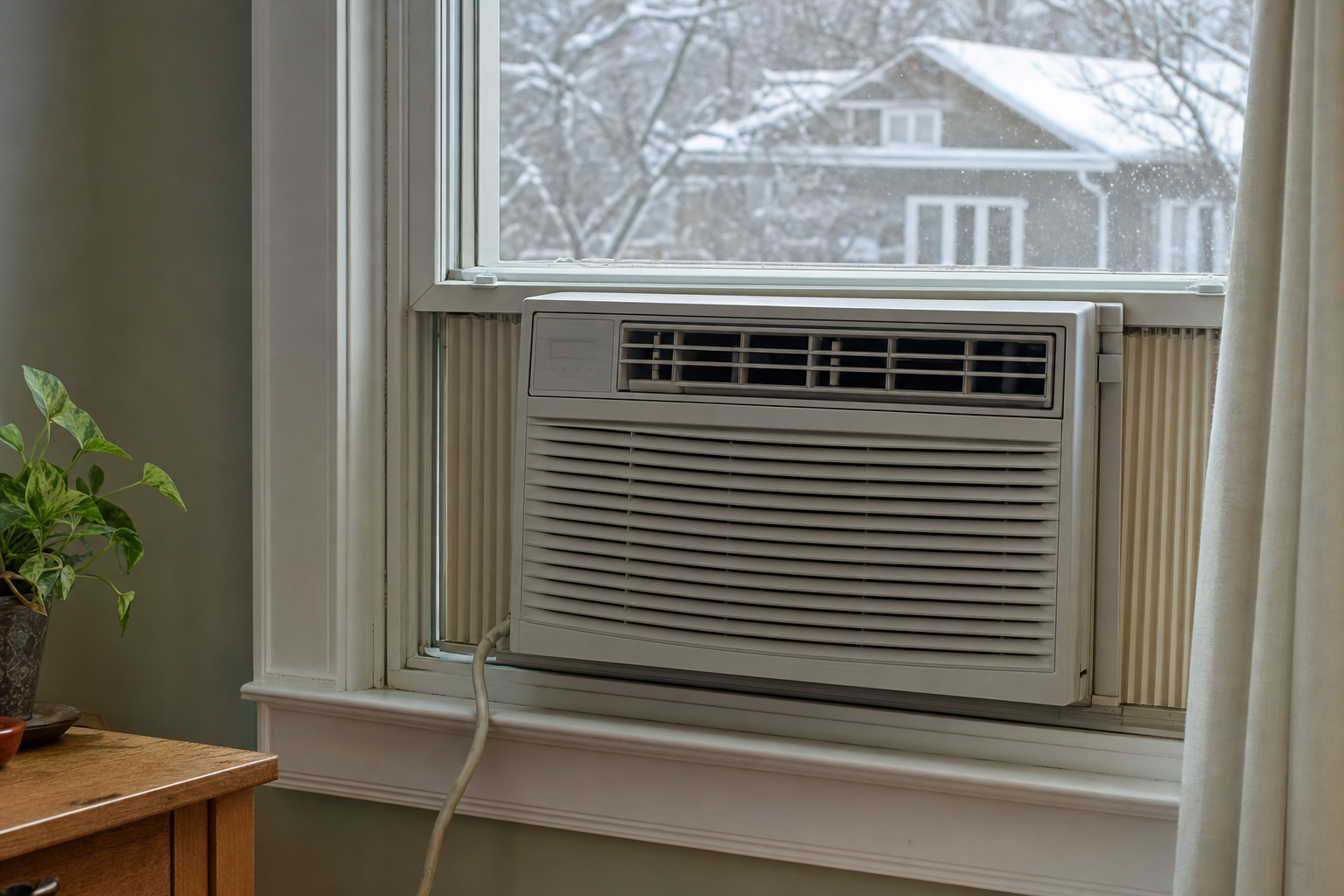
Can you leave a window air conditioner in all winter? Usually, yes, but removing a conventional window unit is generally the better option when it is safe and practical. Removal reduces cold-air leakage through the window opening and protects the appliance from winter weather. If it must remain installed, unplug it, secure the installation and seal the indoor side carefully. Always follow the instructions for your exact model, especially if it is a through-wall unit or provides heat as well as cooling.
Manufacturer guidance is not identical. Frigidaire and Haier recommend removing window units for winter storage, while GE Appliances says removal is optional, particularly where a large unit is difficult to move. That difference makes the use and care manual more important than a universal rule.
Why removal is usually the better choice
A window air conditioner interrupts the window’s normal weather seal. Gaps can remain around the accordion panels, window sash and cabinet, while air can also leak through the appliance itself. The U.S. Department of Energy advises removing a window unit after cooling season or sealing it completely on the indoor side to prevent air leakage.
In a cold or windy climate, those leaks can create drafts and increase the amount of heating needed to keep the room comfortable. The thin side panels supplied with many units insulate far less effectively than an intact, closed window. Old foam seals can also shrink, crack or come loose over time.
Removal also avoids months of exposure to snow, ice, windblown debris and repeated freezing and thawing. Window air conditioners are designed to withstand rain while operating, so a winter outdoors will not automatically damage one. Still, long-term weather exposure can contribute to corrosion and deterioration of seals or installation materials. Debris and animals may also collect around an unused unit.
Storage only helps if the location is dry and secure. A damp, flood-prone basement or a shed accessible to rodents may not be suitable. Frigidaire advises storing the unit in a dry location in its normal bottom-down operating position, preferably off the floor.
How to decide whether it should stay installed
Consider the following before deciding:
- Climate: Removal is particularly worthwhile where winter brings prolonged freezing temperatures, snow, ice or strong winds. In a mild climate, an installed unit may be less of a concern if its manual permits it.
- Weight and location: Window air conditioners can be heavy and awkward, with much of their weight outside the window. Do not attempt to remove a heavy or upper-floor unit alone.
- Building rules: Renters should check with the landlord or property manager before removing brackets, changing an installation or fitting an exterior cover. Some buildings require maintenance staff to handle window units.
- Storage space: Choose a dry indoor area where the unit can stay upright and protected from flooding, accidental impact and pests.
- Installation condition: Loose supports, damaged side panels or noticeable air gaps need attention. If the unit cannot be removed safely, have the installation inspected and sealed correctly.
- Unit type: A through-wall model is normally designed to stay in its wall sleeve. A window heat pump or a unit used for heating must remain unobstructed while it operates.
If the unit is manageable with help, you have appropriate storage and the manual recommends removal, take it out. If it is unusually large, permanently secured or controlled by building management, it may be safer to leave it in place and winterize it according to the manufacturer’s instructions.
How to remove and store a window air conditioner
Arrange for another adult to help. Do not lean out of the window or try to support the appliance by its cord, front grille, louvers or side panels.
- Read the model instructions. Check the installation and storage directions before undoing any screws, brackets or plugs. Do not operate cooling mode below the outdoor temperature range stated in the manual.
- Turn it off and unplug it. If the unit has a remote control, remove its batteries before storage if recommended by the manufacturer.
- Deal with retained water as directed. Some models have a plug intended for seasonal storage; others do not. GE notes that its room air conditioners normally retain water in the base pan for efficient operation, and a plug should not be removed during ordinary use. Never drill holes or remove an unidentified plug. Keep towels and a shallow container ready for water that may spill during removal.
- Remove the installation hardware in the specified order. Have the helper support the unit before releasing the sash lock, screws, brackets or side-panel fasteners. Keep all hardware together for spring installation.
- Lift the unit inward carefully. Keep it as upright as possible and avoid sudden tilting. Follow the manual’s instructions if it specifies a direction for draining remaining water.
- Clean and dry it. Clean the washable filter as directed, commonly with lukewarm water and mild soap, and allow it to dry fully. Wipe the cabinet and remove loose, accessible debris without soaking electrical components or bending coil fins.
- Store it upright. Use the original carton if available, or cover the unit to keep off dust. Store it in its normal operating position in a dry place, ideally raised above a floor that could become wet. Do not store it on its side, back or end.
If a unit has been on its side or back for more than a day, GE Appliances advises leaving it upright and unplugged for 24 hours before reconnecting and using it.
How to winterize a unit left in the window
If removal is impractical, the priorities are stopping drafts, keeping debris out and maintaining a secure installation. Do not use a cover to compensate for a loose or unsafe unit.
- Turn the unit off and unplug it. Close any fresh-air or exhaust vent if your model has one.
- Clean and dry accessible parts. Clean the filter, wipe the cabinet and remove leaves, insects and loose debris. Let the unit dry before covering it.
- Check the supports and window lock. Confirm that brackets, screws and the sash lock remain secure. Do not alter structural supports unless the manual directs you to do so.
- Seal indoor air gaps. Replace worn weatherstripping and use removable, window-safe sealing materials around the sash and side panels. An insulated indoor cover can help reduce drafts through the appliance. The Department of Energy specifically recommends complete sealing on the indoor side when the unit remains installed.
- Use an exterior cover only if appropriate for the model. LG’s winterizing guidance for window and through-wall units includes a waterproof cover secured with tie-downs. Use a correctly sized cover that does not loosen in wind, and periodically remove snow, ice and debris from it.
Never run a covered air conditioner. Keep it unplugged if there is a risk that someone could switch it on accidentally. For guidance on outdoor central-air equipment, which has different winter-covering needs, see Should I Cover My AC Unit in Winter.
Through-wall units and heating models need different treatment
A through-wall air conditioner is installed in a permanent wall sleeve and is generally intended to remain there. Do not pull it from the sleeve or remove mounting parts unless the model instructions specifically say to do so. Clean it, inspect the sleeve and surrounding seals, and use only a cover or winterizing method approved for that unit.
A window heat pump or window unit being used for heat must remain uncovered and able to move air while operating. Follow the model’s outdoor-temperature limits, drainage directions and defrost guidance. A cooling unit with an electric heat setting is not necessarily a heat pump, so do not assume it can operate in the same winter conditions.
If you cannot identify the appliance type or do not have its manual, find the model number on the cabinet and obtain the manufacturer’s instructions before draining, covering or moving it. When removal is unsafe, ask building maintenance or a qualified appliance installer for help rather than risking injury, window damage or a falling unit.
Sources
- U.S. Department of Energy window air conditioner installation guide
- Frigidaire room air conditioner winter storage guidance
- GE Appliances window air conditioner winterizing and storage guidance
- Haier guidance on storing a window air conditioner for winter
- LG guidance on winterizing room air conditioners