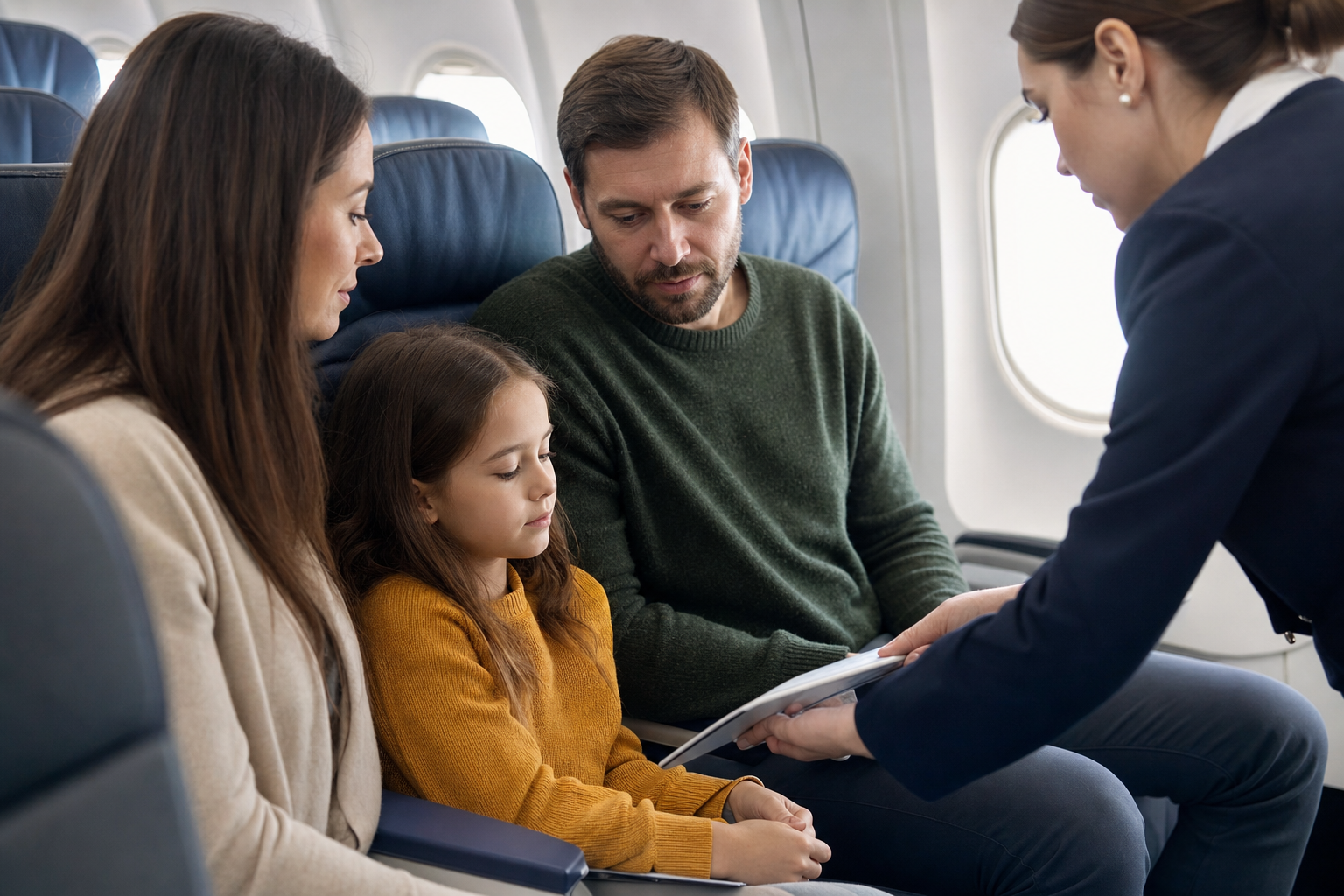
No nationwide federal rule currently requires every airline to seat children with parents for free. As of September 22, 2026, the U.S. Department of Transportation lists its family-seating measure as a proposed rule, not a final rule. However, the Department’s Airline Family Seating Dashboard shows that Alaska, American, Frontier, Hawaiian and JetBlue have committed to seat a child age 13 or younger next to an accompanying adult at no additional cost, across fare types, when specified conditions are met.
The key limit is that these commitments generally cover a child sitting beside at least one accompanying adult. They do not necessarily mean that an entire family will receive one block of seats, or that the family can choose a particular row, window seat or premium seat without charge.
What federal rules do and do not require
For most families, whether a child can sit beside a parent without a seat-selection fee still depends on the airline’s policy. The Department of Transportation issued a proposed family-seating rule on August 1, 2024. The proposal would require airlines to seat children age 13 or younger beside an accompanying adult for no additional charge when adjacent seats are available, subject to exceptions. As of September 22, 2026, the Department’s current rulemaking page lists only the proposed rule.
A commitment shown on the Department’s dashboard is meaningful, but it is not a universal federal entitlement that applies in exactly the same way on every airline and flight. The dashboard’s listed commitments are subject to conditions, including:
- The child and accompanying adult must be on the same reservation.
- Adjacent seats must have been available in the purchased class of service when the flight was booked.
- The adult must either select seats for the entire reservation or skip seat selection for the entire reservation, without later changing assigned seats.
- The aircraft must not be replaced with a smaller one.
- The cabin layout must make it physically possible to place the number of children traveling beside accompanying adult or adults.
When those conditions are met, airlines with assigned seating that make the dashboard commitment must provide the adjacent assignments no later than the day before departure. This means a family may not see the final free assignments immediately after booking.
There is a separate disability-related right. If a child with a disability travels with a personal care attendant who performs an in-flight function airline staff are not required to perform, such as assistance with eating or using the lavatory, the airline must provide adjoining seats in the purchased class of service without a fee. Similar rights apply when an accompanying person is needed as a safety assistant, reader or interpreter. Identify the disability-related seating need to the airline as early as possible because advance-notice or early-check-in requirements can apply.
Safety restrictions also matter. Federal rules prohibit children under 15 from sitting in exit rows. Passengers caring for small children are also ineligible for those seats, so a family-seating request cannot override exit-row rules.
How major airline commitments compare
The table below reflects the Department of Transportation’s dashboard as checked on September 22, 2026. A “Yes” means the carrier commits to fee-free adjacent seating for a child age 13 or younger and an accompanying adult across fare types, subject to the conditions above. A “No” does not mean an airline will deliberately seat a young child alone; it means the carrier has not made the Department-defined commitment.
| Airline | DOT dashboard commitment | Useful policy detail |
|---|---|---|
| Alaska Airlines | Yes | Its commitment includes Saver fares when the stated conditions are met. |
| Allegiant Air | No | Choose adjacent seats during booking when possible and contact the airline promptly if the reservation separates a child and adult. |
| American Airlines | Yes | If the family skips seat selection in Main Cabin or Basic Economy, American says it will assign children under 15 beside at least one accompanying adult when seats are limited. |
| Delta Air Lines | No | Do not rely on the dashboard guarantee; review the seat map and ask for help before travel if seats are separated. |
| Frontier Airlines | Yes | Assignments may not appear immediately, but Frontier says covered adjacent assignments will be provided no later than the day before departure. |
| Hawaiian Airlines | Yes | The Department lists Hawaiian as making the dashboard commitment, subject to its limited conditions. |
| JetBlue | Yes | Its automatic family-seat assignment process includes Main Base customers when the family is on the same booking and seats can accommodate them. |
| Southwest Airlines | No | For flights from January 27, 2026, Southwest uses assigned seating and says it will work to seat children age 12 or younger beside at least one adult in the party when seats are limited. |
| United Airlines | No | Review the seat map before purchase and contact United if a child and accompanying adult are assigned apart. |
Southwest’s change from open seating to assigned seating is especially important. Families on Choice, Choice Preferred and Choice Extra fares can select seats during booking. On Basic fares, seats are assigned at check-in or at the gate, and Southwest says it will work to seat children age 12 or younger beside at least one adult in the party. Our guide to how Southwest boarding works with assigned seats explains the new process.
How Basic Economy and booking details affect seating
Basic Economy, or another airline’s lowest fare, does not automatically mean a child will sit alone. For airlines with a dashboard commitment, the commitment applies across fare types. However, a family may be unable to select exact seats during booking and may instead receive automatic assignments later.
Follow the airline’s instructions for the entire reservation. Selecting a preferred seat for one adult while leaving children unassigned can prevent an automated family-seating process from working. If the airline says to select seats for everyone or skip seats for everyone, do one or the other consistently.
Book everyone on the same reservation record whenever possible. Airlines commonly use that shared record to identify a family group. Separate reservations can result when tickets are bought with different payment methods, one traveler uses miles, or a travel agency divides the booking. If separate reservations are unavoidable, contact the operating airline immediately and ask it to note the linked bookings. That may help, but it does not necessarily provide the same protection as one reservation.
Check the policy of the airline operating each flight, not only the airline shown most prominently on the ticket. A codeshare itinerary can involve different seat maps and seating procedures.
A booking and airport checklist for parents
- Check the airline policy before buying. Confirm the covered age, whether the lowest fare is included and whether the airline requires everyone to select or skip seats.
- Book early on one reservation. A dashboard commitment can depend on adjacent seats being available when you book in the selected cabin.
- Review the seat map before payment. Select free adjacent seats if they are available. If the airline directs Basic Economy families to skip seat selection, leave the whole reservation unassigned rather than choosing scattered seats.
- Save the confirmation and policy. Keep screenshots of the passengers, reservation number, original assignments and the airline’s family-seating terms.
- Check every flight after booking. An aircraft or schedule change can produce a new seat map and separate the family.
- Contact the airline promptly after a change. Explain the child’s age, the original seat assignments and the published policy. Ask for each child to sit beside an accompanying adult rather than requesting one particular row.
- Recheck when online check-in opens. Additional seats or automatic assignments may appear then. Confirm every child is beside an adult before going to the airport.
- Arrive early and speak to the gate agent. If a child is still separated, ask for assistance before boarding begins. Do not wait until everyone is onboard and expect other passengers to exchange seats.
If the airline does not resolve the problem, keep records of seat assignments and conversations. Submit a written complaint to the airline first, then file a complaint with the Department of Transportation if necessary. For an imminent flight, the gate agent is usually the person best placed to make a last-minute seating adjustment.