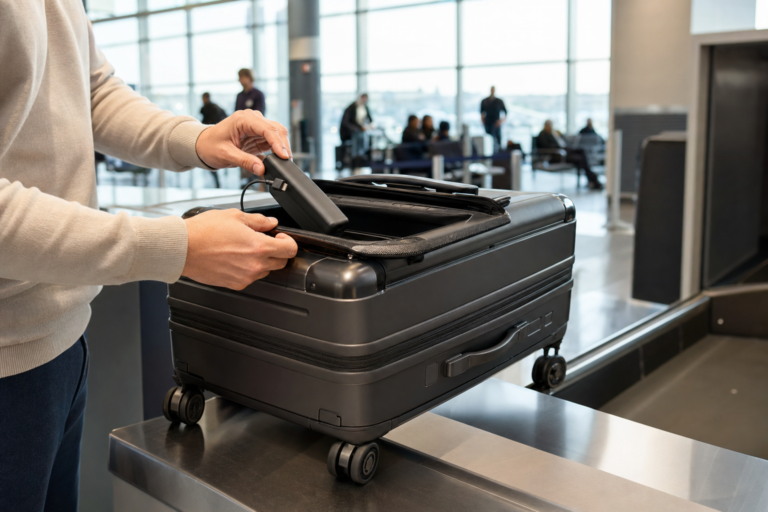
If your checked bag does not appear, stay at the airport and file a mishandled-baggage report before leaving. Start with the baggage desk for the airline that operated your final flight. Get the report reference number, give the address where you can actually receive the bag, and keep receipts for necessary purchases. This written report starts the tracing process and is important for expense reimbursement, a qualifying checked-bag-fee refund and a later lost-bag claim.
What to do at baggage claim before leaving
First, wait until the carousel has stopped, then check the oversized-baggage area and nearby carousels. If other passengers from the flight are waiting too, the bags may simply be late. An airline app can show useful scan information, but it does not replace a report.
If the bag is still missing, take these steps:
- Find the airline’s baggage service office. It is usually near baggage claim. Some airlines provide a code or link for an online report, but use it before you leave the airport.
- File a mishandled-baggage report. Describe the suitcase accurately: size, colour, brand, material, wheels, straps, stickers and distinctive markings.
- Get the file reference in writing. Save the paperwork or confirmation screen, photograph it and email a copy to yourself. A verbal promise that the bag is on the next flight is not a substitute.
- Confirm delivery details. Provide your actual hotel, home or temporary address, plus an email address and working telephone number. Ask whether delivery will be arranged automatically when the bag is found.
- Save travel records. Keep your boarding pass, itinerary, bag-tag receipt, baggage-fee receipt and any messages showing the report time and bag status.
Do not assume you can wait several days to report the problem. Airline reporting deadlines differ, particularly for claims under an airline’s contract of carriage. Reporting at the airport gives you the strongest record of when the bag failed to arrive.
A missing bag-tag receipt should not prevent a report. Give the agent your booking reference, boarding pass, check-in airport and approximate check-in time. The airline may be able to retrieve the bag-tag number from its reservation and baggage records. If an employee will not open a case, ask for a supervisor and submit the airline’s online report while you are still at the airport.
Which airline should receive the report
For a one-airline itinerary, report the bag to that airline. For a codeshare or multi-carrier itinerary, go to the baggage office for the airline that operated the final flight segment. For travel to, from or within the United States, a mishandled-baggage report filed with the final operating carrier is required for the automatic delayed-bag-fee refund on a multi-carrier itinerary.
Hypothetical codeshare example: A passenger buys a ticket from one airline, flies an international segment operated by a partner and then arrives in Denver on a flight operated by a different partner. The passenger should open the baggage report with the carrier that operated the Denver flight. Keep the confirmation even if another airline later handles the tracing or payment.
For an international journey, liability may be governed by the Montreal Convention rather than ordinary domestic rules. The person entitled to receive the bag can generally pursue the last carrier, and may also have rights against the carrier that performed the segment during which the problem occurred. Do not accept being sent between airlines without a written case record.
If you enter the United States from abroad and continue on a domestic flight, you will normally need to collect and recheck checked bags after customs clearance. Failing to do so can affect eligibility for a delayed-bag-fee refund. Read when connecting passengers must recheck bags in the United States before assuming the airline was responsible for a bag left at the first U.S. airport.
What to do during the first day
Use the report number to check the airline’s baggage portal, but also monitor email, text messages and missed calls. If you are changing hotels, boarding a cruise or travelling to another city, update the delivery address before you move. Ask the airline to add a note when delivery to the original address would no longer be useful.
Buy only items you reasonably need while separated from the bag. The U.S. Department of Transportation’s baggage guidance states that airlines must compensate reasonable, verifiable and actual incidental expenses caused by a bag delay, subject to the applicable liability limit. Airlines cannot use an arbitrary daily cap, but they may assess whether each purchase was necessary and reasonably priced.
Hypothetical domestic example: A traveller flies from Chicago to Phoenix for a four-day work trip, but her suitcase does not arrive. Basic toiletries, underwear, a modest change of clothes and an inexpensive work shirt would normally be easier to justify than several outfits or designer purchases. If she has a scheduled business meeting, a reasonably priced suitable outfit may also be necessary. A new laptop would be much harder to connect to the bag delay.
Keep itemised receipts that show the merchant, date, individual items and total. Photograph paper receipts because thermal printing can fade. For an unusual but necessary expense, add a short note explaining its purpose, such as “warm layer needed for an outdoor work appointment.”
Expenses may be more difficult to justify when you are already home, where you normally have clothing and toiletries available. Claim genuine needs that could not reasonably be met from items at home, and explain why they were unavoidable.
Separate the three types of payment
Do not combine every request into a single vague “lost luggage claim.” Keep delayed-bag expenses, bag-fee refunds and a final contents claim separate.
| Remedy | When it applies | What it can cover |
|---|---|---|
| Delayed-bag expenses | While the bag is missing | Reasonable, necessary and documented incidental purchases |
| Checked-bag-fee refund | After a qualifying significant delay or a declaration of loss | The fee paid to transport the affected bag |
| Lost-bag compensation | When the bag is declared or treated as lost | The proven depreciated value of the suitcase and its contents |
For travel covered by the U.S. refund rule, a bag is significantly delayed when it is not delivered within 12 hours after a domestic flight arrives. For an international itinerary between a U.S. and foreign airport, the threshold is 15 hours if the relevant U.S.-international segment is 12 hours or less, and 30 hours if that segment is longer than 12 hours.
The delay begins when you have the opportunity to deplane at your ticketed final destination. It ends when you collect the bag at that airport or the airline delivers it to the location you agreed. Once you have filed the required report and the delay reaches the applicable threshold, the refund should be automatic and made in the original form of payment. There are important exceptions, including where a passenger was required to collect and recheck a bag at the first U.S. entry point but did not do so.
If no bag fee was charged because of airline status, a credit-card benefit or a free allowance, there is no fee to refund. You may still seek reimbursement of reasonable delay expenses and compensation if the bag is lost. See when airlines must refund a delayed baggage fee for the eligibility rules and exceptions.
How to track the bag and manage delivery
Airline systems may show scans from check-in, loading, a transfer point or arrival. A scan shows the last recorded handling event, not necessarily the bag’s live location. Save screenshots whenever the status changes.
If a personal tracker indicates that the bag is somewhere different from the airline’s information, send that detail through the airline’s approved baggage channel. Provide the report number, the tracker’s most recent location and time, and a screenshot if the airline requests one. A tracker location can be delayed or approximate, so treat it as useful evidence rather than proof that a particular employee has the bag.
Do not enter baggage-handling areas, warehouses or private property to retrieve luggage yourself. If the airline marks the bag as delivered but you did not receive it, immediately check the hotel front desk, bell desk, security desk, household members and any authorised delivery location. Ask the airline or courier for the delivery time, address, photograph, signature and driver notes, then state in writing that you dispute delivery and want the report kept open.
If a courier can show that the bag was left correctly at the address you agreed, and it was later stolen, the airline may dispute further responsibility. Report a suspected theft promptly and check the separate notice requirements in any travel, renters or homeowners insurance policy. For tracker preparation and airline restrictions, see using an AirTag in checked luggage.
What to do while the airline searches
Airlines use different standards for declaring a bag lost. Many do so between five and 14 days after the flight, although the timing can vary by itinerary and carrier. Complete a property questionnaire if the airline requests one, but do not treat it as proof that the bag has already been declared lost.
Keep one folder containing:
- the baggage report and reference number;
- boarding passes, itinerary and bag-tag information;
- the baggage-fee receipt or card statement;
- receipts and explanations for necessary purchases;
- screenshots from the airline and any tracker;
- delivery instructions and later address changes;
- a dated log of calls, messages and employee names; and
- photos, receipts or order histories that help establish what was packed.
Submit delay-expense receipts by the airline’s stated deadline rather than waiting for the search to end. For an international journey governed by the Montreal Convention, send a written delay complaint no later than 21 days after the bag is placed at your disposal. Keep proof of submission. An airline may impose a separate, earlier deadline for its initial airport report, which is another reason to report immediately.
Under the Montreal Convention, a bag that has not arrived 21 days after the date it should have arrived may be treated as lost unless the carrier admits the loss earlier. This does not mean payment is automatic: you still need an accurate inventory and evidence of value.
How to submit a lost-bag claim and escalate a dispute
When the airline declares the bag lost, or when an international bag has been missing long enough to be treated as lost, prepare an inventory. List each item, its approximate purchase date, original cost and current value. Airlines usually assess used value after depreciation rather than the cost of replacing every item new today.
Support the inventory with receipts, online order histories, card records, warranty registrations or photographs. If you do not have exact proof, provide a truthful description and reasonable estimate. Inflating a claim can delay payment and undermine the rest of it.
For domestic U.S. travel, airlines may limit liability for a delayed, lost or damaged bag to $4,700 per passenger. For most international travel covered by the Montreal Convention, the limit is 1,519 Special Drawing Rights per passenger, not per bag. The International Civil Aviation Organization’s text of the Montreal Convention confirms that this limit covers destruction, loss, damage and delay of baggage. These are maximum liability limits, not automatic payouts, and delay expenses can count toward the same overall limit.
If you left the airport without a report number, file online immediately and call the destination airport baggage office. Save screenshots showing when you tried. If airlines redirect you repeatedly, write to the final operating carrier with the flight number, date, route and previous report attempts, and ask it to confirm in writing which carrier is handling tracing and payment.
Escalate first to the airline’s central baggage-claims team and then its formal customer-relations channel. If a carrier serving the United States does not provide a required bag-fee refund, refuses reasonable documented delay expenses or will not address a prolonged missing-bag case, file a complaint with the U.S. Department of Transportation. Notify travel insurance or a credit-card benefits administrator as well, but disclose any airline payment and do not seek duplicate recovery for the same loss.