A continuous positive airway pressure machine generally does not count against your carry-on or personal-item allowance on flights covered by United States disability rules. A CPAP is treated as an assistive device when it is used by a passenger with a disability, so it can normally travel in the cabin in addition to the passenger’s regular bags without an extra baggage charge. It must still comply with safety, security and hazardous-material rules and fit in an approved stowage location. Carrying the machine switched off is different from operating it during the flight, which can involve additional conditions.
Pack the CPAP separately and stow it safely
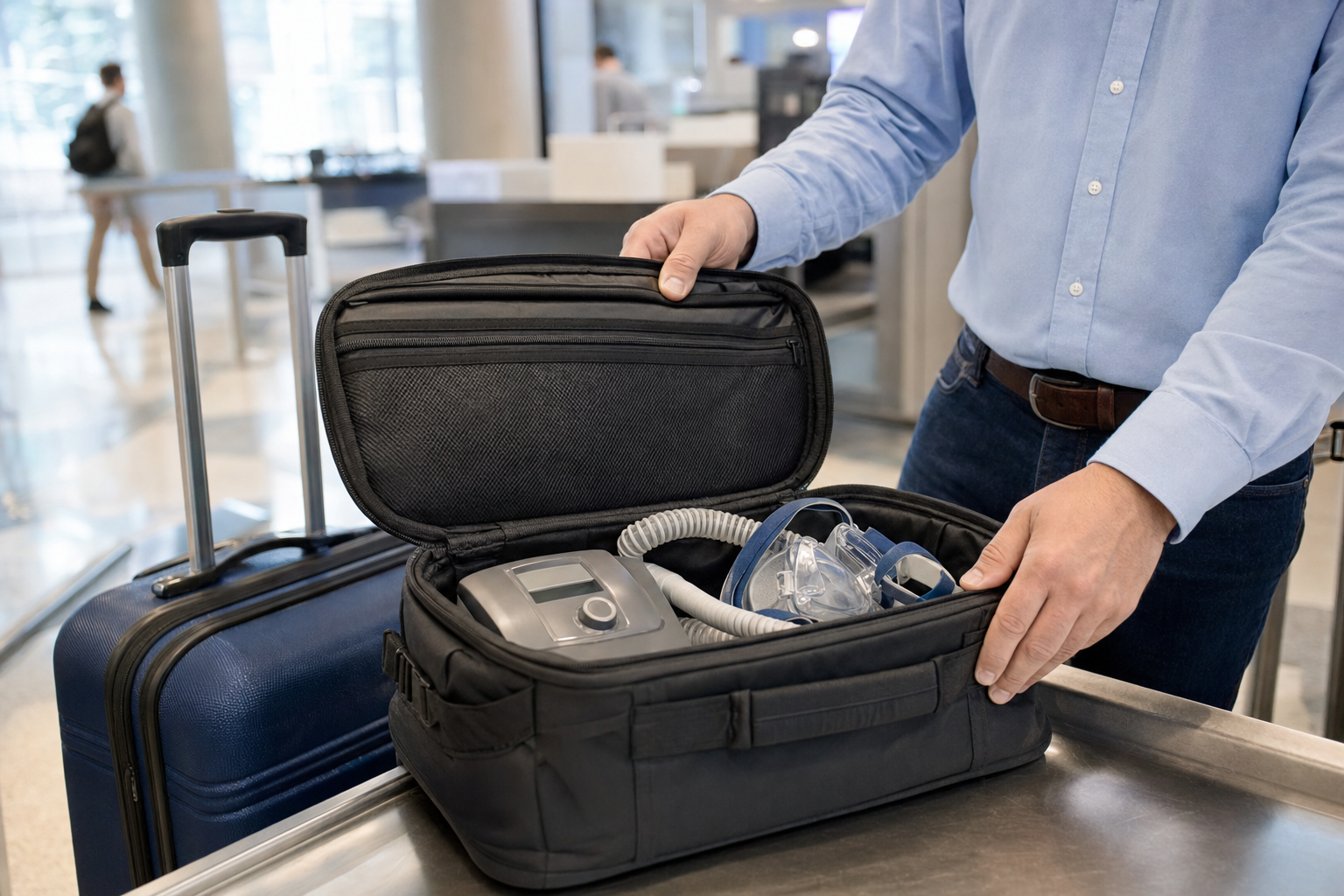
Place the machine in its own protective case if possible. The case may contain equipment and supplies directly related to the CPAP, such as its mask, hose, power adapter, filters, humidifier chamber, compatible battery and cleaning or replacement items needed during the trip. A medical-equipment tag is optional, but it can help airline employees identify the bag quickly.
Keep unrelated personal belongings out of the CPAP case. United States Department of Transportation guidance distinguishes an assistive-device bag from a mixed-purpose bag. If the case also holds clothing, books, ordinary toiletries or unrelated electronics, the airline may count the entire case toward its normal baggage limit and may apply a baggage fee. Equipment required to operate or maintain the CPAP is different from personal items that merely use the available space.
The carry-on exemption does not guarantee unlimited cabin space. The case must fit under a seat, in an overhead compartment or in another approved storage area. It cannot remain loose in the cabin during taxi, takeoff or landing. Space or safety restrictions may occasionally require the airline to place an assistive device in the cargo compartment.
If you need extra time to board and secure the machine, ask for preboarding. Assistive devices have priority over other passengers’ items brought aboard at the same airport when the passenger with a disability uses preboarding. If the CPAP must be checked, identify it as an assistive device and ask how it will be returned. Airlines generally must return checked assistive devices promptly and as close as possible to the aircraft door unless the passenger requests baggage-claim delivery.
Prepare for airport security screening
The Transportation Security Administration permits CPAP, bilevel positive airway pressure and automatic positive airway pressure machines through security. The machine, mask and tubing may usually remain in their case for X-ray screening, although an officer can require them to be removed from the case or carry-on bag for closer inspection. Pack the equipment neatly and allow additional time in case further screening is necessary.
Empty and dry the humidifier chamber before leaving home. This reduces the risk of leaks that could damage the machine or other belongings. It also prevents water already inside the chamber from complicating the liquids screening process.
A container holding no more than 3.4 fluid ounces, or 100 milliliters, follows the standard carry-on liquids rule and must fit inside the passenger’s one-quart liquids bag. Larger amounts of medically necessary liquids may be permitted in reasonable quantities for the journey, but they must be declared to a Transportation Security Administration officer and removed for separate inspection.
The agency’s general exception for medically necessary liquids does not specifically guarantee that every bottle of distilled water for a CPAP humidifier will be accepted. Explain why the water is medically necessary at the start of screening. The officer will decide whether the quantity is reasonable and may inspect or test the container. A liquid that triggers an alarm, cannot be cleared or raises another security concern may be refused even if it is normally permitted.
When practical, buying distilled water after security or at the destination avoids this uncertainty. If you must carry more than 3.4 fluid ounces, use a clearly labelled, manageable container rather than bringing enough water for an entire extended stay.
Check the operating airline before using a CPAP in flight
United States rules do not give airlines blanket discretion to approve or reject every request to use a CPAP. On covered flights and qualifying aircraft, carriers generally must permit a passenger with a disability to operate a compliant respiratory assistive device unless it fails applicable requirements or cannot be stowed and used consistently with safety, security and hazardous-material regulations.
The airline may nevertheless impose specific conditions allowed by the rules. Contact the operating airline, especially when travelling on a codeshare flight sold under another carrier’s name. Ask it to confirm:
- Whether your exact CPAP model has the required manufacturer-affixed label showing compliance with applicable medical portable electronic-device requirements.
- The maximum dimensions and weight that can be accommodated in the cabin.
- Whether the airline requires up to 48 hours’ notice before departure.
- Whether you must check in as much as one hour before its usual check-in deadline.
- How much independent battery capacity you must carry.
- Whether operation is restricted during taxi, takeoff or landing.
A compliance label is relevant to operating the CPAP in the cabin; it is not generally required merely to transport a switched-off machine as an assistive device. In limited circumstances, such as when the carrier reasonably doubts that a passenger can complete the flight safely without extraordinary medical assistance, it may request a medical certificate under the applicable disability rules.
Do not rely on an aircraft seat outlet. An outlet may be unavailable, incompatible with the machine, switched off during part of the flight or unable to provide enough power. If you intend to sleep with the CPAP operating, plan around an airline-accepted battery and test the complete setup before travelling.
Follow both CPAP battery rules and lithium battery limits
An airline may require enough fully charged batteries to operate the CPAP for at least 150% of the expected maximum flight duration. The carrier supplies the expected maximum duration, which may be longer than the scheduled time in the air. If that duration is eight hours, for example, the required capacity may be at least 12 hours based on the battery manufacturer’s estimated operating time.
Test runtime using your normal pressure settings. Heated humidification and heated tubing can greatly reduce battery life, so switching off heat may extend runtime if your clinician and equipment instructions allow it.
There is also an important CPAP-specific condition in Department of Transportation guidance: battery-powered devices brought onboard must use non-spillable batteries. The battery must be clearly marked “Non-spillable” or be completely enclosed in a case. Check the battery, protective housing and manufacturer’s documentation before travel. If a lithium battery does not carry that wording, ask the operating airline whether its enclosed design satisfies the requirement. This condition is separate from the watt-hour limits for lithium batteries.
Federal Aviation Administration limits for rechargeable lithium-ion batteries generally work as follows:
- Up to 100 watt-hours: generally permitted for personal use, subject to proper packing.
- More than 100 through 160 watt-hours: airline approval is required, with no more than two spare batteries per passenger.
- Above 160 watt-hours: generally prohibited in passenger baggage, apart from separate provisions for certain mobility devices.
Spare lithium batteries and power banks must stay in the cabin. Protect each battery from physical damage and short circuit by using its original packaging, a battery case, an individual protective pouch or covered terminals. Remove all spare batteries and power banks before a carry-on bag is checked at the gate. Do not travel with a swollen, leaking, damaged or recalled battery unless it has been removed or otherwise made safe under applicable requirements.
To calculate watt-hours, multiply the voltage by the amp-hour rating. If the label lists milliamp-hours, divide that number by 1,000 before multiplying by the voltage. See how many milliamp-hours are allowed for a power bank on a plane for calculation examples, and check whether you can use a power bank on a plane before depending on a general-purpose battery.
Before leaving for the airport, confirm whether you will only carry the CPAP or operate it onboard, pack it separately from personal belongings, empty the humidifier, verify the device label, inspect the battery marking and calculate the required runtime. International flights operating wholly outside the United States may follow different disability, medical-device and battery rules, so check every operating carrier on the itinerary.
Sources
- United States Department of Transportation Assistive Device Stowage Damage and Delay
- Electronic Code of Federal Regulations Section 382.121 on cabin assistive devices
- Electronic Code of Federal Regulations Section 382.133 on respiratory assistive devices
- Transportation Security Administration What Can I Bring List
- Federal Aviation Administration PackSafe Lithium Battery Guidance