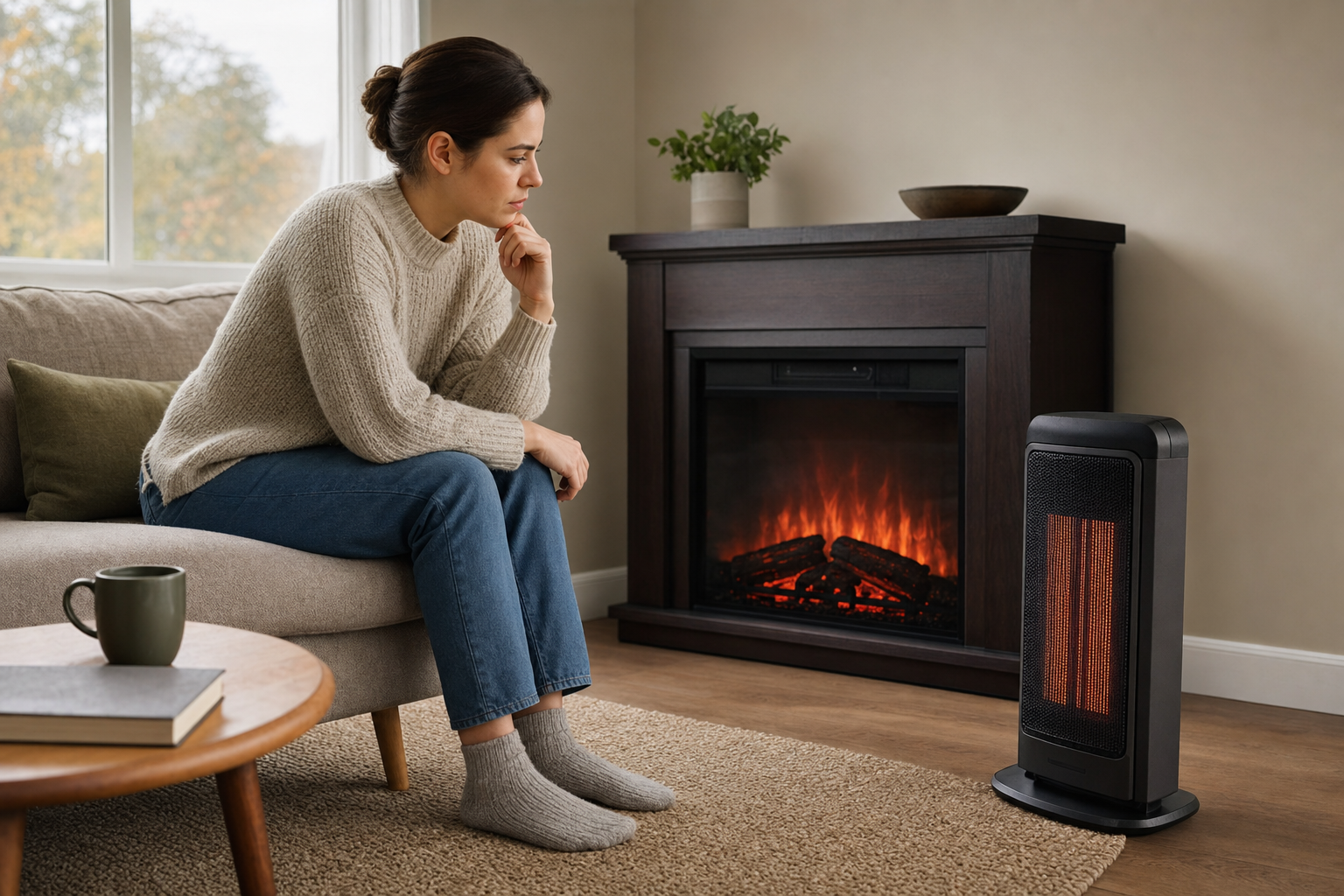
For most shoppers, a portable space heater is the better choice when the main goal is affordable, flexible supplemental heat. An electric fireplace is better when you also want a flame effect and a furniture-like focal point. If both appliances draw 1,500 watts and use electric resistance heating, they provide broadly similar maximum heat output and cost about the same to run. A 1,500-watt model produces approximately 5,100 British thermal units of heat per hour, regardless of whether it looks like a fireplace, ceramic heater or radiator.
Heat output and running cost
Electric fireplaces and conventional electric space heaters generally turn nearly all the electricity they use into heat within the room. The design of the heating element can change how the warmth is delivered, but it does not allow one 1,500-watt resistance heater to produce substantially more total heat than another.
Ceramic and coil heaters often use fans to move warm air quickly. Oil-filled radiators warm gradually and release heat through both natural air circulation and radiation. Infrared-style heaters direct more radiant warmth toward nearby people and surfaces. Electric fireplaces commonly use a heating element and blower behind or above the decorative flame display. These differences affect how soon and where you feel warm, not the basic relationship between wattage and maximum heat output.
Always check the product label and specifications. Small personal heaters may draw considerably less than 1,500 watts. Some electric fireplaces also operate at lower wattages, while certain hardwired models can use a 208-volt or 240-volt supply and produce more heat than a typical plug-in unit.
| Electricity rate | Cost per hour at 1,500 watts | Cost for eight hours at full power |
|---|---|---|
| $0.15 per kilowatt-hour | About $0.23 | $1.80 |
| $0.20 per kilowatt-hour | $0.30 | $2.40 |
| $0.25 per kilowatt-hour | About $0.38 | $3.00 |
To estimate operating cost, convert the appliance’s wattage to kilowatts and multiply it by your electricity price per kilowatt-hour. A 1,500-watt heater uses 1.5 kilowatts. If it runs continuously for one hour, it consumes 1.5 kilowatt-hours. At a rate of $0.20 per kilowatt-hour, that costs $0.30.
Actual consumption can be lower when a thermostat cycles the heating element off after the room reaches the selected temperature. Low, eco and half-power modes also reduce electricity use, but only by reducing heat output or limiting operating time. The exact wattage associated with each setting is product-dependent.
Room coverage and comfort
Manufacturer room-size claims are useful for rough comparisons, but they are not guarantees. A claim that a heater covers a certain number of square feet does not specify the outdoor temperature, insulation level, ceiling height or temperature increase used in the estimate. If two appliances both draw 1,500 watts, a larger advertised coverage area does not mean one creates more heat.
Performance depends heavily on the room and building. Important factors include:
- Outdoor temperature and local climate
- Insulation quality and drafts around doors or windows
- Ceiling height and total room volume
- The number and condition of exterior windows
- Open doorways, hallways and adjoining rooms
- Whether the appliance supplements central heating or must warm a cold room alone
A 1,500-watt appliance may noticeably improve comfort in a closed, reasonably insulated bedroom or office while having little effect in a large open-plan living area. Neither option should automatically be expected to replace a central heating system.
Placement also affects perceived comfort. A fan-forced space heater aimed toward a desk may make you feel warm sooner than a fireplace that releases heat from a top or lower vent. An infrared-style heater can feel effective when you are directly in front of it, while an oil-filled radiator often takes longer to warm the surrounding room. These are differences in heat distribution and response time rather than maximum output.
Practical buying differences
| Consideration | Electric fireplace | Portable space heater |
|---|---|---|
| Portability | Wall-mounted and recessed units are effectively fixed. Mantel and console models can be moved but are often bulky. | Usually easier to carry between rooms. |
| Noise | Many heating models use a blower. Flame-only operation may be quieter, although the visual mechanism can produce a faint sound. | Fan-forced models make fan noise. Oil-filled radiators are often quieter but warm more gradually. |
| Placement | Can serve as a focal point but requires suitable wall, floor or cabinet space and unobstructed vents. | Requires stable floor space away from foot traffic and combustible materials. |
| Installation | Freestanding plug-in models are usually simple. Mounted, recessed or hardwired units require more planning. | Normally ready to use without mounting or construction. |
| Visual effect | Many models can display flames without producing heat. | Usually has no decorative flame effect. |
| Purchase cost | Often costs more because of the firebox, lighting, glass, decorative media or cabinet. | Usually the less expensive route to comparable resistance heat. |
An electric fireplace’s clearest advantage is atmosphere. Many models allow flame-only operation, so you can use the visual effect throughout the year. The lights, electronics and flame mechanism still consume some electricity, and the amount varies by model.
Neither category is automatically quiet. Many electric fireplaces and compact ceramic heaters use blowers, but motor speed, fan design and cabinet construction affect the sound. If noise matters, compare specifications and reviews for the exact products rather than relying on the category name. For more detail on two common heater designs, read Oil Filled Radiator or Ceramic Heater Which Should You Choose.
Before buying a mounted or built-in fireplace, download the installation manual for the exact model and verify every required clearance. Check its rules for walls, floors, furniture, curtains, televisions, shelves and other objects, as well as its ventilation and electrical requirements. Do not assume the clearance shown for a similar-looking model applies to yours.
Safety and the best choice for each room
Useful features include an adjustable thermostat, overheat protection and clear operating instructions. A tip-over shutoff is particularly important for a freestanding portable heater that could be knocked over. When checking safety certification, look for a recognized mark applying to the finished appliance. Certification or recognition of one internal component does not mean that the complete product has been evaluated in the same way.
Plug a portable electric heater directly into a suitable wall outlet, not an extension cord or power strip. Keep all sides of it at least 3 feet from bedding, curtains, furniture, paper, clothing and other materials that can burn. Place it on a stable, level surface where children, pets and passing feet are unlikely to knock it over. Do not run the cord beneath a rug or carpet. Turn the heater off when leaving the room and do not operate it while sleeping. See Can You Safely Plug a Space Heater Into a Power Strip for a fuller explanation.
The 3-foot portable-heater rule should not be treated as the installation specification for every electric fireplace. Fireplace vent locations and clearance requirements differ. Follow the exact model’s manual, keep its air inlets and outlets unobstructed and use a qualified electrician when hardwiring or adding a suitable circuit is required.
- Living room: Choose an electric fireplace if you want a permanent-looking focal point and will use the flame display. Choose a portable heater when warmth, low purchase cost and easy relocation matter more.
- Bedroom: Either option can provide supplemental warmth while you are awake. A portable model should have tip-over and overheat protection and must not be left operating while you sleep.
- Home office: A portable heater is often better value when you mainly need warmth near a desk. Consider an oil-filled model or a quieter fan design if noise disrupts calls or concentration.
- Rental home: A portable heater avoids drilling, recessing and hardwiring. A freestanding fireplace console may also work, but check the lease before mounting anything to a wall.
- Ambiance-first purchase: Choose the electric fireplace. Its flame-only mode and decorative appearance offer benefits a standard space heater cannot provide, but do not pay more expecting a typical 1,500-watt fireplace to produce more heat than a similarly rated resistance heater.
Sources
- U.S. Department of Energy full text energy glossary
- Dimplex electric fireplace technical support
- U.S. Consumer Product Safety Commission portable heater safety guidance
- National Fire Protection Association electric portable space heater safety sheet
- UL Solutions guide to component recognition and finished-product certification