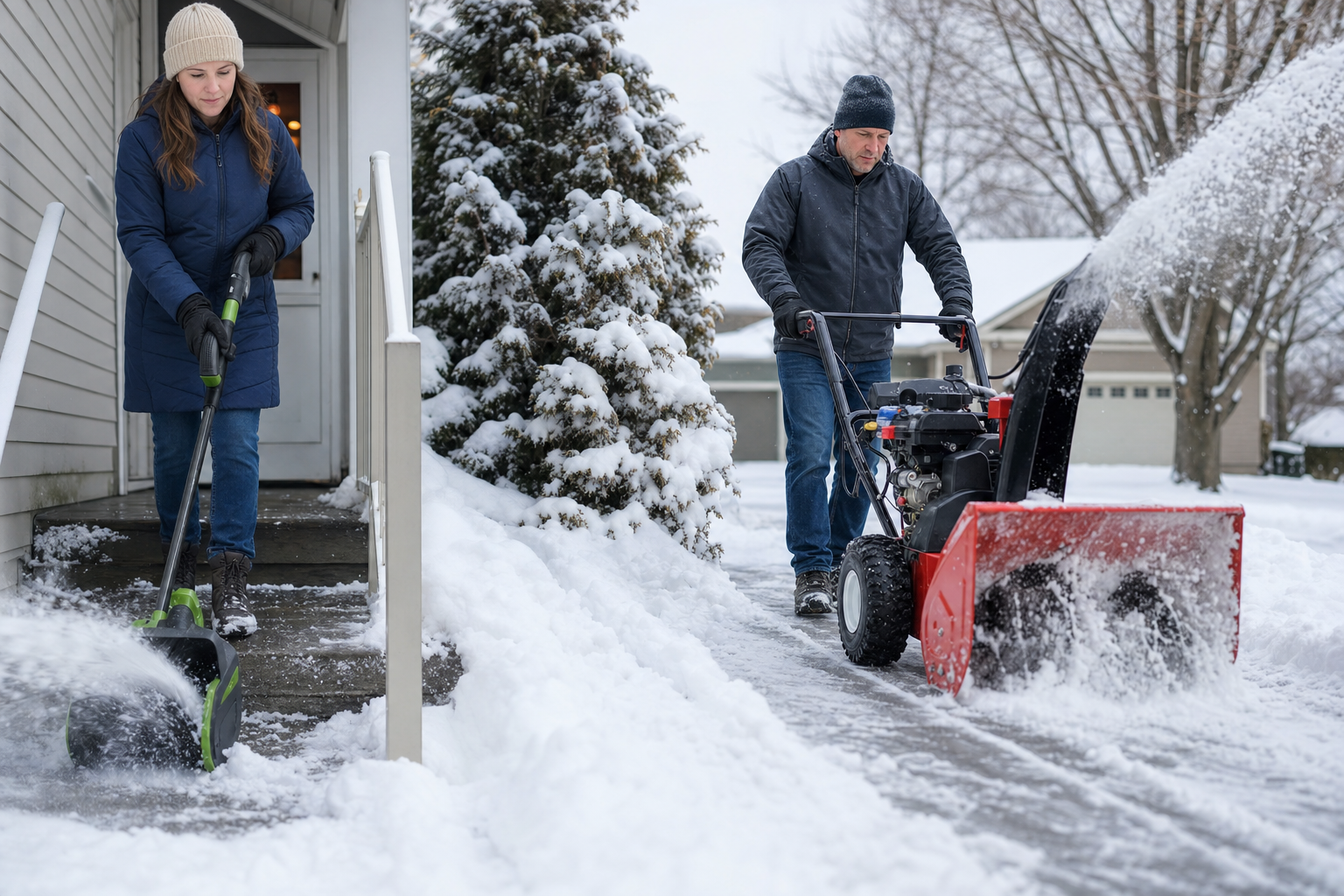
In an electric snow shovel vs snow blower comparison, choose an electric snow shovel for light snow on short, narrow areas that are awkward for a wheeled machine. Choose a walk-behind snow blower for a driveway, repeated storms, deeper snow, wet accumulations or the compacted ridge left by a road plow. A power shovel is a powered alternative to a hand shovel and can complement a larger snow blower, but it is not a like-for-like replacement for one.
For many cordless power shovels, about six inches is a sensible working limit. For example, a current 12-inch EGO cordless snow shovel has a six-inch intake height. Deeper snow can sometimes be removed in more than one pass, but that is slower and may overload a small machine. Snow type matters as much as depth: light, dry snow is easier to move than wet, packed or partly frozen snow.
Match the tool to the area you need to clear
An electric snow shovel is a compact handheld tool with a rotating auger that gathers and throws snow. Models vary, but a 12-inch clearing width is common in this category. It avoids repeatedly lifting shovelfuls of snow, although you must still carry, support and guide the machine.
That compact format is useful where a walk-behind snow blower is too large or hard to manoeuvre:
- Steps and tight corners: A handheld snow shovel can be easier to position than a wheeled machine. Use it on steps only if its operator’s manual allows it, and do not use any machine where you cannot maintain stable footing.
- Decks and patios: A lightweight tool is easier to carry to an elevated surface. Check the manual and work carefully around uneven boards, raised fasteners and changes in level.
- Narrow sidewalks: A narrow clearing path suits confined routes, although several passes may be needed for a wide walk.
- Short paved driveways: A power shovel can work well after a light snowfall when snow has not been compacted by tires or footsteps.
A walk-behind snow blower is generally the better fit for a one- or two-car driveway, a broad parking area, a long sidewalk or several areas to clear. Its wider intake, larger collection housing and discharge chute reduce the number of passes and make it easier to direct snow away from cars, walls and pedestrian routes.
If a blower fits the job, the next decision is usually between a single-stage and two-stage machine. See Single Stage or Two Stage Snow Blower for Your Driveway for a closer comparison.
Electric snow shovel vs snow blower decision table
| Clearing job | Better choice | Why |
|---|---|---|
| Steps and tight corners | Electric snow shovel | Compact and easier to carry where a wheeled machine cannot safely go |
| Small deck or patio | Electric snow shovel | Lightweight and easier to transport and store |
| Short sidewalk with light snow | Electric snow shovel | Reduces lifting without requiring a large machine |
| Small paved driveway with light snow | Either | A shovel saves storage space; a blower makes fewer passes |
| One- or two-car driveway with regular snowfalls | Walk-behind snow blower | Greater clearing width, capacity and discharge control |
| Wet snow or a plow berm | Capable two-stage snow blower | A taller intake and separate impeller are usually better suited to heavy, dense snow |
| Gravel driveway | Two-stage snow blower with adjustable skid shoes | The housing can be raised to reduce the chance of collecting stones |
| Large paved area | Self-propelled snow blower | Less pushing effort and faster coverage |
Snow depth and discharge control matter most
Do not treat a snow shovel’s intake height as a promise that it will clear every type of snow at that depth. A representative 12-inch cordless model has a six-inch intake height, but its manual also notes that deeper snow may require more than one pass. Heavy snow can clog the auger or make the tool stop, so clearing early is usually easier than waiting for snow to become packed or wet.
The ridge left at the end of a driveway by a municipal plow is particularly demanding. It can contain dense snow, ice pieces, slush, grit and stones. A power shovel may handle a fresh, small berm in stages, but it is often a slow job. A suitable two-stage snow blower is normally the better option because its auger feeds snow into a separate impeller and its intake is typically larger than that of a handheld tool.
Discharge control is another important difference. Many power shovels throw mainly ahead, though some include adjustable louvers. The current EGO 12-inch cordless snow shovel, for example, has a 60-degree directional-control range: up to 30 degrees left or right from straight ahead. A walk-behind blower normally has a chute that turns much farther to either side, plus a deflector that helps control how high and far the snow travels.
This matters around parked vehicles, walls, neighbouring property and public sidewalks. With a forward-throwing shovel, you may need to plan your direction of travel carefully or move snow twice. Maximum throw-distance claims are also made under favourable conditions; dense, wet snow will usually travel less far.
Neither tool is effortless. One current cordless snow shovel weighs 14 pounds without its battery, so a long job can tire the arms, shoulders and back. A walk-behind blower is much heavier, but its weight is carried on wheels. Self-propelled models reduce pushing effort, although turning and controlling them still require strength.
Consider surfaces storage batteries and maintenance
Power shovels work best on smooth, level paved surfaces. Their augers and scraper bars run close to the ground, so gravel, loose stones, raised joints and badly cracked pavement can cause damage or create a thrown-object hazard. Single-stage snow blowers have similar limitations because their paddles also work close to the surface.
For gravel, choose a two-stage snow blower with adjustable skid shoes and set them according to the operator’s manual. Raising the housing helps it pass over loose material rather than collecting it. You should still expect a thin layer of snow to remain; trying to scrape a gravel driveway completely bare can send stones through the machine.
Storage strongly favours a power shovel. Some models fold for compact storage along a garage wall. A walk-behind snow blower needs a route and floor space more like a lawn mower, while a large two-stage model needs substantially more room. Before buying, measure the storage space and the route into it, including gates, steps and doorways.
When comparing cordless options, compare the price of a working kit rather than the bare tool alone. A tool-only snow shovel can be good value if you already own the correct battery and charger. If you are entering a new battery system, include compatible batteries and a charger in the cost. Battery systems are ordinarily brand-specific, and runtime depends on battery capacity, snow conditions, temperature and how quickly you work.
A shared battery platform can be useful if you also need a mower, leaf blower or string trimmer. However, do not assume that a small battery from another tool will provide enough runtime for snow clearing. For a comparison of larger cordless and gasoline machines, see Battery or Gas Snow Blower for a One or Two Car Driveway.
Electric equipment avoids gasoline, oil changes and carburetor maintenance, but it still needs care. Inspect the scraper bar, auger, belt and fasteners as directed by the manufacturer. Remove packed snow after use, and store the machine and battery as instructed. Walk-behind models may need replacement scraper bars, paddles, belts, skid shoes or shear pins. Gasoline models also require fuel management, engine-oil checks and other engine maintenance.
Use either machine safely: Remove stones, cords and other objects from the area before clearing. Shut the machine off and disconnect its battery, power cord or spark-plug lead before clearing a clog or making an adjustment. Never put a hand into an auger or chute; use the manufacturer-supplied clean-out tool or another suitable long stick. Never operate a gasoline snow blower in or near an enclosed area, including a garage, because engine exhaust can quickly create a deadly carbon-monoxide hazard.
Choose the electric snow shovel if your recurring task is a deck, narrow paved path or other small area and you can clear light snow promptly. Choose a walk-behind blower if one missed clearing session could leave you with a deep accumulation, a large driveway or a compacted plow berm. In areas with frequent snow, owning both can be practical: use the blower for the driveway and the power shovel for the places it cannot reach easily.