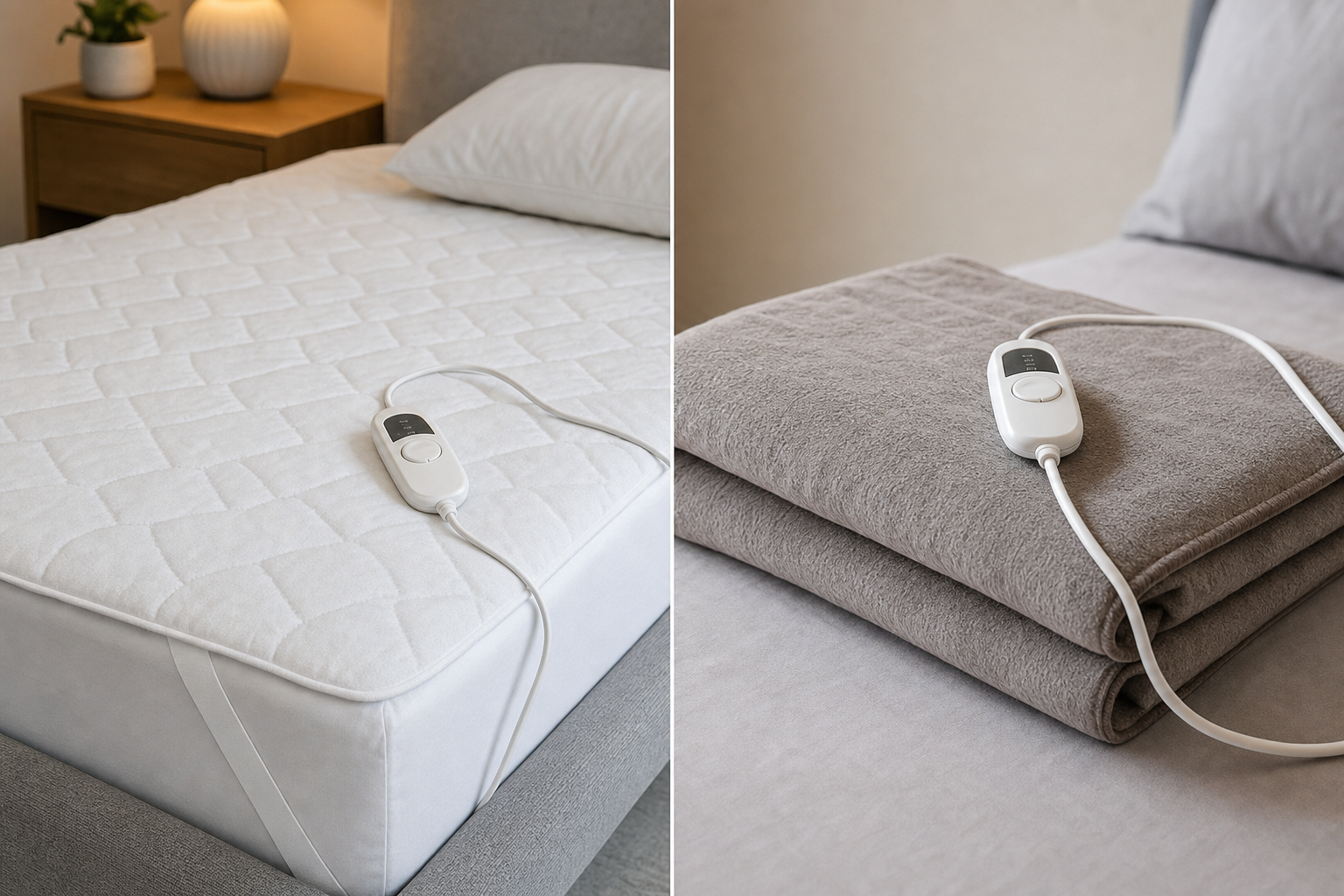
For a cold bed, choose a heated mattress pad when you want steady warmth from below and plan to leave it on one bed. Choose an electric blanket when you want warmth above your body or a product that can also be used on a sofa or in another room, if its manual permits that use. Neither is automatically better: correct fit, approved layering, cord placement and the manufacturer’s instructions matter more than the number of heat settings.
How heated mattress pads and electric blankets differ
Both products use insulated heating elements and a controller, but they are designed for different positions. A heated mattress pad fits on the mattress, normally beneath the fitted sheet, and warms the surface below you. An electric blanket is normally placed over the sleeper. Use each product only in the orientation and bedding layers specified by its manual.
Do not put an electric blanket beneath you as though it were a mattress pad. A blanket must remain flat and should not be folded, bunched or tightly tucked in while operating. The U.S. Consumer Product Safety Commission also warns against covering an operating electric blanket unless its instructions specifically allow the arrangement, because trapped heat can cause overheating.
| Decision point | Heated mattress pad | Electric blanket |
|---|---|---|
| Primary use | Warming a fixed bed from below | Providing warmth above the body |
| Preheating | Effective because it warms the sleep surface | Can preheat a bed when used flat in its approved position |
| Overnight comfort | Stays in place beneath the fitted sheet | Can be pushed aside or removed more easily if you become too warm |
| Portability | Low because it is fitted to one mattress | Higher, especially for a heated throw approved for sofa use |
| Couples | Some larger sizes offer separate controls for each side | Some bed-size blankets offer separate controls |
| Fit concerns | Must suit the mattress size and pocket depth | Must be large enough without needing to fold or tuck heated areas |
| Cleaning | May be washable, but is bulkier to remove and refit | May be easier to remove for washing if the controls detach |
Do not assume that more heat levels mean faster warming or lower energy use. Heating-element layout, controller settings, room temperature, bedding layers and how the product fits all affect the result.
Which is better for your sleeping habits
Preheating a cold bed
A heated mattress pad is usually the more practical choice for preheating because it warms the surface you first feel when getting into bed. Switch it on only for the period and setting allowed by its manual. If the manufacturer recommends turning it down or off before sleep, follow that instruction.
An electric blanket can also warm a bed before use, but it should remain spread flat above the bedding in the position specified by its instructions. Do not climb on it or move it beneath the fitted sheet to speed up warming.
Staying warm through the night
There is no universal winner for overnight warmth. A properly fitted mattress pad is less likely to shift during sleep. An electric blanket provides warmth from above and is easier to move away when you feel too warm, but it can bunch if you move around.
Only use a product overnight when its own manual permits it. Automatic shutoff settings vary by model, and an automatic timer does not make unsafe placement, damaged wiring or improper layering safe.
Couples and dual-zone control
Separate controls can help when partners prefer different temperatures. Before buying a larger heated mattress pad or blanket, confirm that each side has an independent controller and that one side can remain off. Also check where the connectors sit near the foot of the bed and plan a cord route that does not cross a walking area or become trapped by the bed.
Portability and room heating
An electric blanket or heated throw is generally easier to move between rooms than a fitted mattress pad. However, do not assume a throw is safe for every chair or sofa. Some manuals prohibit use on recliners, adjustable furniture, pullout beds and other surfaces where cords or heating elements could be pinched. A mattress pad is best treated as part of one compatible bed setup.
If you need to warm a whole room rather than one person, heated bedding is not a replacement for safe room heating. Compare broader options in Electric Fireplace or Space Heater Which Is Better for Supplemental Heat and Oil Filled Radiator or Ceramic Heater Which Should You Choose.
Fit cleaning and electricity use
Before ordering a heated mattress pad, measure the mattress with any topper or protector that will remain beneath it. Compare the result with the pad’s stated pocket depth. A loose pad can wrinkle, while an overstretched skirt can pull the heated section out of place.
Read the mattress manufacturer’s guidance before using heated bedding. Restrictions vary, especially for temperature-sensitive foam. Tempur-Pedic does not recommend using an electric blanket or heating pad with its mattresses because high heat can affect how TEMPUR-Material responds and conforms. It says that people who choose to use one should limit use to 30 minutes on a low or medium setting. Follow the instructions for your exact mattress rather than assuming that all foam mattresses have the same limits.
Many heated bedding products have detachable controls and washable fabric, but care instructions differ. Disconnect all cords before washing, use only the approved washing and drying method, and do not reconnect the product until it is completely dry. Do not dry-clean, bleach, iron or wring heated bedding unless the manual specifically permits it.
For storage, turn the product off, unplug it, allow it to cool and loosely roll it or store it as directed. Avoid sharp creases and do not place heavy items on top of it. Inspect the fabric, connectors and cords before using it again after seasonal storage.
To estimate electricity use, multiply the product’s rated watts by the hours used, then divide by 1,000 to get kilowatt-hours. For example, a product drawing 100 watts continuously for 30 minutes would use 0.05 kilowatt-hours. Actual use may be lower because many controllers cycle the heat, so use the wattage on the product label and your electricity rate for a more useful estimate.
Safety rules and buying checklist
Keep heated bedding flat, dry and in good condition. Stop using it if you find fraying, exposed or broken wires, scorch marks, loose connectors, unexplained hot spots or a controller that becomes unusually hot. Check the Consumer Product Safety Commission recall database before using an older product or buying a secondhand one.
Do not use a heated mattress pad and an electric blanket, heating pad or another electrically heated product together unless the manufacturer explicitly permits the combination. Do not fold, bunch, tightly tuck or pin heated bedding while it operates. Keep the controller uncovered, and never trap cords between the mattress and foundation or route them beneath rugs.
Many manufacturers also warn against use by infants, children, people with reduced heat sensation or limited mobility, and anyone unable to operate the controls safely. Ask a healthcare professional before use if a medical condition, medication or medical device could affect heat sensation or safe operation.
- Automatic shutoff: Check the timer duration and whether overnight operation is permitted for that exact model.
- Independent safety certification: Look for a recognized independent safety-certification mark, such as UL, that applies to the exact product.
- Cord placement: Confirm that the cord reaches a wall outlet without an extension lead, stretching, pinching or passing beneath a rug.
- Controller design: Choose controls that are readable, reachable and easy to operate in the dark. For couples, check that each person receives a separate controller when needed.
- Mattress and bed restrictions: Read the instructions for the mattress, base and heated product, particularly for foam mattresses, waterbeds, airbeds, bunk beds and adjustable or pullout beds.
- Correct dimensions: Match a mattress pad to the bed size and measured depth. Choose a blanket that provides coverage without folding or tucking heated sections.
- Cleaning instructions: Confirm that the controllers detach, and that you can follow the specified washing and drying method.
- Manual availability: Buy only when instructions for the exact model are available and cover setup, bedding layers, cleaning, storage and replacement controls.
Choose a heated mattress pad if your priority is a prewarmed bed that stays set up in one room. Choose an electric blanket if movable, above-body warmth is more important. In either case, use one heated bedding product at a time and let the manual for that exact model override general advice.
Sources
- U.S. Consumer Product Safety Commission Home Electrical Safety Checklist (cpsc.gov)
- U.S. Consumer Product Safety Commission Recalls and Product Safety Warnings (cpsc.gov)
- UL Solutions electric blanket safety guidance (ul.com)
- Tempur-Pedic guidance on heated blankets and mattresses (help.tempurpedic.com)
- Sunbeam heated bedding instruction manual (sunbeamhome.com)