For most U.S. homeowners comparing MERV 8, 11 and 13, the best choice is the highest-efficiency filter that the heating, ventilation and air conditioning system can accommodate without creating an airflow problem. MERV 8 is a sensible basic filter, MERV 11 provides better everyday particle capture, and MERV 13 is the stronger option for fine particles and wildfire smoke when the equipment supports it. Do not automatically buy the highest number on the shelf.
MERV 8, 11 and 13 at a glance
Minimum Efficiency Reporting Value, usually called MERV, compares how effectively an air filter captures particles from 0.3 to 10 microns under a standardized laboratory test. A higher rating means better capture within specified particle-size ranges. It does not, by itself, show the filter’s airflow resistance, service life or suitability for a particular furnace or air handler.
| Rating | Minimum required average capture efficiency | Practical household use | Main limitation |
|---|---|---|---|
| MERV 8 | 20% at 1 to 3 microns and 70% at 3 to 10 microns | Ordinary dust, pollen, lint and basic equipment protection | No required minimum efficiency for 0.3 to 1 micron particles |
| MERV 11 | 20% at 0.3 to 1 micron, 65% at 1 to 3 microns and 85% at 3 to 10 microns | Pets, seasonal pollen and improved everyday filtration | May have more airflow resistance than a basic filter |
| MERV 13 | 50% at 0.3 to 1 micron, 85% at 1 to 3 microns and 90% at 3 to 10 microns | Fine particles, smoke and households seeking stronger filtration | Requires a system and filter setup that can accommodate it |
These figures describe minimum laboratory performance for air passing through the filter once. They do not mean that a MERV 13 filter removes every smoke particle, or that a MERV 8 filter captures only visible dust. Results in a home also depend on system run time, airflow, filter fit and whether air leaks around the filter frame.
MERV ratings apply to particles, not gases. A MERV 13 furnace filter can reduce smoke particles, but it does not reliably remove smoke odors or other gaseous pollutants. Gas removal requires a filter or air cleaner designed for gases, usually with a meaningful amount of sorbent media such as activated carbon.
Which rating fits common household needs
Choose MERV 8 for basic filtration and equipment protection. It is often an appropriate replacement when the existing approved filter is MERV 8, the system has limited filter capacity, or there are no particular concerns about smoke or fine-particle filtration. It captures a useful share of larger airborne particles, including pollen, lint and dust.
Choose MERV 11 for stronger everyday filtration. It improves capture in the 1 to 3 micron range and has a defined efficiency threshold for particles as small as 0.3 micron. This makes it a reasonable middle-ground choice for homes with pets, seasonal pollen or a desire for better particle filtration without moving directly to MERV 13.
Choose MERV 13 for better fine-particle filtration when the system supports it. The U.S. Environmental Protection Agency advises using a MERV 13 or higher filter, or the highest rating the system can accommodate, when upgrading central heating and cooling filtration. For wildfire smoke, the agency specifically recommends a filter marked MERV 13 or higher and advises checking with the system manufacturer or a qualified heating and cooling technician if compatibility is uncertain.
During a wildfire-smoke event, check the filter more often because it may load with particles faster than usual. Run the central-system fan as much as practical to increase filtration, while considering electricity use and humidity control. A portable air cleaner can also provide focused filtration in a bedroom or other regularly occupied room, particularly when the central system cannot use a higher-efficiency filter. See Air Purifier Versus HVAC Filter for Wildfire Smoke for help comparing those approaches.
Why filter depth and construction matter
MERV describes particle-capture efficiency, not the precise resistance a filter adds to airflow. That resistance is called pressure drop. Higher-efficiency media can create more resistance, but filters with the same MERV rating can perform very differently because of their media, pleat design, face area and frame construction.
For that reason, do not assume every MERV 13 filter is more restrictive than every MERV 11 filter. Compare the manufacturer’s published initial pressure-drop data at an airflow relevant to your system whenever it is available. Pressure drop also rises as a filter collects dust, which is why replacement intervals should follow the filter and equipment manufacturers’ guidance rather than a fixed schedule alone.
A deeper pleated filter usually has more media surface area than a one-inch filter with the same length and width. This can allow a higher-efficiency filter to operate with manageable resistance, but the actual result depends on the particular products and airflow. A four-inch filter requires a compatible media cabinet; it cannot be substituted into a one-inch slot. Likewise, a system with a one-inch slot may physically accept a one-inch MERV 13 filter but may not be suitable for every MERV 13 product.
Read Should You Buy a 1 Inch or 4 Inch Furnace Filter before changing filter formats.
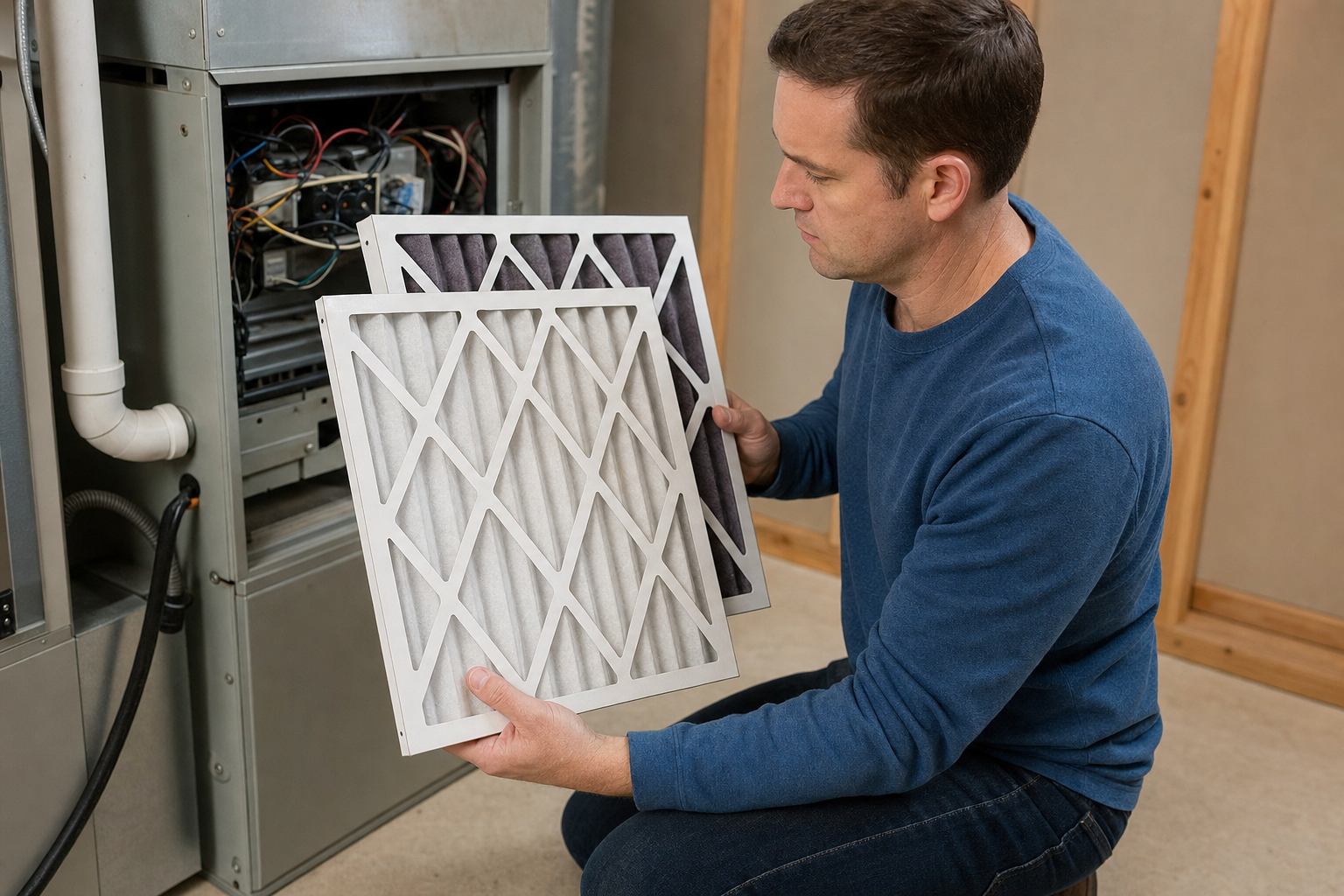
Fit matters as much as the rating. A filter that is undersized, bowed, crushed or poorly sealed can allow unfiltered air to bypass its edges. Use the correct actual dimensions for the filter rack, and install it with the airflow arrow pointing toward the blower. For common arrangements, see Which Way a Furnace Filter Goes in Common Setups.
How to confirm your system can handle an upgrade
Before moving from MERV 8 to MERV 11 or 13, check the equipment rather than relying only on general packaging claims.
- Read the existing filter. Record its length, width, depth and MERV rating. Use a filter that fits correctly. Printed nominal dimensions can differ slightly from the filter’s measured dimensions.
- Find the furnace or air-handler model number. It is usually on a rating plate on or behind an accessible service panel. Use the model number to locate the manufacturer’s owner, installation or service documentation.
- Check the filter arrangement in the documentation. Look for requirements concerning filter dimensions, filter area, approved filter cabinets, airflow or external static pressure. A separate media cabinet or whole-house air cleaner may have its own replacement-filter specification.
- Compare actual products, not only MERV ratings. If you are considering an upgrade, compare the listed pressure drop of the proposed filter with that of the current filter at a similar airflow. A thicker filter or a larger filter face area may be a better upgrade path than simply choosing a denser one-inch filter.
- Ask a qualified technician when the answer is unclear. A technician can assess system airflow and measure pressure across the filter and the system while it operates. This is more reliable than judging compatibility from MERV rating or filter thickness alone.
The practical buying rule is straightforward: use MERV 8 for basic filtration, consider MERV 11 for improved everyday particle capture, and use MERV 13 for stronger fine-particle and wildfire-smoke filtration when the system can accommodate it. If the manual does not give a clear answer, retain the current approved filter specification until a qualified heating and cooling professional confirms that an upgrade is suitable.