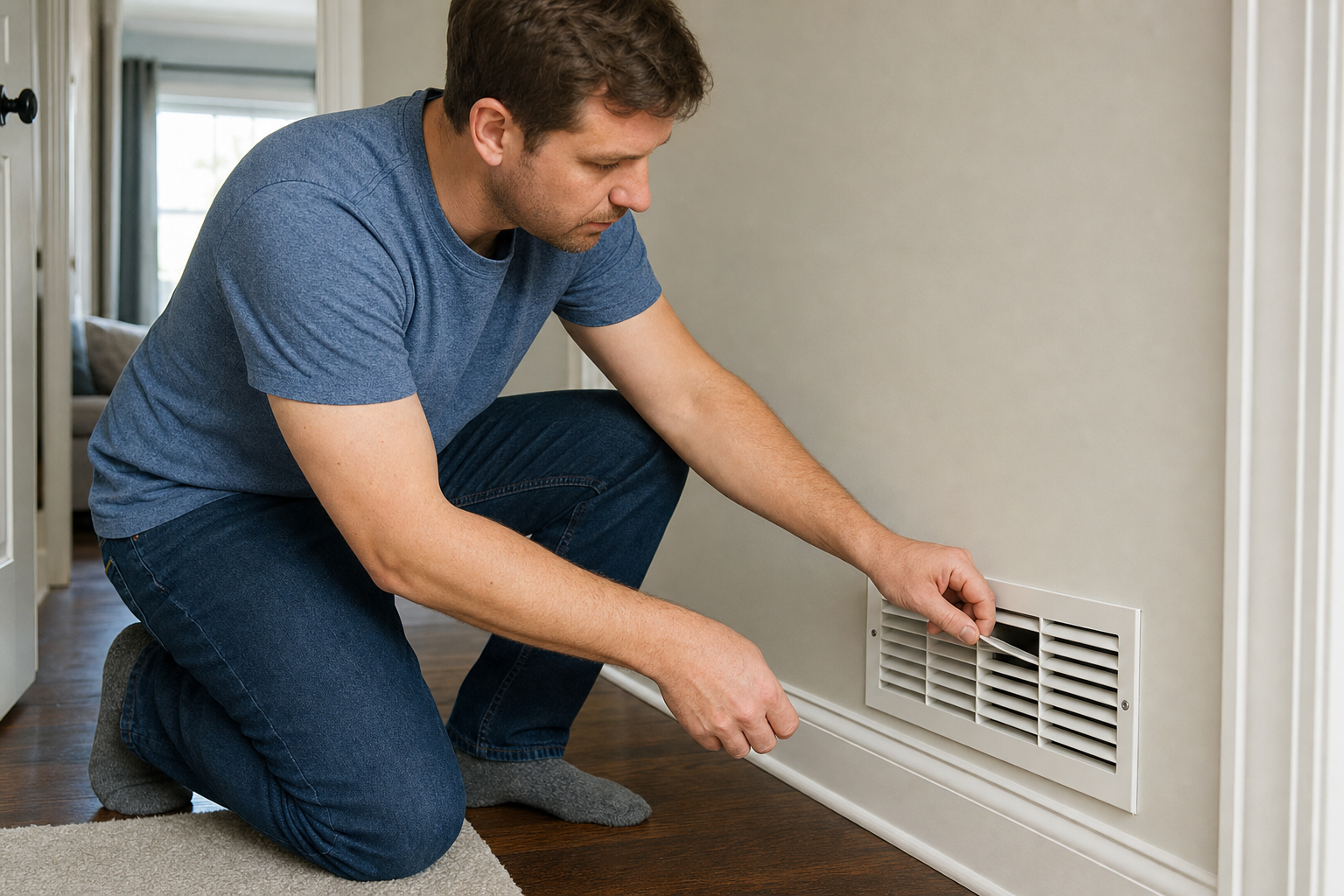
For most homes with central forced-air heating or cooling, you should not fully close vents in unused rooms to save energy. Closing several supply registers does not turn the system into a smaller, properly controlled system. It can restrict airflow, increase duct pressure, worsen air leakage and create uneven temperatures. A small register adjustment for comfort is different from shutting off multiple rooms, but there is no universal number of vents that every system can safely have closed.
Why closing vents rarely produces dependable savings
A supply register delivers heated or cooled air into a room. It usually has adjustable louvers and may have a lever that changes the opening. A return grille draws air back to the furnace or air handler so it can be filtered and conditioned again. Returns are generally larger, do not blow air and often have fixed grilles.
A central system and its ducts are designed to move a particular amount of air. When several supply registers are closed, the blower must work against greater resistance or move air through fewer outlets. The exact response depends on the blower type, duct sizes, equipment controls, register design and existing duct leakage. That is why rules such as closing no more than a certain percentage of vents are unreliable.
Restricting a register can change the direction, velocity and reach of the air leaving it, but the result is not necessarily a useful increase in airflow elsewhere. National Renewable Energy Laboratory testing found that register restriction can increase static pressure and expose duct leaks to greater pressure. The same research also showed that results vary with airflow, duct condition and the way the register is restricted. This supports having airflow changes measured rather than assuming that closed vents will redistribute air efficiently.
An unused room also remains thermally connected to the house. Heat moves through its walls, floor, ceiling and door, so the rest of the home may still supply some of the energy needed to keep that room from becoming extremely hot or cold. Meanwhile, the thermostat may continue running the central equipment because the occupied rooms are not receiving air in the balance the system was designed to provide.
Adjustable supply louvers can be used to direct air away from furniture or make a modest comfort correction. However, a room that is consistently overconditioned may indicate poor duct balancing, an oversized branch duct, insulation problems, excessive solar gain or an incorrectly located thermostat. A heating, ventilation and air conditioning (HVAC) technician can inspect the system and adjust balancing dampers while checking airflow and static pressure.
Problems closed supply vents can cause
The United States Department of Energy advises that closing vents in unused rooms can strain an HVAC system and lead to greater energy use rather than savings. Not every home will experience an immediate failure, but closing multiple registers can contribute to several problems:
- Greater duct leakage: Higher pressure in supply ducts can push more conditioned air through loose joints and damaged sections. The loss is especially costly when ducts pass through an attic, crawl space, garage or other unconditioned area.
- Uneven comfort: Rooms with open vents do not necessarily receive a predictable share of the diverted air. Some may become too warm or cold while others receive little noticeable benefit.
- Air noise: Restricted registers and increased air velocity can produce whistling, rattling or popping sounds.
- Furnace overheating: Insufficient airflow across a furnace heat exchanger can allow excessive heat to build up. A safety limit switch may shut off the burners, sometimes leaving the blower running while the furnace cools.
- Short cycling: A furnace that repeatedly starts and stops before completing a normal heating cycle may waste energy, create temperature swings and increase equipment wear. Closed registers are one possible airflow restriction that should be checked.
- Cooling problems: Low airflow across an indoor cooling coil can reduce performance and moisture removal. In some circumstances, an airflow restriction may contribute to ice forming on the coil.
If you have already closed vents and notice weak airflow, unusual noises, ice near the indoor cooling equipment or heating cycles lasting only a few minutes, reopen the registers and inspect the air filter. Turn off the affected heating or cooling mode and call a qualified technician if normal operation does not return.
Why return vents and closed doors need special care
Do not close or cover a return grille. Return ducts provide the path that room air needs to reach the central equipment. Blocking a return with furniture, rugs, curtains, boxes or a magnetic cover can reduce airflow through the entire system rather than simply changing the temperature of one room.
Closing a bedroom door can also alter airflow. Some homes have a dedicated return in each major room. Others have a central return in a hallway and depend on transfer grilles, short pathways called jump ducts or gaps beneath doors to let air leave closed rooms.
If a room receives supply air but lacks an adequate return path, closing its door can pressurize the room. The area containing the central return may become depressurized. These pressure differences can increase air leakage through the building shell, cause drafts and make room temperatures less consistent. Building Science Education guidance identifies dedicated returns, transfer grilles, jump ducts and door undercuts as possible parts of a return-air strategy, although the correct solution depends on the airflow required.
Possible signs of a poor return path include a door that moves when the blower starts, strong air movement beneath the door or a bedroom that becomes noticeably less comfortable when closed. A contractor can measure the pressure difference and determine whether the room needs a larger transfer path or a dedicated return.
A seldom-used room should not be allowed to become dangerously cold in winter. Avoid relying on one universal minimum temperature because the safe setting depends on the location of water pipes, insulation, outdoor conditions and how long the home will be unattended. Homes with pipes in exterior walls, crawl spaces or poorly insulated areas may need a more conservative setting. This guide to what temperature to leave your house in winter when away explains the main factors.
Better ways to reduce heating and cooling costs
Start with measures that reduce the heating or cooling load without interfering with the system’s designed airflow:
- Use thermostat setbacks: Reduce the whole-home setting when everyone is asleep or away, as appropriate for your equipment, climate, pets and household. An ENERGY STAR certified smart thermostat can automate energy-saving settings, but it must be compatible with the system.
- Check the filter: A dirty filter already restricts airflow, so adding closed registers can make an existing problem worse. Inspect it regularly and replace or clean it according to the equipment and filter instructions. See how often to change a furnace filter in winter for practical inspection guidance.
- Seal accessible duct leaks: Use duct mastic or listed metal-backed tape rather than ordinary cloth-backed duct tape. Consider professional testing when ducts are concealed or run outside the conditioned part of the home.
- Improve the room itself: Air sealing, insulation, window coverings and exterior shading can reduce unwanted heat loss or gain without restricting the HVAC system.
- Request professional balancing: A technician can measure delivered airflow and adjust suitable balancing dampers instead of relying only on register position.
If you need genuine room-by-room control, consider equipment designed for zoning. A properly engineered zoned forced-air system uses thermostats, motorized dampers and controls that account for system airflow when only one area needs conditioning. Manually closing registers is not an equivalent substitute.
Other heating systems may provide more direct control. Hydronic radiators, radiant floors and some hot-water baseboards can use separate piping zones and valves. Ductless mini-split heat pumps can condition individual areas independently. Any solution still needs to protect plumbing, finishes and indoor humidity from extreme conditions.
For a typical central forced-air home, the safer approach is to keep supply registers generally open, keep every return unobstructed and correct the underlying source of high energy use or poor comfort. Duct sealing, insulation, suitable thermostat control and measured air balancing offer more dependable benefits than shutting off unused rooms.