For most U.S. drivers, modern studless ice-and-snow tires are the better all-around choice. Choose studded tires only when a large share of your winter driving is on persistent smooth ice or hard-packed, polished snow that is not promptly treated. On regularly plowed urban roads, slush, fresh snow, wet pavement and bare cold roads, studless winter tires are usually quieter, more practical and easier to use across state lines.
Legal and chain warning: Studded-tire rules, including permitted dates, vary by state and can apply to visitors. Check the official transportation, motor-vehicle or legislative website for every state on your route. Winter tires are not a universal substitute for chains: a posted restriction may allow traction tires, require chains to be carried or require chains to be installed. Always follow the signs and current road authority instructions.
Know which winter tire you are buying
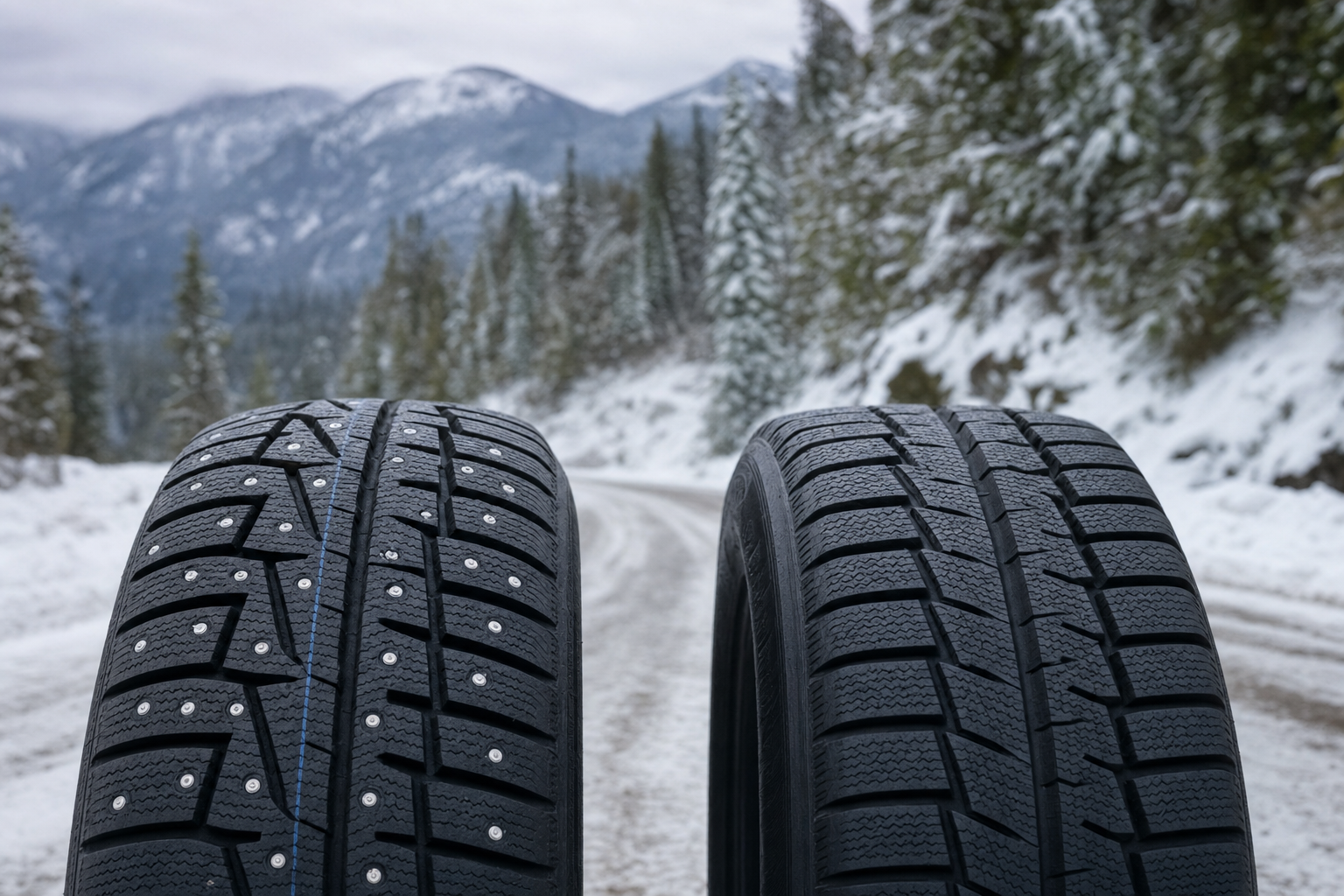
The names are similar, but they describe different products:
- Studded winter tires have metal studs installed in molded holes in the tread. They may be factory-studded or fitted with the correct studs by a tire professional before use.
- Studdable winter tires have molded holes that can accept studs but may be sold without them. Without studs, they rely on their tread pattern, siping and cold-weather rubber compound. They are not automatically equivalent to a premium purpose-built studless tire.
- Studless ice-and-snow tires use specialized rubber compounds, dense siping and winter tread designs to grip snow and ice without metal studs. They are different from conventional all-season tires. Some all-weather tires also carry the three-peak mountain snowflake symbol, but they are designed for year-round use rather than maximum winter performance.
A common mistake is assuming that adding studs makes any studdable tire better than every studless model. In one Tire Rack comparison, its studless ice-and-snow benchmark stopped sooner and accelerated faster on ice than the tested studded tire. That is not a result for every tire or condition, but it is a useful reminder to compare the exact models and sizes you are considering rather than relying on category labels alone.
If you buy studdable tires, decide about studs before driving on them. Tire Rack advises that only new, never-driven tires should be studded because debris can enter the holes and incorrect installation can damage the tire. Fit winter tires as a matched set of four, whether your vehicle has front-wheel, rear-wheel or all-wheel drive.
How studded and studless tires perform
| Road condition | Studded winter tires | Modern studless winter tires |
|---|---|---|
| Smooth ice | The strongest reason to consider studs. Metal pins can improve braking and acceleration on suitable icy surfaces, especially near freezing. | Premium models can be highly capable and may outperform less advanced studded tires. They are usually the more versatile option when icy conditions are occasional. |
| Packed snow | May offer an advantage when snow is hard, polished or icy enough for the studs to engage. | Generally very capable because flexible rubber and sipes create many gripping edges. Individual tire design matters greatly. |
| Fresh snow | Studs add relatively little in loose snow; tread depth and the ability to clear snow do most of the work. | Usually strong, particularly with a tread pattern designed for snow traction and evacuation. |
| Slush and wet roads | No inherent advantage from studs. Water evacuation and resistance to slush planing depend mainly on tread design. | Usually the better match for mixed winter commuting, although wet-road performance varies by model. |
| Dry, cleared pavement | Much louder, with little practical benefit from the studs. Frequent bare-pavement use also wears the studs and road surface. | Normally smoother, quieter and more predictable for long stretches of cleared road. |
Transportation research supports this practical distinction: studs can provide their clearest benefit on particular ice conditions, while their advantage narrows or disappears on other surfaces. Oregon Department of Transportation guidance says non-studded traction tires work about as well as studded tires on ice and better in most other winter conditions.
Noise, wear, laws and ownership costs
Road noise is the clearest everyday drawback of studs. On bare pavement, they can produce tapping at low speeds and a pronounced drone at highway speeds. In Tire Rack’s comparison, the studded tire received noise-comfort scores between poor and very poor, while the unstudded version was substantially quieter. Vehicle insulation and tire construction affect the experience, but metal studs rarely disappear acoustically.
Ride quality is more dependent on the tire model. A studded tire can ride similarly to its unstudded version, but added vibration and sound may make it feel less refined. For long highway commutes and vehicles where cabin quietness matters, a high-quality studless winter tire is normally the better fit.
Dedicated winter tires should come off when consistently warm weather returns. Their rubber compounds are designed to remain flexible in cold conditions and can wear faster in warm weather. Studded tires add seasonal legal deadlines. In Oregon, studs are legal from November 1 through March 31. Washington law generally permits them from November 1 through March 31, although the Washington State Department of Transportation can authorize an extension when conditions warrant. These dates are not a national standard.
Washington also illustrates why regulations matter beyond the individual driver. The Washington State Department of Transportation estimates that studded tires cause $20 million to $29 million in damage to state-owned asphalt and concrete roads each winter. The agency notes that studs do not count as chains where chains are required; drivers must install chains when a chain-only restriction is posted.
Costs vary more by tire size and product tier than by category alone. A budget studdable tire can cost less than a premium studless tire, but adding studs requires parts and installation labor. In Washington, new studded tires also carry a state fee of $5 per tire. Both options bring seasonal changeover and storage costs. A second set of wheels increases the initial purchase price but can simplify seasonal swaps and reduce repeated mounting and balancing.
Choose for the roads you actually drive
| Main driving pattern | Best starting choice | When to consider the alternative |
|---|---|---|
| Maintained urban and suburban roads | Premium studless ice-and-snow tires | Consider studs only when untreated ice is a routine part of most winter trips, not for occasional icy mornings. |
| Rural roads with sustained ice | Studded tires may be justified | Choose studless tires if you also drive substantial highway mileage, wet pavement and cleared roads, or cross state lines where stud rules differ. |
| Mountain routes and passes | High-quality studless tires and compatible chains | Studs can help on consistently icy local roads, but they do not remove the need to carry or install chains when restrictions require them. |
Before ordering, estimate how much of your winter mileage is actually spent on sustained hard ice rather than simply counting snowy days. Then compare independent tests for the precise tire models and sizes under consideration. Give particular weight to ice braking, snow handling, wet braking and road noise.
Confirm that the tires carry the three-peak mountain snowflake symbol where required or appropriate, and that their size, load index and speed rating are suitable for your vehicle. Check the tire placard and owner’s manual, and buy a matched set of four. If you are comparing dedicated winter tires with broader year-round alternatives, see Should You Choose All Weather Tires or Winter Tires.
Mountain travelers should also check the owner’s manual for chain clearance before buying equipment. The guide to snow chains, cables and snow socks explains the main options. Do this before the first storm, since even excellent winter tires cannot solve an incompatible or missing chain setup at a controlled pass.