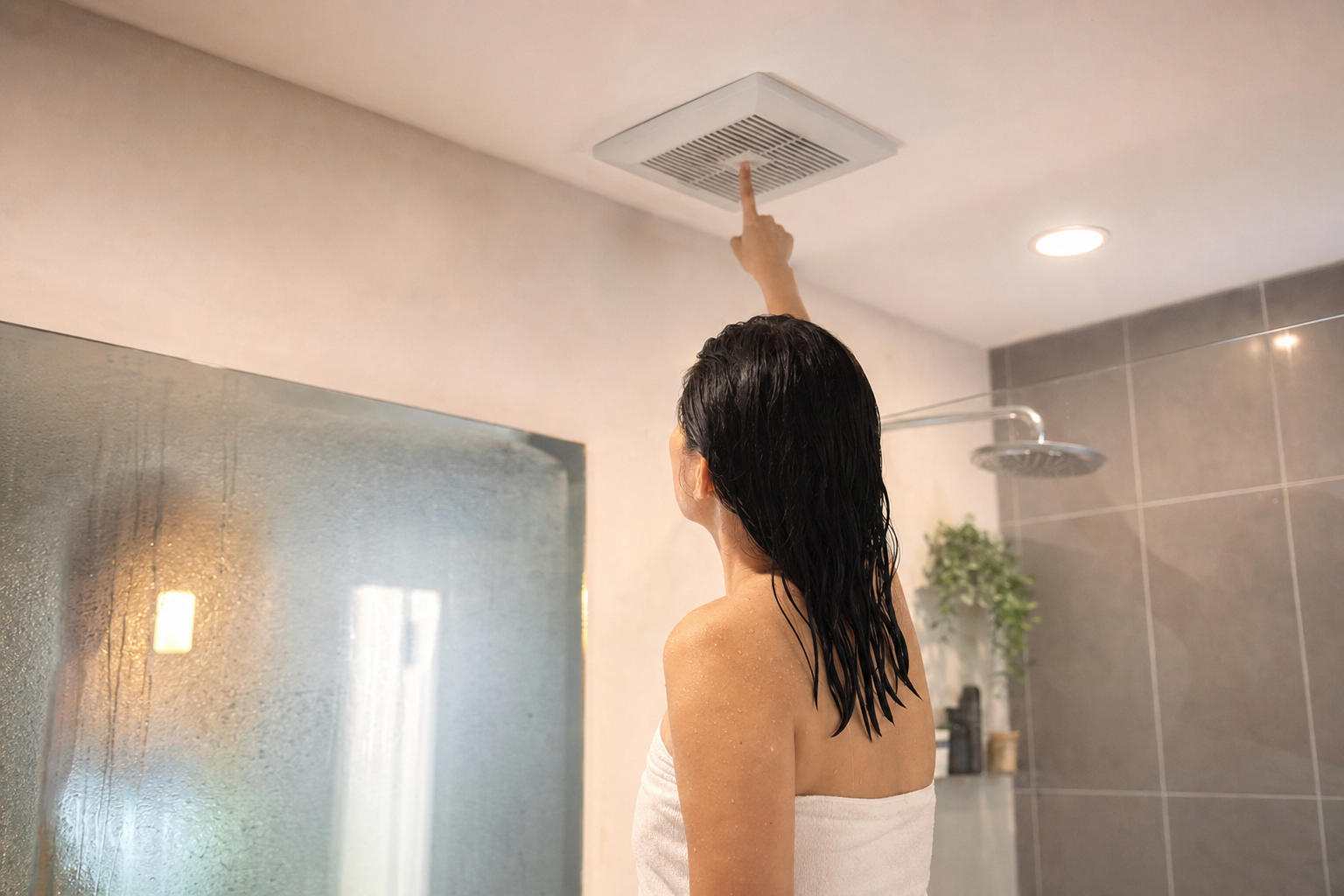
Run the bathroom exhaust fan for the entire shower and for at least 20 minutes afterward. If the mirror, walls or ceiling are still damp, use a longer cycle of up to one hour. A bathroom that remains humid after that needs attention to the fan, ductwork, outdoor vent or another moisture source rather than simply more runtime.
Start with 20 minutes, then adjust for your bathroom
The Home Ventilating Institute recommends leaving a bathroom fan on for 20 minutes after the room is used. That is a practical baseline when the fan is correctly sized, the duct is in good condition and the room does not start out unusually humid.
The U.S. Department of Energy-supported Building America Solution Center takes a more cautious approach for intermittent fans, recommending one hour after a shower for effective humidity control. The two recommendations are useful starting points rather than guarantees: the right runtime depends on the amount of moisture produced and how well the installed system actually moves air outdoors.
For most households wondering how long to run a bathroom fan after a shower, use this routine:
- Turn the fan on when the shower starts, rather than waiting until the room is already steamy.
- Leave it running throughout the shower.
- Run it for at least 20 minutes afterward.
- If condensation or damp surfaces remain, add ten to 15 minutes to the next post-shower cycle.
- Use a 40- to 60-minute cycle when needed, especially after a long or hot shower or several showers in succession.
Cold walls, ceilings and windows can make condensation more visible during winter. High humidity elsewhere in the home can also mean that the bathroom takes longer to dry.
Why some bathrooms need a longer runtime
Runtime is only one part of moisture control. The fan must remove humid air efficiently, and replacement air must be able to enter the room. A fan can run for an hour without solving the problem if its duct is blocked, disconnected, too restrictive or not vented outdoors.
Fan capacity and bathroom size
Bathroom fans are rated in cubic feet per minute, usually abbreviated to CFM. For bathrooms up to 100 square feet, the Home Ventilating Institute recommends about one CFM per square foot. Under that guideline, a 60-square-foot bathroom calls for a fan rated at about 60 CFM.
For bathrooms larger than 100 square feet, the institute recommends sizing ventilation by fixtures instead: 50 CFM each for a toilet, shower and standard bathtub, or 100 CFM for a jetted tub. An enclosed toilet room should have its own ventilation. Local building codes and the fan manufacturer’s instructions can add requirements, particularly for a new installation or replacement.
A fan’s published rating is measured under specified test conditions. Installed airflow can be lower when the duct is undersized, long, kinked, crushed or sagging, or when it has several sharp bends. A dirty grille, blocked exterior hood or stuck damper can reduce airflow as well.
Duct route and outdoor venting
A bathroom exhaust fan must discharge outdoors. It should not vent into an attic, crawlspace, garage, wall cavity or space between floors. Those routes merely transfer warm, moist air to a concealed area where it can condense on framing, insulation and other materials.
A short, direct duct route with few bends helps the fan perform as intended. The Building America Solution Center recommends using the duct diameter specified by the fan manufacturer and avoiding kinks and unnecessary turns. Insulating ductwork that runs through an unconditioned attic can also help limit condensation in the duct.
Makeup air and starting humidity
Air exhausted from the bathroom must be replaced. In many homes, replacement air enters beneath the bathroom door or from adjacent rooms. A tightly sealed door with little undercut can restrict that flow and reduce the fan’s effective draw. If the fan works noticeably better with the door cracked open, limited makeup air may be contributing to the problem.
The U.S. Environmental Protection Agency advises keeping indoor relative humidity below 60 percent where possible, ideally between 30 and 50 percent. A bathroom will take longer to dry if the rest of the home is already humid. For seasonal guidance, see what indoor humidity should be in winter.
How to tell when the fan can be switched off
A timer is convenient, but the room’s condition is the better test. The fan has run long enough when the added moisture from the shower has largely cleared and surfaces are no longer collecting condensation.
Look for these signs:
- The mirror has cleared or has only slight moisture at its edges.
- Painted walls and the ceiling feel dry rather than cool and damp.
- Water droplets are no longer forming on the window, toilet tank or metal fixtures.
- The room no longer feels noticeably more humid than the adjoining space.
- A humidity meter has returned close to its pre-shower reading.
An exhaust fan cannot dry standing water, soaked bath mats or towels left in a heap. Wipe up puddles and spread towels and mats so they can dry. Ventilation removes water vapor; it does not replace basic cleanup.
If condensation regularly forms on windows elsewhere in the home, the problem may extend beyond bathroom ventilation. Review these steps for stopping condensation inside windows during cold weather.
What to do if the bathroom stays damp
If the room remains steamy or surfaces remain wet after 45 to 60 minutes, check the system rather than routinely running the fan for several hours.
- Check for obvious airflow. Hold a single sheet of toilet tissue near the intake grille while the fan runs. It should be drawn toward the grille. This can confirm that air is moving, but it cannot measure airflow or prove that the fan meets its rated CFM.
- Clean the grille. Dust can restrict airflow. Clean removable parts according to the manufacturer’s instructions, and disconnect power before cleaning inside the housing. A fan that makes noise is not necessarily exhausting enough air.
- Compare performance with the door slightly open. Better performance can indicate that the room lacks an adequate path for makeup air.
- Inspect the outdoor outlet safely. From a safe ground-level position, check that the exterior damper opens while the fan runs and that debris, paint or a pest nest is not obstructing it. Do not climb onto a roof or disassemble electrical equipment.
- Confirm that the fan vents outdoors. If you cannot identify an exterior wall or roof outlet, arrange an inspection. A duct that ends in an attic or other enclosed space should be corrected.
- Have airflow measured if problems persist. A qualified contractor can use a flow hood or other suitable instrument to measure installed airflow and inspect the duct route, connections and termination.
A countdown timer makes a 20-, 40- or 60-minute post-shower cycle easier to use. A humidity-sensing fan or compatible control can also run automatically when moisture rises. Follow the product instructions and applicable local electrical and building codes for any installation or wiring work.
Arrange a professional inspection if condensation persists despite an hour of fan operation, moisture stains return, paint peels, mold or a musty odor develops, or water appears around the fan housing. Persistent dampness can result from an undersized fan, an obstructed or disconnected duct, inadequate makeup air, a plumbing leak or insufficient insulation. Correcting the cause is more effective than extending the runtime.