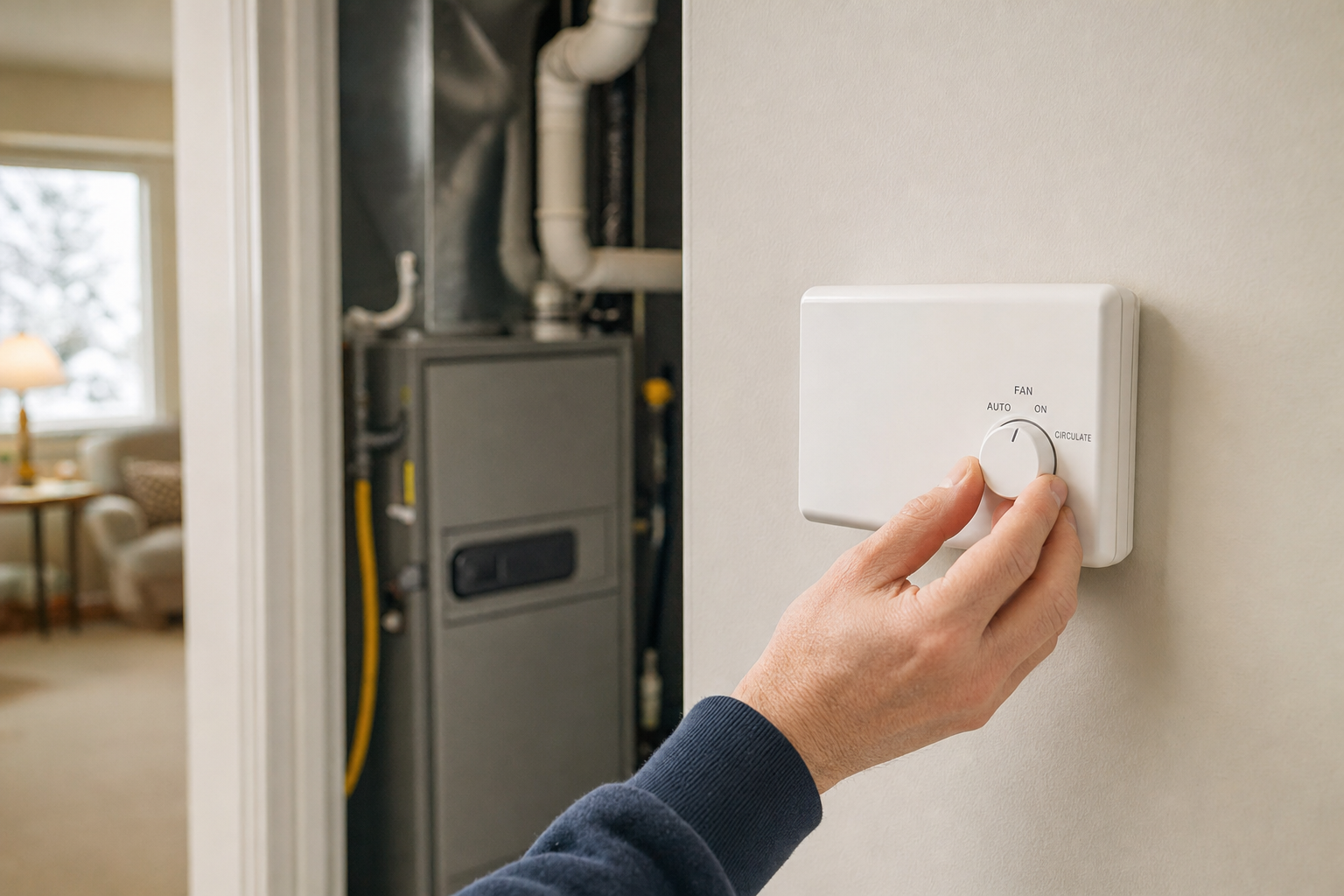
For most U.S. homes in winter, use Heat for the system setting and Auto for the fan setting. In Auto, the indoor blower runs when the furnace or heat pump is heating, then stops after the equipment’s normal shutdown delay. Use Circulate when you need some extra air mixing for uneven rooms or more filter runtime. Use On only when continuous airflow provides a noticeable comfort or air-cleaning benefit that justifies the extra blower runtime.
Do not confuse the fan setting with the thermostat’s system setting. System Auto allows a thermostat to change between heating and cooling when conditions and its configuration allow. Fan Auto controls when the indoor blower runs. During winter, selecting Heat and Fan Auto avoids unintended cooling changeovers and is the usual starting point.
What Auto On and Circulate control
The fan selector controls the forced-air system’s indoor blower. It does not by itself tell a gas furnace to ignite, a heat-pump compressor to start or auxiliary heat to turn on.
| Fan setting | What it does | Best use |
|---|---|---|
| Auto | Runs the blower during heating or cooling calls, including normal equipment-controlled startup and shutdown delays. | Everyday operation in most homes. |
| On | Runs the blower continuously, including between heating and cooling cycles. | Continuous circulation or central filtration when the benefit is clear. |
| Circulate | Runs the blower for part of each hour when normal heating or cooling runtime has not already met the thermostat’s circulation target. | A middle ground for air mixing and filtration. |
Circulate is not standardized. On some Honeywell Home thermostats, it runs the fan about 35 percent of the time, or roughly 20 minutes per hour, minus runtime already supplied by heating or cooling. Some Trane thermostats allow the user to choose a circulation time from 10 to 55 minutes per hour. Check the manual for the specific thermostat rather than assuming that every Circulate setting follows the same schedule.
Auto does not necessarily mean that the blower stops the instant the thermostat reaches its set temperature. A furnace commonly keeps the blower on briefly to deliver remaining heat and cool internal components. A variable-speed blower may also ramp down gradually. Those controlled delays are normal.
Why Auto is the sensible winter default
When choosing between furnace fan On or Auto in winter, Auto usually offers the best balance of comfort, electricity use and filter life. The blower runs when there is heat to distribute instead of moving room-temperature air through the house all day.
Air moved between heating cycles is not necessarily colder than the room, but moving air can increase heat loss from skin and feel drafty. This is especially noticeable when a register points toward a bed, desk or favourite chair. Fan On makes that sensation more likely because airflow continues after the heat source has stopped.
Heat pumps operate differently from gas or oil furnaces. They normally provide gentler supply-air temperatures and often run longer cycles, so the air at a register may feel less hot even when the system is working properly. During defrost, an air-source heat pump temporarily changes operation to clear frost from the outdoor coil; indoor airflow and temperature can change briefly. Fan Auto remains a sound default, but it will not make heat-pump supply air feel like furnace air.
The fan setting also does not control auxiliary or emergency heat. A heat pump’s auxiliary heat is normally brought on automatically when the system needs additional capacity. Emergency Heat is a separate mode, usually selected manually, that relies on the backup heat source and commonly locks out the heat-pump compressor. Do not select Emergency Heat merely because the registers feel less hot than furnace vents.
Your blower motor affects the electricity cost
More fan runtime always uses more blower electricity, but the amount varies greatly with the motor, selected speed, duct resistance and electricity price. A universal monthly cost estimate is therefore not reliable.
- Permanent split capacitor motors: Older permanent split capacitor, or PSC, motors are generally less efficient for extended fan-only operation. Continuous operation can noticeably increase electricity use.
- Electronically commutated motors: Electronically commutated motors, often called ECMs, can be more efficient and may be programmed to run at a lower circulation speed.
- Variable-speed systems: These systems can adjust airflow more precisely. When properly designed and configured, low-speed continuous circulation may use substantially less electricity than full heating or cooling airflow.
Actual performance still depends on the equipment and installation. In particular, some constant-airflow electronically controlled motors can draw more power as duct resistance rises. Check the furnace or air-handler model and its technical literature, or ask a qualified technician which motor and fan-only speed the system uses. The thermostat label alone does not identify the blower type.
For a home-specific estimate, multiply the blower’s documented or measured wattage by expected operating hours and the local electricity rate. Auto has the least fan-only runtime, Circulate adds limited runtime and On adds the most.
When Circulate or On can improve comfort
Try Circulate when one floor is warmer than another, bedrooms cool noticeably between cycles, or a sunny room overheats while an interior room stays chilly. Extra mixing can reduce temperature differences, particularly during mild weather when the heating system does not run often.
Circulate is also a reasonable first step if you want more central filtration without running the blower continuously. A central filter captures particles only while air passes through it. More runtime provides more opportunities for filtration, provided that the filter fits properly and is compatible with the system.
More airflow can load a filter sooner. Check it monthly after changing to Circulate or On, and replace or clean it when dirty according to the equipment instructions. Filter thickness, pets, renovation dust and household conditions all affect the replacement interval. See how often to change a furnace filter in winter for a detailed checking schedule.
Consider Fan On when:
- Circulate does not provide enough mixing and continuous airflow clearly improves occupied rooms.
- You want maximum runtime through a compatible whole-home air cleaner.
- A variable-speed system was designed and commissioned for quiet, low-speed continuous circulation.
- You need extra circulation for a limited period and will reassess comfort, noise and filter condition.
If the system has an older PSC blower, start with Circulate rather than On. With an efficient variable-speed blower, On may be more practical, but it still increases filter loading and can create drafts.
Extra fan operation cannot solve major duct leaks, insufficient return-air capacity, poor insulation or incorrect system balancing. Keep supply registers and return grilles open and unobstructed. Closing vents to force air elsewhere can disrupt designed airflow and raise duct pressure. Read more about whether to close vents in unused rooms.
How to troubleshoot a blower that will not stop
Continuous blower operation is normal when Fan is set to On, during programmed Circulate periods, or when a compatible accessory is calling for airflow. It may also continue briefly after a heating cycle. Use these checks to distinguish normal operation from a fault:
- Check both thermostat settings. Confirm that the system is set to Heat and the separate fan setting is Auto. Check the thermostat app too, if one is connected.
- Allow for a normal shutdown delay. Wait several minutes after the heating call ends. Variable-speed ramp-down and heat-pump defrost can also affect normal blower timing.
- Review schedules and accessories. A programmed fan period, circulation target, ventilator or some installed humidity and air-cleaning accessories may request airflow.
- Check basic airflow. Replace or clean a dirty filter as directed by the manufacturer, and make sure supply registers and return grilles are clear. Restricted airflow can overheat a furnace, causing its high-limit safety control to shut off the burners while the blower continues to cool the equipment.
- Arrange service if it continues. If the fan remains on with Fan set to Auto and no heating call, possible causes include a thermostat or wiring fault, stuck relay, control-board problem or a limit-switch condition.
Do not repeatedly reset an overheating furnace or bypass any safety control. Request professional service if the blower continually pushes cool air, burners start and stop rapidly, airflow is weak, an error code appears, or a clean filter does not correct the problem. If you smell gas, leave the home immediately without operating lights, switches or electronics, then call 911 or the gas utility from a safe location.